PSA Screening Australia: What the Guidelines Say in 2026
PSA Screening Australia: guidelines say it isn't routine. Learn what results mean, follow-up steps and the risks to weigh before testing.

Australian men had 698,828 PSA tests in 2005–06, a 42% rise on the 492,147 recorded in 2001–02, according to AIHW tracking of test volumes. All of that testing happened without a national screening program behind it.
Australia has no population-wide PSA program. There is no invitation letter, no register and no age at which the health system calls you in for a prostate blood test. A man who wants the test has to raise it with his GP, so every one of those hundreds of thousands of tests began the same way: one man, one question, one consultation.
That puts the weight on what gets said in that room. What does the number measure, and what can it never tell you? If it comes back raised, what happens next? And how often does a high reading turn out to be something other than cancer? The answers sit in Australian guidance, and they are more specific than a single blood-test result on its own can ever be.
Where Australia Stands on PSA Screening
The absence of a national program is a decision, not an oversight. The AIHW's prostate cancer report is precise about what the test does: PSA testing and a digital rectal examination can indicate an increased risk of prostate cancer, but neither test is diagnostic, and confirming cancer requires a prostate biopsy.
That gap between raised risk and confirmed diagnosis shapes Australian practice. A raised PSA can also reflect non-cancerous conditions, and testing can produce false-positive results, overdiagnosis or overtreatment. The AIHW describes Australian prostate cancer detection as guided by clinical recommendations and shared decision-making rather than automatic screening of every man.
The position is old enough to have grey hair. In 1996 the Australian Health Technology Advisory Committee advised that asymptomatic men should not routinely undergo PSA testing because evidence of benefit was insufficient, and recommended that men considering testing be informed about the test's limitations and the follow-up decisions it can trigger. Three decades later the architecture hasn't moved: no national program, an individual decision, and a conversation that has to happen before the blood is drawn.
For a man at average risk who decides to go ahead, Cancer Council's clinical practice guidelines for PSA testing support total PSA testing every two years from age 50 to 69, with further investigation when PSA exceeds 3.0 ng/mL. That figure is a prompt to look closer, not a diagnosis. A single result above it should generally lead to a repeat test after 1 to 3 months rather than an immediate biopsy, because benign prostatic enlargement, inflammation, infection or a recent procedure can all lift the reading. The same guidance expects the pre-test conversation to cover overdiagnosis, biopsy complications and treatment-related harms.
The threshold rule: a result above 3.0 ng/mL earns a repeat test in one to three months. It doesn't earn a biopsy that week.
Here's how the positions fit together, by group and by result.
| Group or result | Australian guidance | Note |
|---|---|---|
| All men, population-wide | No population-wide PSA screening program | Benefits do not clearly outweigh harms |
| Average-risk men aged 50–69 who choose testing | Total PSA every two years after informed discussion | Discuss overdiagnosis and biopsy before testing |
| PSA above 3.0 ng/mL | Repeat test after 1–3 months before any biopsy | The threshold is not diagnostic on its own |
| Increased-risk men aged 40–69 | Conditional pathway using age-specific PSA percentiles | Referral when results stay persistently high |
| Men outside the 50–69 range | No standard two-yearly recommendation | Individual decision with a GP |
| Aboriginal and Torres Strait Islander men | Routine testing from age 40 removed in proposed 2025 changes; thresholds for 50–69 aligned with the general population | Proposed change; check current status |
Read the table as a lookup, not a prescription. Find the row that matches your age, your risk and your result, and treat the guidance column as the script for a GP conversation rather than an instruction you can act on alone. The next sections explain what each of those numbers and caveats means in practice.
What a PSA Test Measures and What It Cannot Tell You
Start with the mechanics, because they explain most of the confusion.
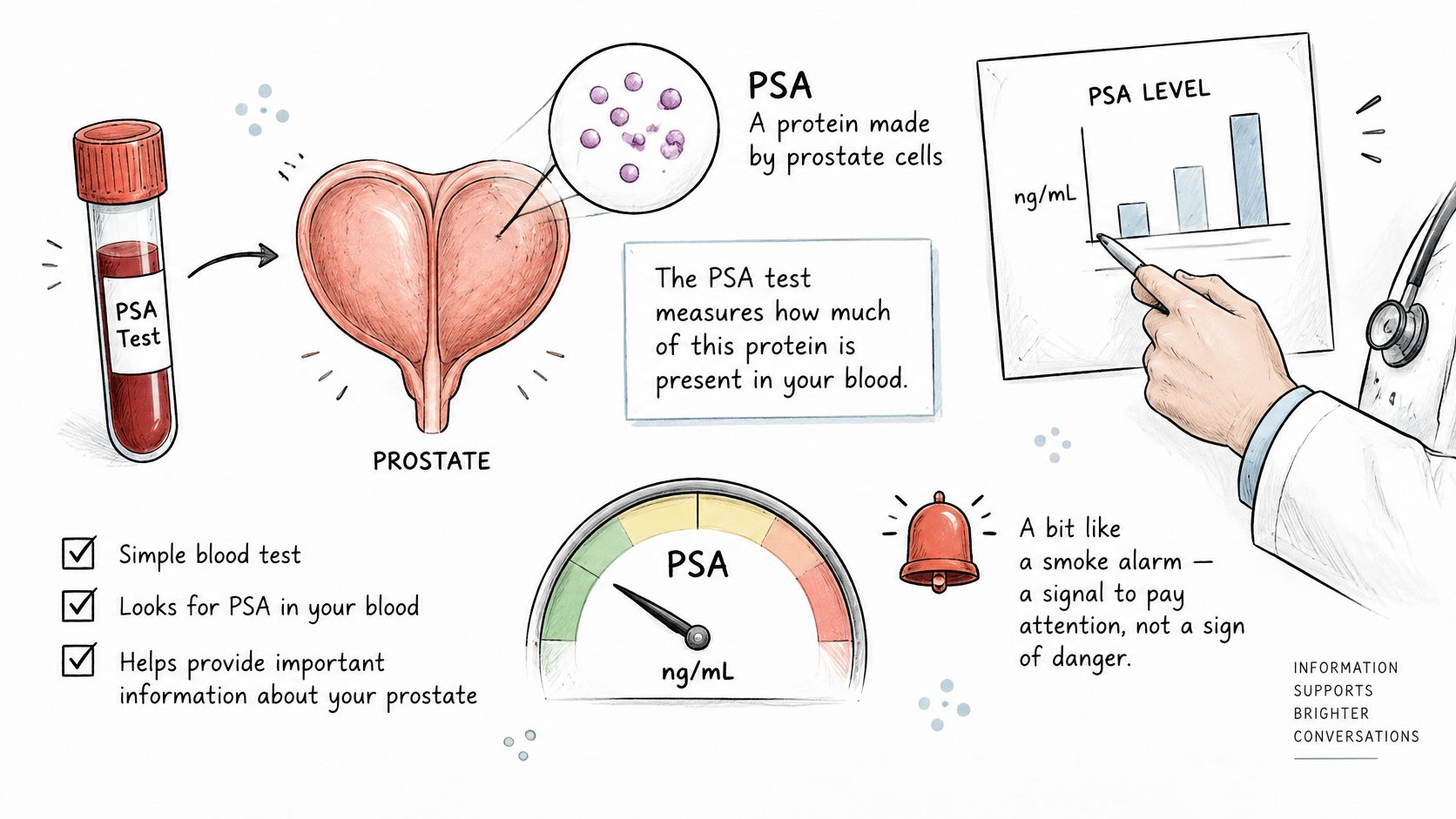
PSA stands for prostate-specific antigen, a protein made by prostate cells. The blood test reports how much of it is circulating, measured in nanograms per millilitre (ng/mL). It's a prostate marker rather than a cancer marker, and that distinction is the whole ballgame.
Think of a smoke alarm. It goes off when there's a fire, but also when someone burns toast or the bathroom steams up. A screaming alarm tells you to go and look. It doesn't tell you what's burning, how big it is or whether you need the fire brigade. A PSA reading works the same way: it tells you and your GP to investigate, and the investigation is what produces an answer.
Why a high number isn't a cancer diagnosis
Plenty of things push PSA up without any malignancy at all. Benign prostatic enlargement is the most common as men age. Inflammation of the prostate and urinary infection both raise it. So can a recent catheter, a prostate procedure, vigorous cycling, or ejaculation in the day or two before the test. Each of those is a reason a repeat test, done under calmer conditions, can come back lower.
The test also can't describe behaviour. A PSA number says nothing about how aggressive a cancer is, whether it has spread, or whether it would ever have caused symptoms in your lifetime. Judging that requires imaging and, sometimes, tissue.
Why a normal number isn't a clean bill of health
Some cancers produce readings below the threshold your GP uses, so a "normal" result doesn't rule cancer out when symptoms or family history point the other way. That's the false-negative side of the test, and it's why a reassuring number never overrides a persistent urinary symptom or a strong family history.
If your report arrives with several markers on it, our guide to how to interpret blood test results explains how units, reference ranges and flagged values work, so you can read the page before your appointment instead of during it.
For a plain-language run-through of the test itself, the video below is a reasonable starting point before you sit down with your GP.
The practical move is to stop reading a PSA number as a verdict and start reading it as one signal among several, then ask what it's being compared with: your age, your symptoms, your family history and your own previous results.
Risk Factors That Change the PSA Conversation
The same reading can mean different things in two men of the same age, which is why Australian guidance is built around individual risk rather than a single cut-off applied to everyone.
The standard pathway assumes a man at average risk, aged 50 to 69, who has weighed the trade-offs and decided to test. Step outside that description and the conversation changes shape.
What shifts the conversation
- Age and life expectancy. A man with a serious illness and a limited life expectancy gets little from finding a slow-growing cancer, and the calculus flips accordingly.
- Symptoms. Urinary changes, blood in urine or semen, or bone pain are a reason to investigate promptly rather than wait for the next scheduled test.
- Family history. A first-degree relative with prostate cancer, particularly one diagnosed young, moves a man into a higher-risk category.
- Inherited genetic risk. Australian recommendations identify earlier or more intensive assessment for men with factors such as BRCA2-associated risk, and RACGP guidance lists a conditional pathway for increased-risk men aged 40 to 69, using age-specific PSA percentiles and referral when results stay persistently high.
- Ancestry. Some ancestry groups carry higher risk, and that belongs in the pre-test discussion rather than in a generic leaflet.
Then there's the trend. A single reading is a snapshot, while a series over several years is a story. A number that climbs steadily across three or four tests means something different from one that spikes once and settles, and it's the reason your GP wants the old results, not just today's.
Aboriginal and Torres Strait Islander men
Older online advice sometimes recommends earlier or lower-threshold testing for Indigenous men. Recent Australian guideline development has moved to a more nuanced position, and it's worth understanding why.
The 2025 public consultation report states that evidence supporting routine testing from age 40 was weak, citing prostate-cancer incidence of 0.5 per 100,000 among Aboriginal and Torres Strait Islander males younger than 45 unless additional risk is present, such as a first-degree relative diagnosed before age 60. The proposed change removed the routine age-40 recommendation and aligned PSA thresholds for Indigenous men aged 50 to 69 with those used for the general population, while acknowledging potentially more aggressive disease and differences in healthcare access and engagement.
Two things can be true at once here. Identical guidance doesn't erase inequity, and testing earlier isn't automatically the fix. What matters is a shared decision that covers family history, symptoms, access barriers and culturally safe care, with attention to both underdiagnosis and unnecessary testing. Treat the 2025 position as proposed change and confirm the current status with your GP.
What to Do After an Elevated PSA Result
Start with the figure most Australian explainers leave out. Among Australian men who go on to have a follow-up biopsy after an increased PSA, approximately 66–75% do not have cancer, according to Cancer Council Australia's early detection guidance. Most men who receive a high reading end up having more tests and no diagnosis.
That reframes the whole experience. A high result starts a process; it doesn't announce an outcome.
The pathway, step by step
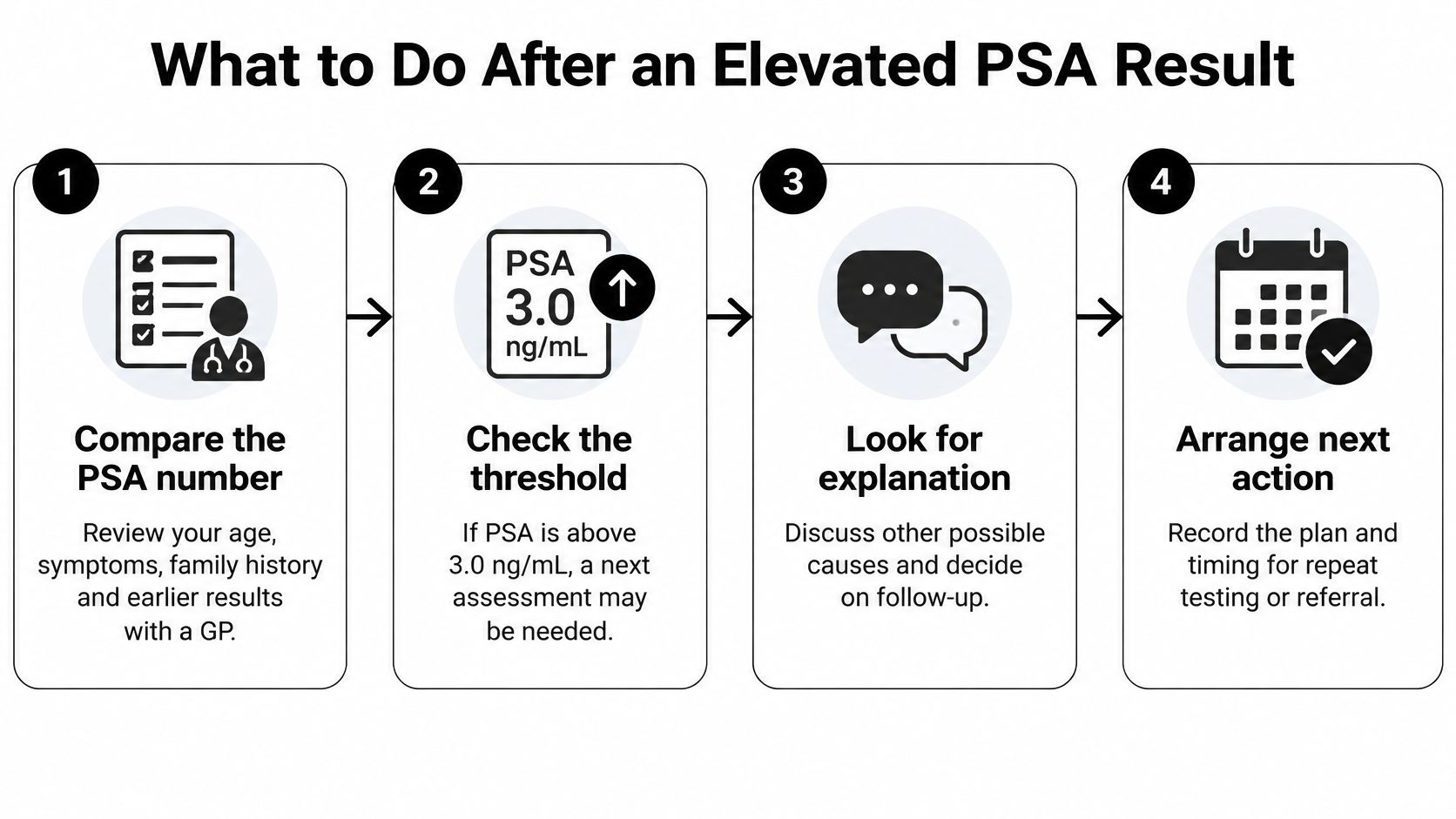
- Compare the number, don't react to it. Sit down with your GP and read the result against your age, symptoms, family history and earlier results. A reading that would be unremarkable in one man can be worth chasing in another, and the context is the interpretation.
- Check the threshold and repeat before you biopsy. If PSA is above 3.0 ng/mL, the usual next move is a repeat test after one to three months. The reason is simple: transient causes are common, and a repeat filters out readings that were never going to persist.
- Look for an explanation if the repeat stays high. Recent infection, a catheter, a prostate procedure or a rising trend all change what happens next. This is the point where the conversation moves from a number to a clinical picture.
- Expect imaging before tissue. Multiparametric MRI is used to stratify who needs a biopsy, rather than sending every man with a raised PSA straight to a needle. It gives the urologist a map.
- Treat biopsy as the confirmation step, not the first step. A transrectal ultrasound-guided biopsy remains the definitive way to confirm malignancy. Once you have the result, review it with your GP or urologist and agree in writing on what happens next and when.
Timing matters at every stage. To find out when to expect the repeat, this explainer on how long blood test results take in Australia covers typical turnaround and what delays it.
Two terms are worth carrying into the appointment. A false positive is a raised reading with no cancer behind it, and it buys anxiety plus the small risks of biopsy. A false negative is a reassuring reading in a man who does have cancer, and it buys misplaced comfort. Both exist, and neither is rare enough to ignore.
Every step above is a checkpoint, and no single number should be treated as a diagnosis or a reason to self-treat.
Weighing Benefits Against Harms in Numbers
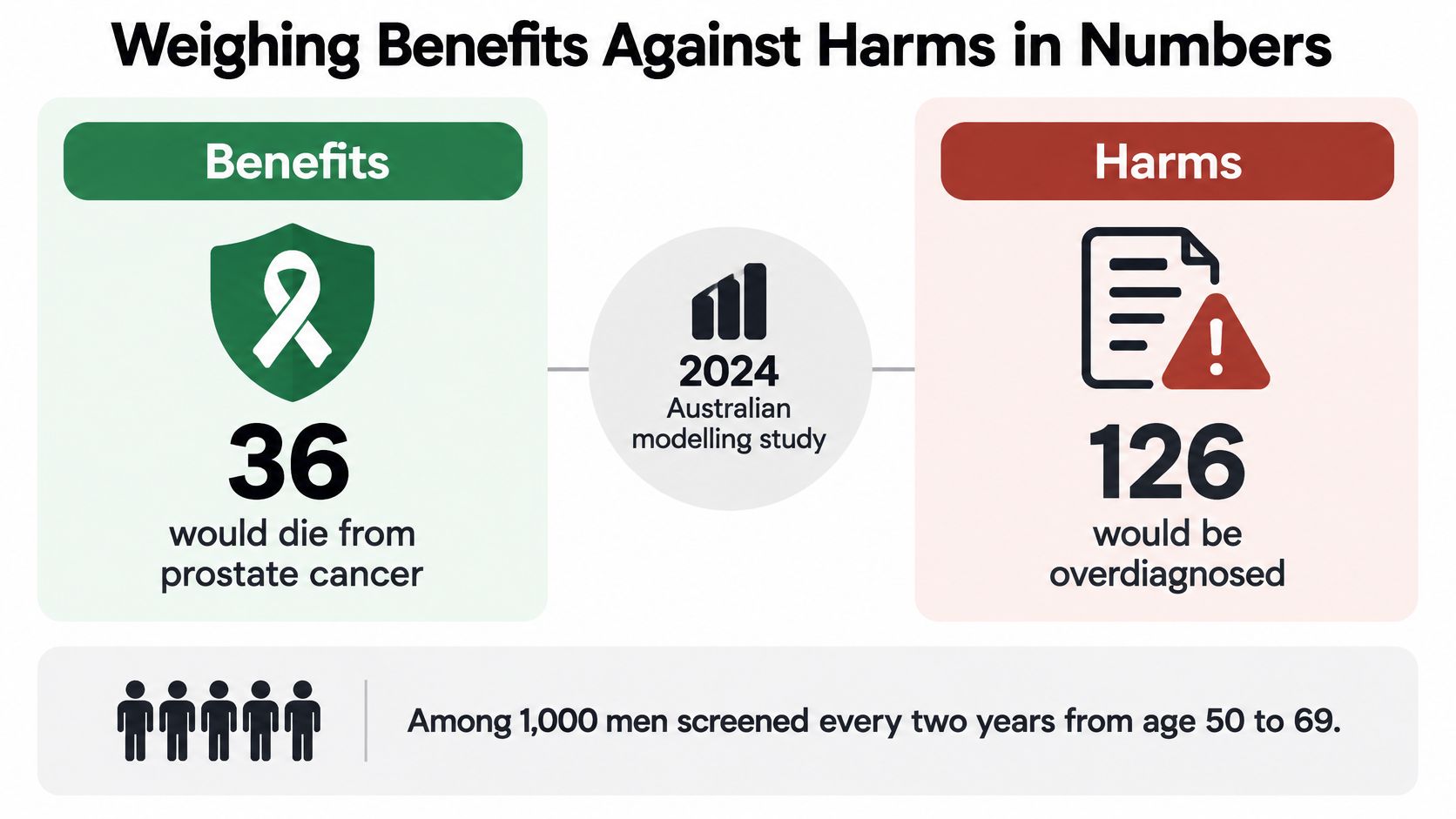
A 2024 Australian modelling study published in the International Journal of Cancer estimated that, among 1,000 Australian men who follow PSA testing every two years from ages 50 to 69, 36 would die from prostate cancer and 126 would be diagnosed with prostate cancer.
Read that carefully. It describes a modelled group of testers, not a promise about any individual, and it isn't a comparison showing what would have happened to those men without testing. What it does give you is a sense of scale: in a thousand men, a few dozen deaths and a triple-figure number of diagnoses.
The benefit side of the ledger is early detection of a cancer that would have caused harm. Finding an aggressive tumour while it's still confined, and treating it, is the outcome testing is designed to produce. Modern diagnosis supports that aim with MRI before biopsy and active surveillance for low-risk disease, which is how clinicians try to keep the benefits without dragging every man into treatment.
The harm side is longer than many expect:
- Overdiagnosis. Some detected cancers would never have caused symptoms in a man's lifetime, yet the diagnosis still arrives and changes how he sees himself.
- Overtreatment and side effects. Surgery and radiotherapy carry real risks to urinary, bowel and sexual function, and a cancer that never needed treating exposes a man to those risks for nothing.
- Biopsy complications. Bleeding, infection and discomfort are uncommon but genuine, which is precisely why the repeat test comes first.
- Anxiety from false positives. Months of investigation that end in "no cancer" still cost something.
- False reassurance. A low reading in a man with symptoms can delay the investigation he needs.
The honest question isn't "does testing find cancer?" It does. The question is whether finding this cancer, in this man, at this age, will do him more good than harm.
That question has a different answer for a fit 55-year-old with a father diagnosed at 60 than for a 78-year-old with significant heart disease. It also depends on how you personally weigh a small chance of earlier detection against a larger chance of tests and treatment you didn't need. Raise it with your GP before the blood test, not after.
Talk to Your GP Before You Test
The conversation that decides whether testing helps you happens before the needle goes in, and it runs better when you arrive with details your GP cannot guess.
Five things to bring.
- Your age and general health, including any serious illness that would make treatment less worthwhile. Screening only pays off if you would live long enough for an early finding to matter.
- A first-degree family history of prostate cancer, with the relative's age at diagnosis. A father diagnosed at 58 shifts your risk further than one diagnosed at 80.
- Any known inherited risk, such as a BRCA2 variant, and your ancestry where it is relevant.
- Current urinary symptoms, plus any recent infection, catheter or prostate procedure, because each can push PSA upward with no cancer present.
- Previous PSA results with dates. One reading is a snapshot; a dated series shows whether the number is stable or climbing, which is what clinicians weigh.
Five questions to ask.
- Which risk group do I fall into, average risk between 50 and 69, or an earlier pathway because of family history or ancestry?
- For someone like me, how does earlier detection compare with the harms on the other side of the ledger?
- What result would trigger a repeat test, an MRI or a biopsy referral, and where is my threshold?
- Who follows up an abnormal result, and how is that follow-up arranged and recorded?
- If I test now, when is the next one due, and what would make us stop?
Question 4 deserves a moment of attention. A raised PSA usually leads to a repeat test before anything more invasive, and knowing who owns that result, and how they will contact you, keeps a flagged reading from sitting unanswered in a system.
Before you book: decide who will review the result and how you'll be contacted. A test with no owner for the result is worse than no test.
Don't assume your GP will raise it. A 2026 survey of New South Wales general practitioners found that 14.8% offered PSA testing to all men, while 43.2% offered it after men asked about the test (published survey findings). Raising the topic is often your job.
Nor should you wait for a letter that isn't coming. An Australian population-based Medicare study found that 48% of Australian men aged 50–69 had at least one PSA test during 2014–2018, down from 68% during 2005–2009 (the 2023 study). Testing rates move with GP and patient choices, not with a national call-up.
Practical logistics are worth sorting early. PSA doesn't need fasting, but if your GP adds cholesterol or glucose at the same time, check which blood tests require fasting before you book the collection, so one appointment covers everything.
If you'd rather not wait weeks for a GP appointment just to get blood drawn, Vital iQ Health lets you order a private blood test online without a GP referral or a separate GP visit. You can choose from 41 ready-made panels or build a custom testing profile, then attend a NATA-accredited collection centre near you anywhere in Australia. Once results are in, a partnered telehealth GP can walk you through the numbers and recommend next steps from home, which gives you a sharper set of questions to take back to your own doctor.