CK Blood Test: What Your Creatine Kinase Result Means
Learn what a CK blood test measures, why levels rise, how to read reference ranges and when a high result needs urgent medical care.

You had a blood test for something else entirely, and one line came back flagged. Creatine kinase, 512 U/L, with 30 to 250 printed beside it. Your legs were sore from a Saturday long run, you slept badly, and now you're searching whether your muscles are failing.
People in that position get one of two responses. Someone tells them to repeat the test in a week and not to worry. Or they disappear into pages about rhabdomyolysis, statin myopathy and muscular dystrophy written for clinicians, and come out more frightened than they went in.
A CK result isn't a verdict. It's a measurement of how much muscle enzyme has leaked into your blood, and the same number means very different things depending on who you are and what you did in the days before the needle went in. An athlete after a hard session, a 60-year-old with aching thighs on a statin, and someone passing cola-coloured urine need three different next steps, even if all three read the same figure on the page.
What follows is a walk through what the test measures, how to read it against your own laboratory's range, and where the line sits between an ordinary training effect and something that needs a hospital tonight.
What a CK Blood Test Measures and Why It Matters
Your quads ache two days after a hill session. A blood test booked for an insurance check comes back with a raised CK, and nothing dramatic has happened. You trained harder than usual.
Creatine kinase (CK), also called creatine phosphokinase, is an enzyme stored inside muscle cells, where it helps regenerate the energy a muscle needs to contract. It belongs inside those cells. When a muscle fibre's membrane is damaged, CK escapes into the bloodstream the way water escapes a cracked tank, and the test measures how much has spilled.
In Australian pathology practice, a CK blood test is a spectrophotometric measurement of muscle-cell injury, run on about 5 mL of blood collected into lithium-heparin or serum-separator tubes, as the Royal College of Pathologists of Australasia handbook sets out. It's an ordinary draw. No fasting, no preparation, a few minutes in the chair.
Here's the concept in one picture.
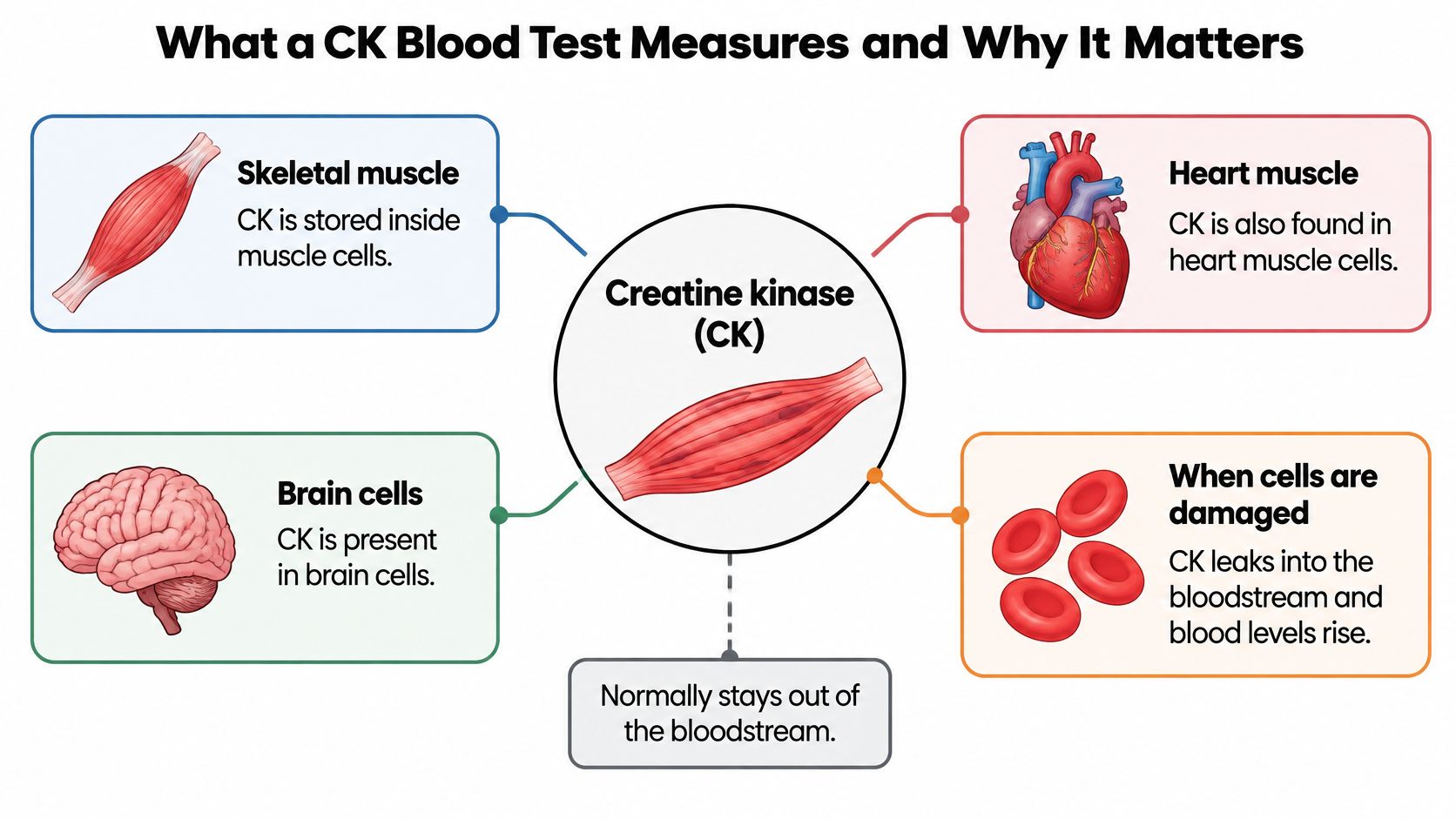
Why a GP orders it matters, because the reason shapes how the result gets read. The common triggers are suspected muscle injury, inflammatory muscle disease, medicine-related muscle toxicity, trauma, and assessment after severe exertion. The RCPA lists the causes behind a rise as vigorous exercise, intramuscular injections, trauma, myositis, myopathy, rhabdomyolysis and hypothyroidism, which is a wide spread running from the harmless to the urgent.
One clarification saves a lot of confusion. CK is not troponin. Troponin is the marker clinicians reach for when heart-muscle injury is suspected, and a CK result cannot rule a heart problem in or out. If chest pain is the question, CK isn't the answer.
What the number tells you: muscle cells have released enzyme into your blood. It doesn't tell you which muscle, how much damage, or what caused it.
There's one more use worth knowing. CK can support assessment of inherited muscle disorders, including Duchenne muscular dystrophy carrier status, although a normal result does not exclude carrier status. So a reassuring number is reassuring, not a guarantee.
The takeaway is simple. A CK result is a signal of muscle-cell breakdown, not a diagnosis, and it earns its meaning only when your GP reads it alongside your symptoms, your medicines and your training week.
How to Read Your CK Result Against the Reference Range
A CK value means nothing on its own. 480 U/L can be high on one report and unremarkable on another, because the range that governs your result is the one printed next to it, not a figure you found online.
The pathology handbook lists sex-specific adult reference intervals. They look roughly like this, and your own report will print its own version.
| Item | Females | Males | Note |
|---|---|---|---|
| Typical adult CK interval (RCPA) | 30–150 U/L | 40–250 U/L | Reference point only; check your own report |
| Interval printed on your report | Printed on report | Printed on report | Governs interpretation for that specific test |
The unit is U/L, units per litre, a measure of enzyme activity per litre of blood. The figure itself is a count, not a percentage and not a severity score.
Why two laboratories give two different ranges
Australian pathology results are read against laboratory-specific reference intervals rather than one national cutoff, because ranges shift with the testing method, age, sex, muscle mass, physical activity and the population the laboratory serves, as healthdirect's guide to understanding pathology tests explains. Two labs running different platforms can hand you two different upper limits for the same blood sample.
That's why the flagged asterisk on your report is a prompt, not a conclusion. Australian health information is explicit that a result outside a reference interval does not automatically indicate disease and should be read alongside symptoms, medical history, medicines, supplements and the reason the test was ordered.
A flagged result tells you the laboratory noticed something. Your GP tells you what it means.
The trend beats the single number
One raised value carries less information than two or three values over time. A CK that spikes after a hard training block and settles on a rested repeat tells a very different story from one that stays high with no explanation. That's why a sensible clinician asks about repeat measurements and related investigations, such as renal-function tests and other muscle or cardiac markers, before drawing conclusions.
Physically active adults sit in the trickiest spot here, because strenuous exercise can temporarily raise CK, so an isolated elevation may reflect recent exertion rather than a primary muscle disorder.
Before your appointment, do three things. Compare the value with the range on your own report, not a remembered number. Note the date of the draw and anything unusual in the days before it, including hard training, a fall, an injection or a new supplement. Then write down your symptoms with dates, because "my legs have felt heavy for three weeks" is more useful to a GP than "I've been a bit sore." If you want a broader grounding in reading any laboratory report, this guide to interpreting blood test results covers the general principles.
What Raises or Shifts Your CK Result
Picture a runner training for a half marathon. Sunday is a 30 km long run, Tuesday is the blood draw, and the CK comes back well above the top of the range. The instinct is to assume permanent muscle damage. In reality, that pattern is the most ordinary thing in the world: hard, unaccustomed work damages a few muscle fibres, enzyme leaks out, and the level falls again with rest.
The cause matters more than the size of the number, because different causes leave different patterns.
| Cause | Typical CK pattern | Clue to check |
|---|---|---|
| Vigorous or unfamiliar exercise | Short-lived rise, often falls with rest | Hard session or new training in the past few days |
| Intramuscular injection | Short-lived rise | Recent injection |
| Trauma or crush injury | Rises after the injury and falls as it heals | Recent fall, impact or prolonged pressure |
| Myositis or myopathy | Persistent elevation | Ongoing weakness; specialist assessment |
| Rhabdomyolysis | Marked elevation | Severe pain, dark urine, reduced urination |
| Hypothyroidism | Persistent mild rise | Thyroid test and symptoms |
| Certain medicines, including statins | Variable | Muscle pain, dose changes, interacting medicines |
The pattern that matters most is the one that doesn't resolve. A rise after exercise or an injection usually fades once the trigger is removed. An elevation that persists after the reversible causes are cleared needs clinical investigation rather than another round of waiting.
Factors that shift the number without disease
Plenty of things move CK up and down without any muscle disease at all. Recent hard training is the biggest and most common. Alcohol affects how a result is interpreted. Dehydration and hot weather concentrate the blood and stress muscle. Recent intramuscular injections raise CK near the injection site. Muscle mass pushes the baseline up, which is why males typically run higher than females. Age shifts the expected range. Kidney function and thyroid status both influence what the number means. On top of all that, the laboratory's own method sets where the flag sits.
None of these make the test useless. They make the context essential.
How to reduce noise before the test
If your GP wants a baseline, give them a clean one. Tell the collector about any recent activity, because a phlebotomist who knows about Sunday's long run will note it on the request. Keep your fluid intake normal in the days beforehand rather than dramatically overdoing or underdoing it. Avoid an unusual training session or a new class in the 48 hours before the draw unless your doctor has told you to train as normal.
Practical rule: if you're being retested to see whether a rise has settled, repeat the conditions as closely as you can. Same kind of week, same kind of rest, so the comparison means something.
Before you sit down with your GP, run a quiet self-check. Did anything change in the past few days, such as heavy training, a fall, a vaccination, a new medicine or a supplement you started? Have you noticed weakness, cramps, swelling or dark urine? Has your weight, sleep or energy changed? A raised CK on its own doesn't identify its own cause. Recent activity, weakness, pain, medicines and thyroid symptoms do most of that work, and you hold that information, not the laboratory.
When a High CK Needs Urgent Care
A moderate rise after a hard session is common enough to be unremarkable. Rhabdomyolysis is a different event, and the difference is not the number on its own. It's the number plus the person plus the symptoms.
A mildly or moderately abnormal result after intense training is not automatically rhabdomyolysis. Systemic symptoms change the picture entirely, and they're what should move you from "book a GP appointment" to "go now."
| Situation | What it may suggest | Next step |
|---|---|---|
| Mild rise after hard training, no symptoms | Likely exercise-related | Rest, then ask your GP whether to repeat |
| Moderate rise with muscle soreness only | Possible exercise or medicine effect | Book a GP review |
| Muscle pain or weakness that is getting worse | Possible significant muscle injury | See a GP the same day |
| Severe swelling, dark or cola-coloured urine, reduced urination | Possible rhabdomyolysis | Emergency department now |
| Collapse, or dehydration after heat exposure | Possible serious muscle breakdown | Emergency department now |
The red flags are worth memorising, because they're the reason this test is taken seriously. Severe muscle pain or swelling. Marked weakness, the kind where standing from a chair is a struggle. Dark or cola-coloured urine. Passing much less urine than usual. Feeling faint, dehydrated or unwell after heat exposure.
Rhabdomyolysis is commonly diagnosed in hospital using blood and urine tests, as healthdirect's page on rhabdomyolysis explains. The urgency comes from the kidneys. When muscle breaks down rapidly, intracellular proteins and enzymes flood the circulation and can contribute to acute kidney injury, which is why clinicians look at creatinine and estimated glomerular filtration rate alongside the CK, and why kidney function tests are used both to check for kidney disease and to monitor function over time.
When you call or present, say what you did. Recent exercise, especially in heat or at a new intensity. Any injury, fall or prolonged pressure on a limb. Alcohol or drug exposure. Supplements, particularly anything new. Every medicine, with doses. Then ask the clinician directly whether your CK, creatinine and eGFR, electrolytes and a urine test should be repeated after a period of rest.
Any red-flag symptom means urgent medical care. It does not mean waiting a week for a repeat test to see how things look.
CK Results When You Take Statins
The most common fear runs like this: "my CK is up, so the statin is damaging my muscles and I need to stop it today." That conclusion is understandable and often wrong, and acting on it without advice carries its own risk.
Muscle pain is a recognised possible side effect of statins, and rhabdomyolysis is rare. Healthdirect's guidance on statins specifically advises people not to stop a statin without speaking with a doctor or pharmacist.
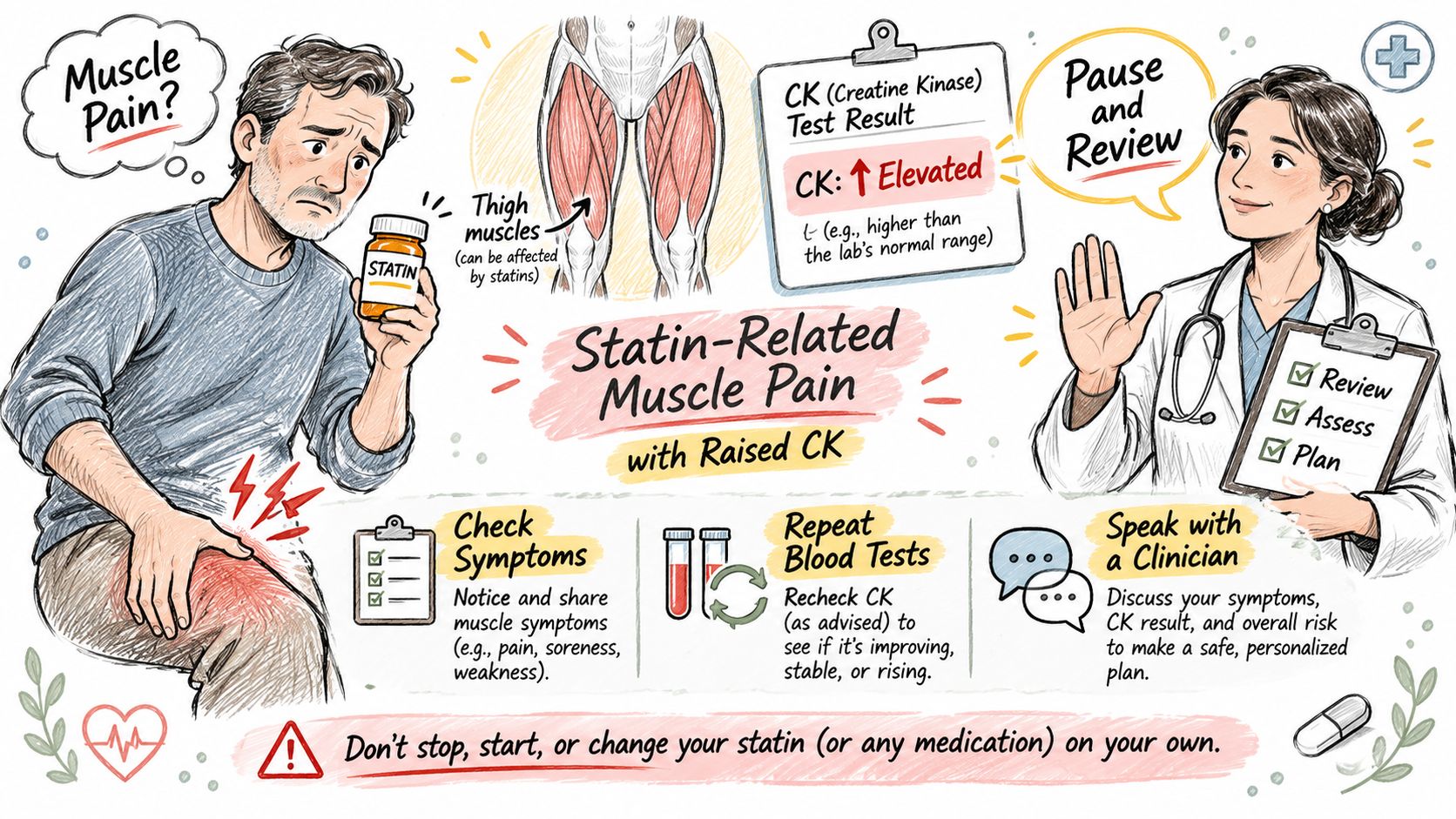
Context does most of the work here. CK testing is more informative when symptoms are present, and a result needs reading alongside when the aches started, recent exercise, dose changes, interacting medicines, thyroid status, kidney function and the other causes of muscle injury. A mildly raised CK in someone with no symptoms at all is a different finding from the same number in someone whose thighs ache climbing stairs.
A five-step path when you have muscle pain on a statin
- Note the timing. When did the aches start, and did a dose change, a new medicine or a hard training block come first?
- Bring the full list. Every medicine, every dose, every supplement, including anything bought over the counter.
- Ask about repeat testing. Whether CK, creatinine and eGFR should be checked again after rest is a clinical decision, not a guess.
- Don't stop the statin on your own. Speak with your doctor or pharmacist first, because the cardiovascular reason you started it hasn't gone away.
- Escalate for red flags. Dark urine, reduced urine output or weakness that is getting worse means urgent care, not a routine review.
That last point separates the two situations cleanly. Mild, stable muscle aches with a modest CK rise belong in a GP conversation. Escalating weakness, severe pain, dark urine or reduced urine output need urgent assessment because of possible rhabdomyolysis.
Here's a short walkthrough of what muscle pain on a statin can mean and how clinicians think it through.
An abnormal CK also doesn't automatically mean permanent statin intolerance. Clinicians may consider a dose adjustment or a different statin, and treatment changes stay medically supervised. If cholesterol is on your mind alongside the muscle question, this explainer on LDL cholesterol levels covers what those numbers mean.
The statin decision belongs to your prescriber. The lab result is one input, not the verdict.
Confirm Your Next Step With a Clinician
Two things decide what happens next: your symptoms and the trend across results. A flagged number on its own settles nothing, so an abnormal CK belongs in a conversation with the GP or specialist who ordered it.
In practice, three paths cover almost everyone. A repeat test after rest, paired with creatinine or eGFR, electrolytes and a urine check, answers whether a rise was a passing effect of training or something that persists. Specialist review fits when the elevation stays unexplained or weakness is progressive. Urgent care is the answer whenever a red-flag symptom is present, and it does not wait for a repeat sample.
A useful way to hold the three paths apart: the repeat test asks a question, the specialist review investigates a pattern, and urgent care treats a problem already underway. The same CK value can sit comfortably in the first path for an athlete after a hard session and firmly in the third for someone with dark urine.
What to bring to the appointment
Arrive with the material that makes the conversation fast and accurate.
- The full report, including the reference range printed alongside the result.
- A symptom timeline with start dates for pain, weakness, cramps, swelling or dark urine.
- Every medicine and supplement, with doses, including anything you started in the past three months.
- The date of your last hard training session, plus any injury, fall or intramuscular injection.
- Previous CK results with their own reference ranges, so the trend is visible on paper rather than from memory.
A telehealth consultation is a practical way to talk a result through, particularly when you have questions before deciding whether to book in person. Your regular doctor stays the right destination for follow-up when a result remains unexplained or persistently raised.
Worth knowing if you're organising testing yourself: Vital iQ Health lets customers order private blood tests online without a GP referral or a GP visit, then attend any NATA Accredited Pathology collection centre near them for the sample. Partnered telehealth GPs can walk you through your results, answer your questions and recommend next steps from home.
That's the whole framework in one line. Repeat test, specialist review or urgent care, chosen on symptoms and trend, with your own laboratory's reference range in front of you when you decide.
If a flagged CK result has left you unsure whether to rest, repeat or escalate, Vital iQ Health makes the next step straightforward: order a private blood test or pathology panel online with no GP referral needed, then visit any NATA-accredited collection centre near you and receive results within 24 to 72 hours. Our partnered telehealth GPs can talk you through what your result means for your training, your medicines and what to do next. Visit Vital iQ Health to choose your test and arrange your collection.