How to Interpret Blood Test Results: A Practical Guide
Learn how to interpret blood test results, from reference ranges and glucose cut-offs to trends and when to see a clinician in Australia.

Your blood test report has arrived, and a bold high or low flag catches your eye. You recognise some of the test names, but the abbreviations, units and reference ranges leave you wondering whether you should be worried before your appointment.
Learning how to interpret blood test results starts with a sequence of checks, not a search for diseases associated with a single number. You can organise the information and identify useful questions yourself. A clinician makes the final call about what the findings mean for your health.
What a Flagged Result Actually Tells You
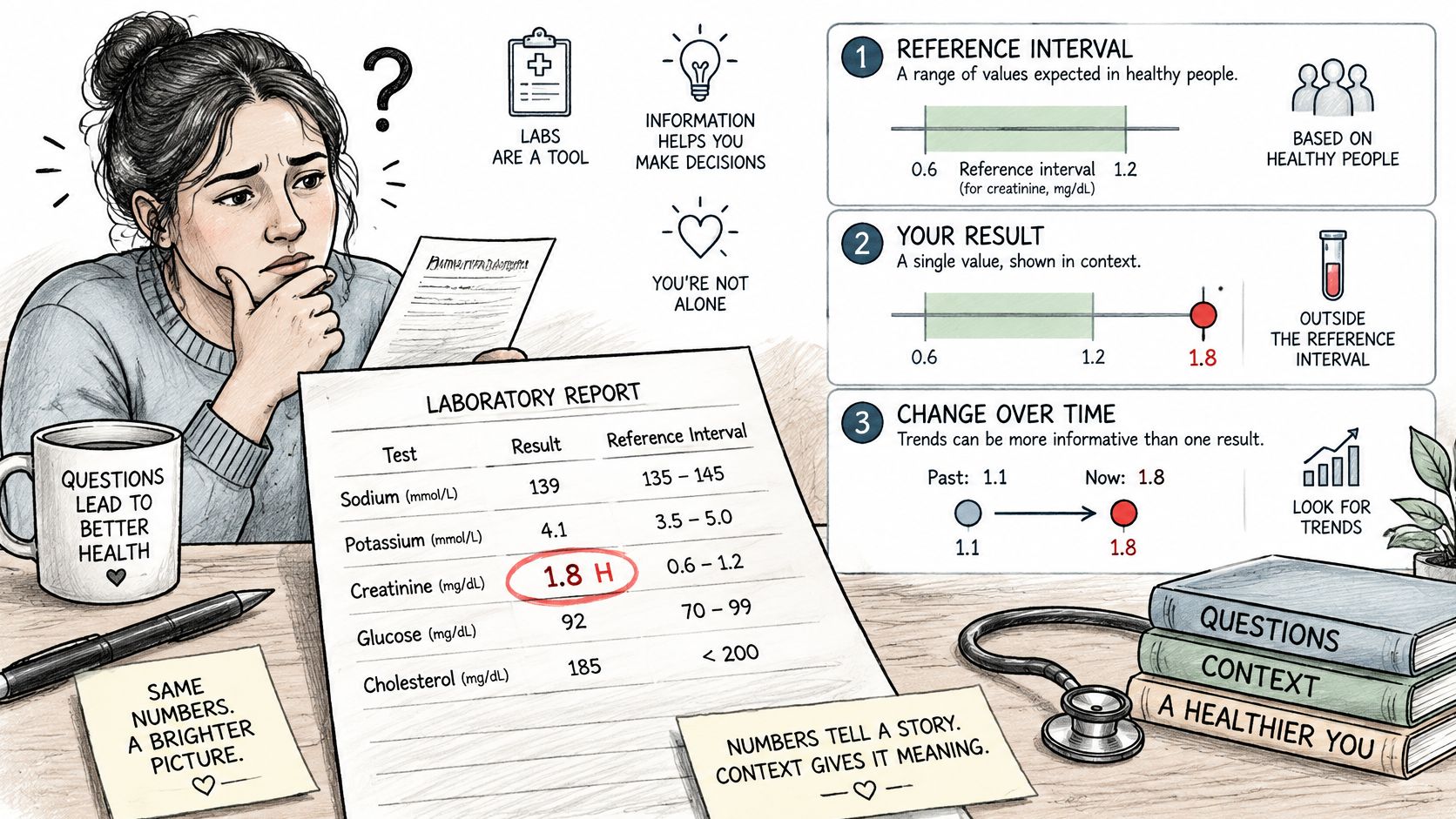
A flag beside a result tells you that the laboratory has highlighted it for review. It doesn't, by itself, tell you the cause, seriousness or treatment needed.
Keep these ideas separate:
- Reference interval: A population-based comparison showing results considered typical for a defined group.
- Clinical decision limit: A threshold used when considering diagnosis, further investigation or treatment.
- Personal trend: The direction and size of changes in your own results over time.
A result can sit outside a reference interval without establishing disease. Equally, an unflagged result doesn't guarantee that there's no health problem. Healthdirect Australia explains that interpretation depends on why you were tested, your age, sex, overall health, lifestyle, medicines, supplements and other treatments.
The highlighted marker is a starting point for discussion, not the whole interpretation.
Start with the report, not a diagnosis search
Find the marker's full name and note whether the value is just outside the printed interval or substantially beyond it. Check that you can also find the collection date, units and laboratory reference interval.
If albumin is highlighted, for example, an explanation of a low albumin blood test result can help you understand the terminology. It can't establish why your own result is low.
Practical rule: Use the flag to choose what needs explaining, not to decide what condition you have.
Marked abnormalities or symptoms deserve clinical review rather than reassurance based on an online comparison.
Common Blood Markers and Their Reference Ranges
Use this lookup table to identify the marker and its related tests, then take the actual comparison interval from your own report.
| Marker | What it reflects | Typical adult range | Read alongside |
|---|---|---|---|
| Total cholesterol | Overall cholesterol carried in the blood | Use the report's interval and clinician's cardiovascular assessment | LDL and HDL cholesterol |
| LDL cholesterol | Cholesterol carried in LDL particles | Use the treatment target set for your cardiovascular risk | Total cholesterol and overall risk |
| Fasting glucose | Blood sugar after fasting | Use the report's fasting interval | HbA1c and whether the sample was fasting |
| HbA1c | Longer-term blood sugar exposure | Use the report's interval or your agreed diabetes management target | Fasting glucose |
| Haemoglobin | The oxygen-carrying protein in red blood cells | Use the report's age- and sex-appropriate interval | Ferritin and red cell indices |
| Ferritin | A marker used to assess iron stores | Use the report's sex-appropriate interval and clinical interpretation | Haemoglobin and inflammation markers |
| TSH | Thyroid signalling from the pituitary | Use the report's interval for your clinical circumstances | Free T4 |
| Creatinine | A waste product used to assess kidney filtration | Use the report's appropriate interval | eGFR |
| ALT | An enzyme used in liver assessment | Use the testing laboratory's interval | Other liver tests, alcohol, medicines and recent exercise |
| Potassium | An electrolyte involved in heart rhythm and muscle function | Use the testing laboratory's interval and any urgent comments | Kidney function and medicines |
| Vitamin D (25-OH) | A marker of vitamin D status | Use the report's interpretive limits | Symptoms and supplement use |
| Vitamin B12 | A vitamin involved in nerve and red cell health | Use the report's assay-specific interval and comments | Haemoglobin and symptoms |
The printed laboratory range takes precedence over a generic internet range. Australian guidance on reading pathology results highlights the importance of the reporting laboratory's intervals because methods, units and reporting conventions aren't always interchangeable.
Read related markers together
Start with the marker you're concerned about, check its value against the adjacent interval, then look at the related results. Don't assume that every test within a group measures the same thing.
For example, haemoglobin and ferritin answer different questions. Haemoglobin helps assess the blood's oxygen-carrying capacity, while ferritin helps assess iron stores. Ferritin can also rise during inflammation, so a result within its interval doesn't always settle the question of iron deficiency.
Our explanation of an iron studies test can help you distinguish the components before discussing the pattern with your clinician.
Similarly, creatinine is usually considered alongside eGFR, rather than treated as a standalone verdict on kidney health. TSH is interpreted with thyroid hormone results and the reason testing was requested.
A related marker provides context. It isn't a reason to order every available test or to diagnose yourself from a panel.
Shortlist the markers you most want explained. Prioritise those connected to symptoms, laboratory comments or treatment you're already receiving, rather than treating every flag as equally important.
How to Read a Report and Judge Changes
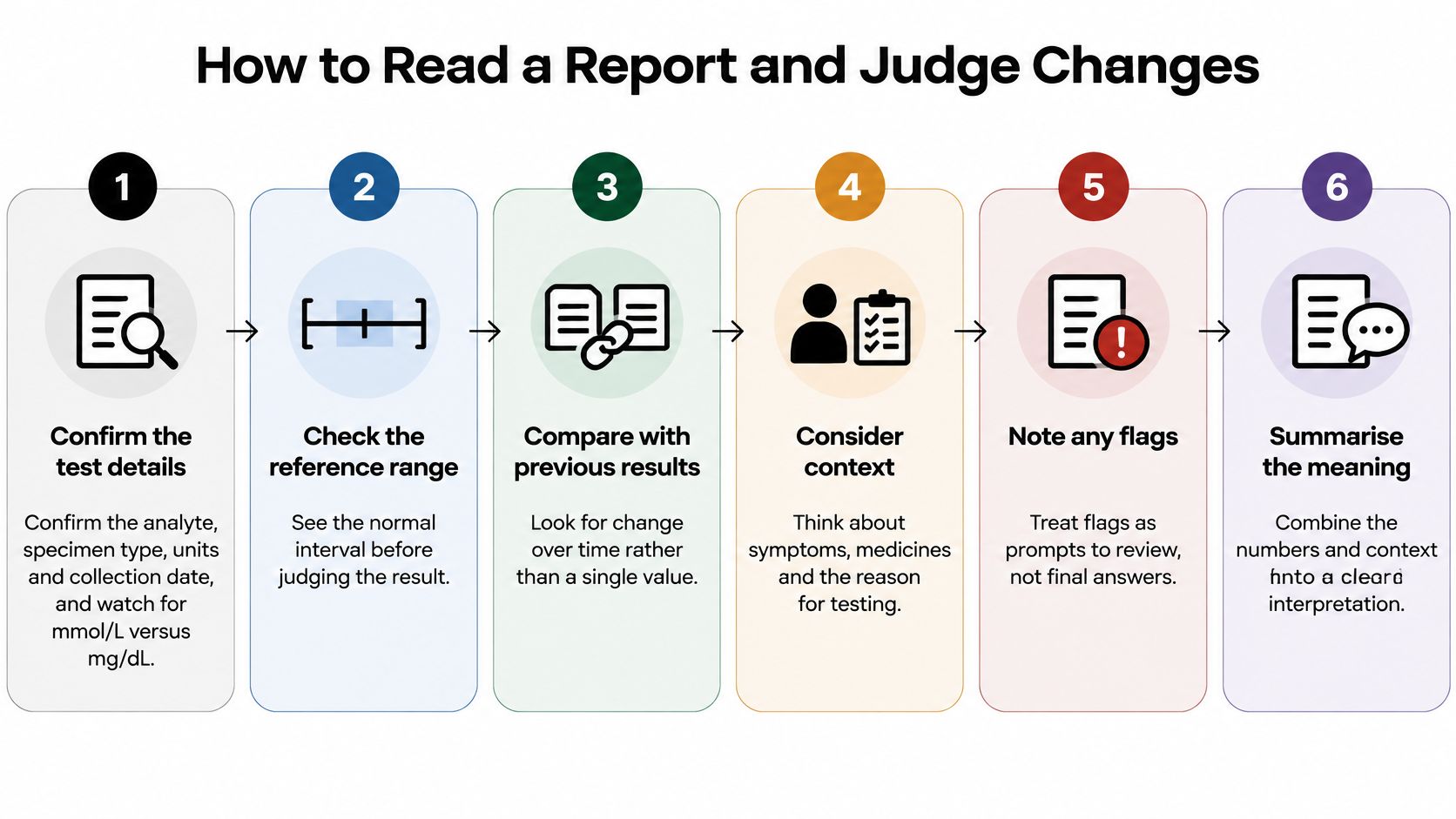
Read the report in a fixed order so you don't judge a number before checking what it represents. Keep the complete document open, including laboratory comments, rather than relying on a cropped screenshot.
This visual provides a useful overview of the checks involved.
Run the checks in order
Confirm the test details. Identify the analyte, meaning the substance being measured, along with the specimen type, units and collection date. A serum result and a whole-blood result aren't automatically equivalent, and values expressed in mmol/L and mg/dL can't be compared by their digits alone.
Check the correct reference interval. Use the interval printed beside the result, and check whether the report identifies an appropriate category for your age, sex or pregnancy status. If a category appears wrong or unclear, make that a question for the clinician rather than substituting a range from another website.
Identify what kind of boundary you're looking at. A population reference interval isn't necessarily a diagnostic threshold or treatment target. The Royal College of Pathologists of Australasia pathology manual explains that most reference intervals cover approximately the central 95% of a healthy population, leaving about 5% of healthy people outside them by chance.
Review preparation and sample comments. Record whether you fasted, exercised recently, were unwell, or took medicines or supplements around collection; posture and sample handling can also matter. Look for comments about haemolysis, meaning breakdown of red blood cells in the sample, or lipaemia, meaning excess fatty particles that can interfere with some measurements.
Compare comparable results. Match the analyte, units, specimen type, laboratory and, where available, testing method before describing a trend. A different laboratory doesn't make comparison impossible, but you shouldn't assume a numerical difference represents a change in your health.
Bring in symptoms and clinical risk. Note what prompted testing, what symptoms you're experiencing and whether treatment has changed. Your clinician combines these details with examination findings and how likely a condition was before the test, rather than interpreting the report in isolation.
Don't stop prescribed medicine or change supplement doses to produce a different result. Tell the clinician what you take and ask for specific preparation instructions if repeat testing is recommended.
Judge the size and timing of a change
A higher or lower result isn't automatically a meaningful trend. The RCPA's general pathology guidance distinguishes variation arising before testing, during laboratory measurement and during reporting, so a result can move without a true physiological change.
Record both the absolute change, meaning the amount added or subtracted, and the percentage change, meaning that difference relative to the earlier result. Percentage change is calculated by dividing the difference by the earlier value and multiplying by one hundred.
Neither calculation establishes significance on its own. Your clinician considers the test's expected measurement and biological variation, the time between collections and whether the result crosses a relevant decision limit.
For example, a small movement after changing laboratories needs a different discussion from a steady change measured using the same method after a treatment adjustment. A rapidly changing result may also warrant attention even before it passes outside the printed interval.
Trend check: Ask whether the change is larger than expected variation, not simply whether the latest number is higher.
Keep a simple record with columns for collection date, laboratory, result, units, interval and relevant circumstances. Include treatment changes and illness, but don't rewrite laboratory comments in a way that loses their original meaning.
The video below offers another way to approach reading a laboratory report.
Match the pattern to a sensible next step
These patterns help you prepare for review. They aren't a substitute for instructions from the laboratory or treating clinician.
| Result pattern | Likely meaning | Next step |
|---|---|---|
| Single mild flag, no symptoms | Possible chance result or preparation effect | Review preparation and ask whether repeat testing or routine follow-up is appropriate |
| Flag with symptoms | May reflect a clinically relevant change | Arrange a GP review promptly, with urgency guided by symptoms |
| Markedly abnormal result, such as markedly high potassium | May be clinically significant, even if interference is possible | Seek same-day medical advice and follow any urgent laboratory instructions |
| Consistent direction across repeated results from the same laboratory | Possible meaningful trend | Ask a clinician to assess its size, timing and significance |
| Change after fasting, exercise, illness or a new medicine | Preparation, interference or a genuine treatment effect may contribute | Discuss whether repeat testing under comparable conditions is needed |
| Results from different laboratories | Methods, units or reference intervals may differ | Assess each against its own interval and ask whether confirmation at the same laboratory would help |
A useful summary isn't just “high” or “normal”. It records the value, relevant interval, collection date, laboratory comment and agreed next step.
Why Glucose Results Need the Right Test
Glucose results are particularly easy to misread because different tests describe different aspects of blood sugar control. Fasting plasma glucose measures blood sugar after fasting; a glucose tolerance test assesses the response to a glucose drink; HbA1c reflects longer-term exposure.
The Australian Institute of Health and Welfare identifies the following diabetes diagnostic cut-offs for non-pregnant adults: fasting plasma glucose of 7.0 mmol/L or higher, glucose of 11.1 mmol/L or higher at 2 hours after a 75-gram oral glucose load, or HbA1c of 6.5% (48 mmol/mol) or higher.
| Measure | What it describes | Units | Diagnostic cut-off |
|---|---|---|---|
| Fasting plasma glucose | Blood sugar after fasting | mmol/L | At or above the fasting threshold specified above |
| Post-load glucose | Blood sugar response to a glucose drink | mmol/L | At or above the post-load threshold specified above |
| HbA1c | Longer-term blood sugar exposure | % and mmol/mol | At or above the HbA1c threshold specified above |
The different HbA1c units describe the same type of measurement using different reporting systems. They aren't directly interchangeable with the units used for plasma glucose.
Apply the threshold without jumping to a diagnosis
Suppose your fasting glucose is above the laboratory's interval but below the diagnostic threshold. That doesn't justify either diagnosing diabetes yourself or dismissing the result because it hasn't reached the cut-off.
Your clinician may recommend repeat testing, HbA1c or another assessment after reviewing symptoms, medical history and collection conditions. A result at a diagnostic threshold also needs clinical interpretation and, where appropriate, confirmation.
Diagnosis and management are different decisions. Once someone has diabetes, their clinician uses an agreed management target to assess treatment; that target isn't the diagnostic boundary applied again.
Before your appointment, check whether the glucose sample was fasting and whether HbA1c was measured too. If you're unsure what preparation was required, review which blood tests require fasting and confirm the instructions for any repeat collection.
Prepare Your Questions Before Your Results Appointment
Turn your reading into a short, organised appointment note. You don't need a proposed diagnosis, just the information that helps your clinician explain the report and decide what happens next.
Bring the details that affect interpretation
- The full report: Include units, reference intervals, collection date, laboratory name, method if listed, and all interpretive comments.
- Medicines and supplements: Record names, doses and recent changes, including non-prescription products.
- Collection circumstances: Note fasting status, recent illness, unusual exercise and anything that differed from your usual routine.
- Earlier reports: Bring the original results rather than a list of numbers without units.
- Symptoms and timing: Write down when symptoms began, whether they're changing and how they affect daily activities.
At Vital iQ Health, we deliver results directly to customers from NATA-accredited laboratories within 24 to 72 hours. Receiving a report gives you access to the findings, but it doesn't replace a clinical explanation.
Ask for a clear plan
Use these questions to keep the discussion focused:
- Personal meaning: What does this flagged result mean for me, given my age, sex, symptoms and history?
- Repeat testing: Does it need repeating, when should that happen, and what preparation should I follow?
- Changes to the plan: Which symptoms, related results or future changes would lead to a different next step?
- Urgency: Does anything require urgent care, and whom should I contact if I become unwell?
Ask the clinician to document any important trend and explain what they're monitoring. Before leaving, make sure you know who will review repeat results and how you'll receive the follow-up advice.
Don't wait for a booked review if you develop chest pain, severe breathlessness, fainting or confusion. Seek immediate medical attention, and follow urgent instructions if a laboratory or healthcare professional contacts you about a critical result.
If you're well and haven't received urgent instructions, book your clinician review this week and write your questions down before the appointment. That gives you a concrete next step without trying to resolve every uncertainty yourself.
Our partnered telehealth GPs can walk you through your blood test results, answer your questions and recommend next steps from home. Visit Vital iQ Health to explore private blood testing and arrange support with understanding what your report means for you.