Fast Heart Rate: Causes and When to See a Doctor
Fast heart rate causes, warning signs and when to get urgent care. Learn what is normal, what to record at home and which tests help.
If your heart is racing, is the number on your watch enough to tell you whether something's wrong? Not usually. A fast heart rate is a starting point, but the rhythm, duration, triggers and symptoms give a doctor much more useful information.
The safest decision order is simple: check for emergency symptoms first, then consider whether the pulse settles, and finally record the pattern for assessment. You don't need to identify the cause yourself before asking for help.
When a Racing Pulse Needs Urgent Care
| Situation | Usual meaning | What to do |
|---|---|---|
| Pulse over 100 at rest, regular, no other symptoms, settles with quiet rest | Often a normal body response, particularly after activity, stress or caffeine | Recheck after rest and note triggers |
| Resting rate above 100 that persists across several checks | Possible rhythm problem or another medical cause | Book a GP appointment |
| Irregular or fluttering beats that come and go | Possible atrial fibrillation or another arrhythmia | Arrange timely GP review and keep a log |
| Fast pulse with chest pain, severe breathlessness, fainting or marked dizziness | Possible serious rhythm problem | Call 000 now |
| Fast pulse with a very unwell appearance or new confusion | Possible emergency | Call 000 now |
A resting rate above 100 is a benchmark, not a diagnosis. The same number can mean a normal response to climbing stairs or an unexplained rhythm that needs review, so the pattern around it matters more than the reading alone.
A pulse that slows with quiet rest and comes with no warning symptoms is generally less concerning. A pulse that stays above 100 across several checks, or keeps returning without a clear trigger, should be reviewed by a GP. The term itself is explained in healthdirect's tachycardia guidance. Settling with rest is reassuring, but it does not prove that every episode is harmless.
Chest pain, fainting, severe breathlessness, marked dizziness or new confusion means calling 000 immediately. Do not wait for another wearable reading, try to finish a pulse log or drive yourself to an appointment.
Decide from symptoms before the number
Emergency symptoms outrank any number on a device. A person who looks very unwell needs help even if the watch does not show an especially high rate.
For episodes without emergency symptoms, ask two questions in order. Is the racing explained by exertion, stress, caffeine or illness? Does it resolve when you stop and rest? A pulse that gradually slows after climbing stairs is different from one that starts while you are sitting still. Repeated unexplained episodes deserve assessment, even when you feel well afterwards.
Safety rule: Do not use a reassuring pulse reading to overrule concerning symptoms.
Irregular episodes can be painless or intermittent. Australian AF awareness reporting highlights the importance of seeking review for unexplained racing, fluttering, light-headedness and unusual tiredness rather than waiting for pain.
A normal reading between episodes does not rule out an intermittent rhythm problem. Tell the clinician what happened during the episode, not just what your pulse is doing at the appointment. If you are unsure which category fits, seek medical advice rather than repeatedly checking your watch. Home checks should support a decision, not delay one.
What Counts as a Fast Heart Rate
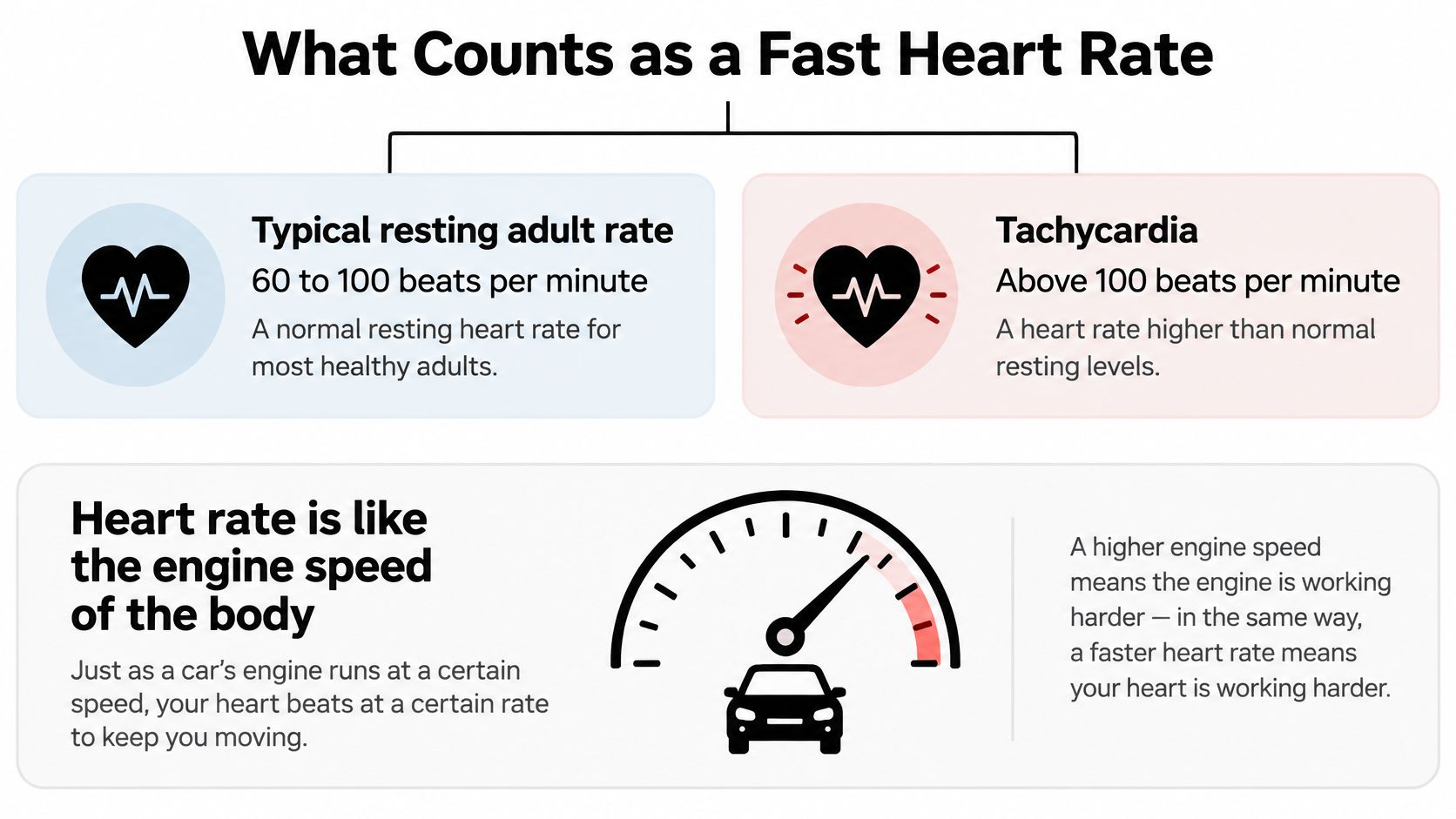
Tachycardia generally means a heart rate above 100 beats per minute, according to the Heart Foundation's heart arrhythmia guidance. That label describes speed, not a diagnosis or a measure of how dangerous an episode is.
Think of the rate as a speedometer. Rhythm, duration and context help distinguish a car travelling appropriately from an engine misfiring. A faster reading during physical effort has a different meaning from an unexplained racing pulse at rest.
Use these checks to describe what's happening:
- Resting rate: Were you resting, or had you just walked, exercised or stood up?
- Regularity: Did the beats feel evenly spaced, irregular, fluttering or interrupted?
- Duration: Did the episode fade gradually, stop abruptly or remain present?
- Trigger: Was there exertion, stress, illness, heat, caffeine or a medicine beforehand?
- Symptoms: Did you have pain, breathlessness, weakness, dizziness or faintness?
A normal response versus an abnormal rhythm
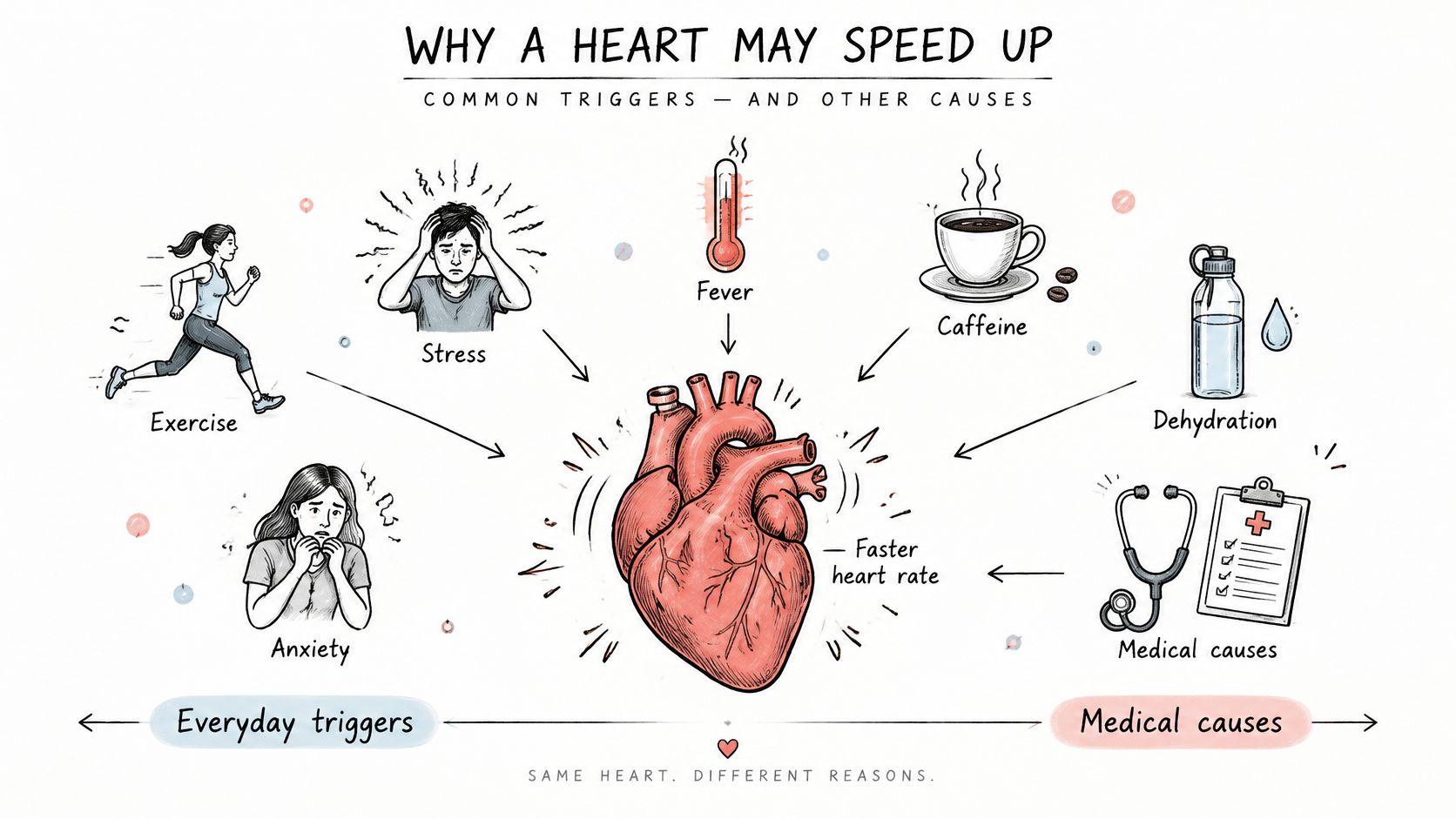
With sinus tachycardia, the heart's natural pacemaker speeds up in response to a need or trigger, such as exercise, fever, dehydration or stress. The important question is why it has accelerated, rather than whether the number alone needs treatment.
Other fast rhythms involve abnormal electrical activity. Supraventricular tachycardia, or SVT, starts above the ventricles, while ventricular tachycardia starts in the heart's lower pumping chambers and can be dangerous when sustained. You can't reliably distinguish these by feeling your wrist.
Age, fitness and medicines also affect your usual resting pulse. Trained athletes may have a lower baseline, so a change from your own usual pattern can be useful information.
A sudden or recurrent unexplained episode warrants a GP discussion. Don't assume a regular beat is harmless, or that an irregular sensation automatically means atrial fibrillation.
Common Causes Behind a Racing Heartbeat
The same sensation can have several explanations. These clues help a clinician choose appropriate checks, but none confirms a diagnosis on its own.
The illustration groups everyday triggers and medical causes.
| Cause | Typical clue | What helps confirm it |
|---|---|---|
| Exercise, stress or anxiety | Rate rises with effort or worry and settles with rest | Pulse log with activity notes and clinical review if unexplained |
| Caffeine, nicotine, alcohol or decongestants | Symptoms follow intake and may ease as the effect wears off | Diary of intake, dose and symptom timing |
| Fever, dehydration or illness | Pulse changes alongside temperature, fluid intake or illness symptoms | Temperature and fluid record, plus clinical assessment |
| Anaemia or iron deficiency | Fatigue, pale skin or breathlessness on exertion | Blood tests for haemoglobin and iron status |
| Overactive thyroid | Weight loss, heat intolerance or tremor | Thyroid function blood test |
| Atrial fibrillation | Irregular pulse that may be painless or intermittent | ECG, with ambulatory monitoring if episodes aren't captured |
| Supraventricular tachycardia | Racing that starts and stops suddenly | ECG recorded during an episode |
| Postural orthostatic tachycardia | Rate climbs on standing, often with dizziness | Lying and standing heart rate and blood pressure assessment |
Why the clue isn't the diagnosis
Stress and anxiety can accelerate the heart, but feeling anxious during an episode doesn't establish anxiety as its cause. An unexpected rhythm change can itself feel frightening. Likewise, caffeine before an episode is worth recording, but it shouldn't automatically explain away persistent symptoms.
For suspected iron deficiency, an iron studies test examines iron status. Haemoglobin testing answers a related but different question, whether anaemia is present. Symptoms alone can't reliably separate these possibilities.
Atrial fibrillation becomes more common with age. The Australian Institute of Health and Welfare estimates that AF affected approximately 2.0% of Australia's general population in 2020, equivalent to more than 500,000 people, and an estimated 5% of Australians aged 55 years and over.
Those population figures don't tell you the cause of your own episode. AF may produce few noticeable symptoms, while a forceful heartbeat can occur without AF.
Causes can also overlap. Someone with anaemia may notice a racing heart most clearly during exercise, while illness and reduced fluid intake may occur together. Record plausible contributors rather than choosing a single explanation in advance.
This video provides an additional visual explanation of racing-heart concerns.
How to Record Your Pulse for Your Doctor
A useful pulse record shows what happened around the reading. Only measure at home when you're well enough to do so safely; collecting information must never delay urgent care.
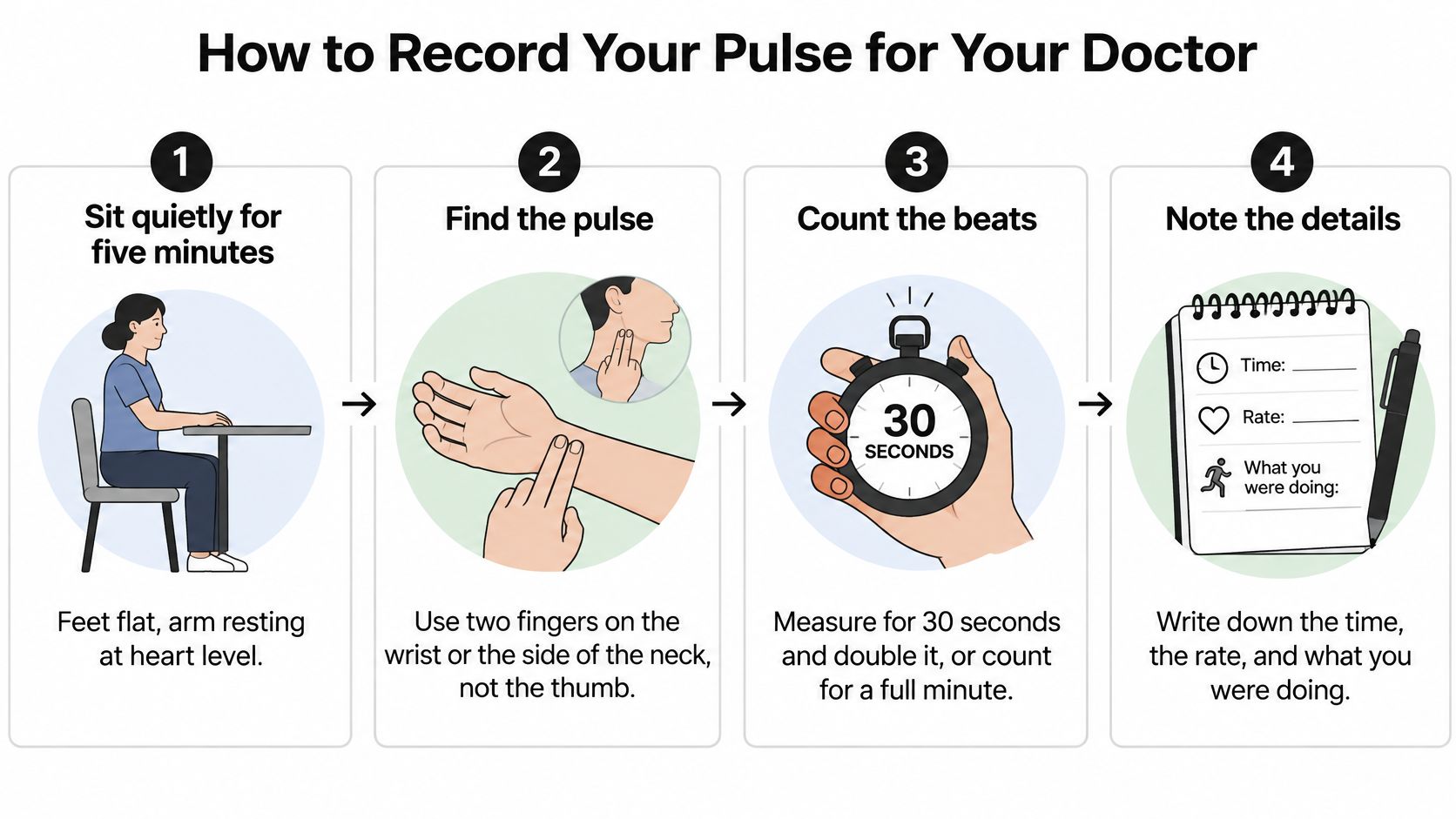
Settle before measuring. Sit for five minutes with your feet flat and your arm supported around heart level. This helps avoid mistaking the effect of recent movement for your resting pulse.
Find the pulse gently. Place your index and middle fingers on the thumb side of your wrist, or lightly on one side of your neck. Don't use your thumb, because you may feel its own pulse, and never press both sides of your neck.
Count the beats. Count for a full minute, especially if the beat feels irregular; when it's steady, you can count for thirty seconds and double the result. A longer count is more useful when beats aren't evenly spaced.
Describe the rhythm. Note whether it feels regular, irregular or as though it speeds up and slows down. Use plain descriptions rather than trying to name an arrhythmia.
Record the circumstances. Write down the time, activity, posture and possible triggers, including caffeine, alcohol, illness, poor sleep and medicines. Include non-prescription cold remedies and supplements.
Add symptoms and duration. Record what you felt and whether the episode began or ended suddenly. If you don't know how long it lasted, write that rather than guessing.
Keep useful comparisons. Repeat under similar resting conditions on other days, and record episodes when safe. Include ordinary readings too, so the clinician can compare symptoms with your baseline.
The measurement sequence is illustrated below.
Bring a short, readable record rather than a collection of unexplained watch screenshots.
Your finished log should contain the date, rate, rhythm, duration, activity, posture, triggers and symptoms. Wearable readings can help identify trends, but a displayed pulse rate isn't the same as a clinician-interpreted rhythm recording. Save any available symptom-linked recordings without assuming that the device's label is a diagnosis.
How Doctors Check a Fast Heart Rate
| Test | What it shows | When it is used | Typical turnaround |
|---|---|---|---|
| Resting ECG | Electrical rhythm and rate at one moment | Initial assessment of a fast or irregular rhythm | Usually recorded during the visit; review arrangements differ |
| Holter monitor | Continuous rhythm during the prescribed wear period | Episodes likely to occur during monitoring | Results after the wear period and analysis |
| Event recorder | Symptom-linked or automatically detected rhythm recordings | Infrequent episodes that shorter monitoring may miss | After a useful recording is obtained and reviewed |
| Standing heart rate and blood pressure test | Changes from lying to standing | Suspected postural tachycardia | Measurements taken in clinic |
| Thyroid, iron and haemoglobin blood tests | Thyroid function, iron status and evidence of anaemia | Investigation of possible reversible causes | Laboratory processing followed by clinical review |
Match the recording to the episode
A resting ECG is often an initial test because it records the heart's electrical activity directly. Its limitation is timing: an intermittent rhythm may not occur while the recording is being made. A normal result therefore needs to be interpreted alongside the history.
A Holter monitor records continuously during its wear period. An event recorder can suit less frequent episodes because it allows a longer opportunity to capture them. Neither guarantees an answer if the relevant event doesn't occur or isn't recorded clearly.
A clinician chooses the device and recording period from your symptom pattern. Tell them whether episodes happen daily, unpredictably, during activity or after standing, rather than requesting a particular monitor.
Assess posture and reversible causes
For suspected postural orthostatic tachycardia syndrome, or POTS, the clinician compares heart rate and blood pressure after lying down and during standing. They also document symptoms such as dizziness, palpitations, faintness or difficulty concentrating.
The Heart Foundation's POTS guidance specifies a sustained increase of at least 30 beats per minute during 10 minutes of standing in adults, confirmed by two consecutive measurements one minute apart, or at least 40 beats per minute in adolescents, alongside orthostatic symptoms and without sustained orthostatic hypotension.
The rise alone isn't a POTS diagnosis. Anaemia, iron deficiency, thyroid disorders, infection, medicines, arrhythmias and structural heart disease can produce similar findings. Don't deliberately provoke severe symptoms with an unsupervised standing test.
Blood tests investigate contributors, but they don't record the rhythm. A complete blood panel should be checked for its actual inclusions rather than assumed to contain every relevant test. At Vital iQ Health, we deliver test results within 24–72 hours; that turnaround isn't a substitute for urgent assessment.
Bring your pulse log so the doctor can connect the test choice to what you've experienced.
Confirm the Next Step With a Doctor
Choose the care pathway before ordering tests. If you have emergency warning symptoms, call 000 rather than waiting for a clinic appointment, a telehealth consultation or pathology results.
Otherwise, arrange timely GP review for a persistent unexplained resting increase, irregular beats or recurrent racing episodes. Don't postpone the appointment because you haven't collected a perfect log.
Ask questions that match your pattern
Use the consultation to clarify what needs checking:
- For the rhythm: Ask whether an ECG is appropriate and what the plan is if it doesn't capture an episode.
- For intermittent symptoms: Ask whether a Holter or event recorder fits how often the episodes occur.
- For associated symptoms: Discuss whether fatigue, heat intolerance, illness or exertional breathlessness justify thyroid, iron or haemoglobin testing.
- For follow-up: Ask who will review the results and what changes should prompt earlier care.
Keep blood testing in its proper role
At Vital iQ Health, we offer Cardiovascular Assessments and private blood panels that can be ordered online without a prior GP referral. Our partnered telehealth GPs can explain findings and recommend next steps.
This is a supplement to, not a replacement for, a rhythm check. Blood tests and a telehealth conversation alone can't show which electrical rhythm occurred during a racing-heart episode. Our guide to interpreting blood test results can help you prepare questions, but individual results still need clinical context.
Take your pulse log, a list of medicines and supplements, and the date and duration of the latest episode to your appointment. Those details help the doctor decide what to investigate without relying on the heart rate number alone.
Vital iQ Health offers Cardiovascular Assessments and private blood testing to investigate relevant health markers alongside your doctor's assessment of a fast heart rate. Visit Vital iQ Health to explore testing options and partnered telehealth support, while arranging ECG-based assessment when a rhythm problem needs checking.