Iron Studies Test: How to Read the Results
See what an iron studies test measures, why ferritin and saturation are read together, and which Australian cut-offs change the result.
The popular advice to check your iron and take a supplement if it's low skips the most important question: which iron result is low, and what do the other markers show? A normal ferritin doesn't always exclude deficiency, and a high ferritin doesn't automatically mean you have too much iron.
An iron studies test is best read as a pattern. Your clinician looks at stored iron, the iron available for use, and whether your blood count shows an effect, then considers inflammation, supplements, symptoms and family history. That approach helps avoid treating a laboratory flag while missing its cause.
Markers Inside an Iron Studies Test
An iron studies test is a group of linked measurements, not a single measure of all the iron in your body. The panel describes storage, transport and availability, with each result answering a different question.
Australian laboratory reports don't all use the same order or include every component. You may see serum iron, ferritin, transferrin, total iron-binding capacity, sometimes unsaturated iron-binding capacity, and calculated transferrin saturation.
Markers usually reported in an iron studies test
| Marker | What it reflects | Why it misleads alone |
|---|---|---|
| Serum iron | Iron circulating at the time of the draw | Swings with time of day and recent iron intake |
| Ferritin | Storage iron | Falls in deficiency but also rises with inflammation, infection, liver disease and malignancy |
| Transferrin | Protein that carries iron | Often rises when the body is short of iron, so a high level is not extra iron |
| TIBC | Total iron-binding capacity | Moves with transferrin and describes capacity, not stores |
| UIBC | Unused iron-binding capacity | Shows empty carrying space, not how much iron is stored |
| Transferrin saturation | Circulating iron relative to binding capacity | Low can mean poor supply for red cells; high can flag possible overload |
What the names don't tell you
Transferrin saturation, usually shortened to TSAT, isn't a separate substance floating in your blood. The laboratory calculates it from serum iron relative to iron-binding capacity, expressing how much of that capacity is occupied.
That distinction helps explain an apparently contradictory report. Someone can have a high transferrin result but insufficient iron, because the result describes the carrier protein rather than its cargo. Likewise, a generous binding capacity doesn't mean generous iron reserves.
TIBC and UIBC are related but answer different questions. TIBC describes the total carrying capacity, while UIBC describes the unused portion. Neither directly measures the iron held in storage.
A full blood examination, or FBE, is often requested alongside iron studies. Haemoglobin indicates whether anaemia is present, mean cell volume describes average red-cell size, and red-cell distribution width describes variation in cell size. Our guide to a complete blood panel explains the broader blood-count context.
Practical rule: Check which measurements your report actually contains before assuming that an iron result includes ferritin, saturation and a blood count.
How to Prepare for the Blood Collection
Preparation makes your sample easier to interpret, particularly when your clinician is investigating possible iron overload or comparing repeated results. Follow the instructions for your actual request rather than applying a fasting rule from an unrelated blood test.
Use this checklist when organising your collection.
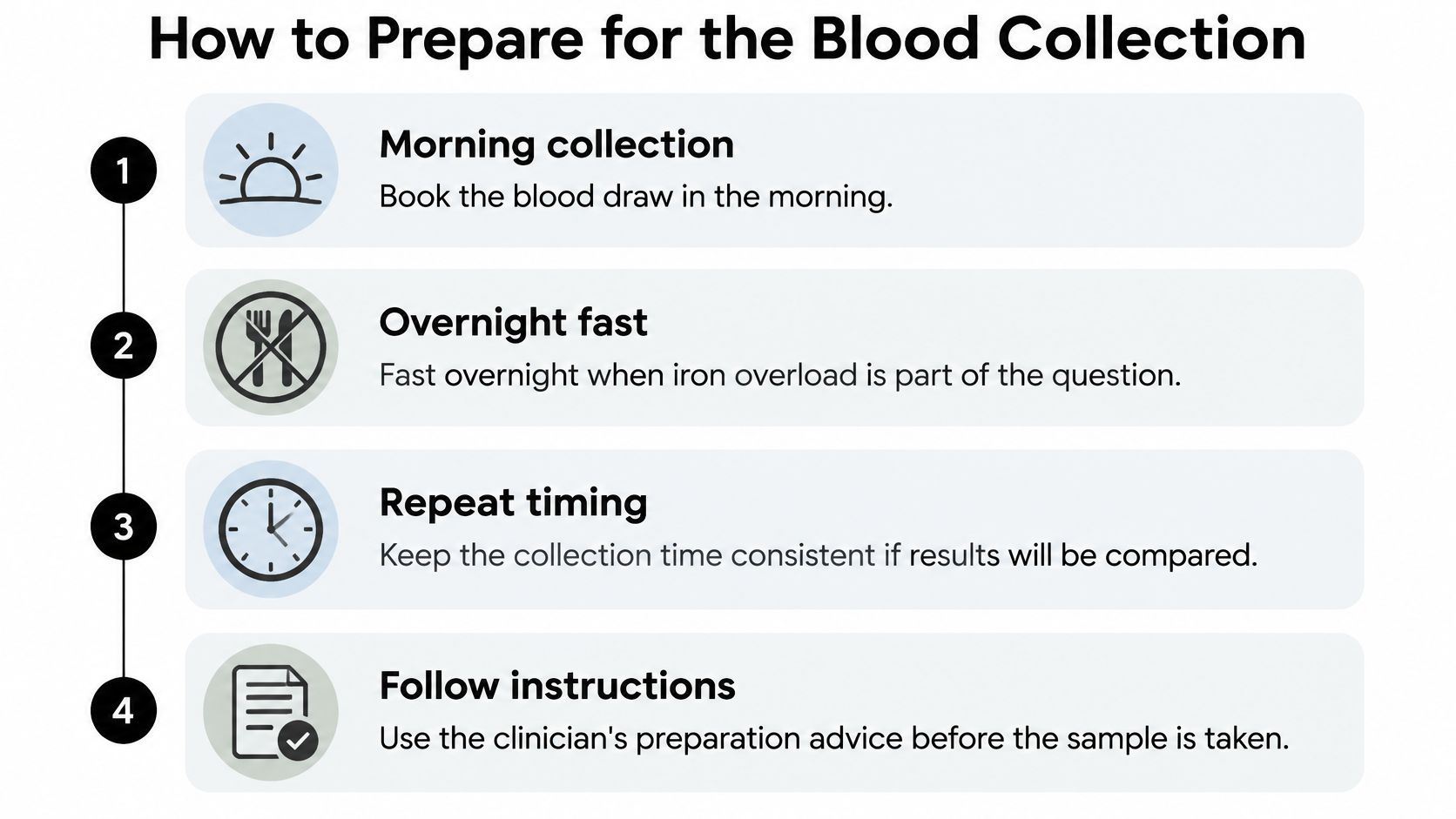
Arrange the collection time. A morning sample after an overnight fast is preferred when hereditary haemochromatosis is part of the question. For monitoring, keeping collection conditions consistent helps your clinician compare results fairly.
Confirm what to do with oral iron. A recent tablet can alter circulating iron and complicate interpretation. Ask your clinician for the appropriate withholding interval, and don't stop prescribed treatment or other medicines independently.
Describe anything that could affect the sample. Tell the clinician about recent iron infusions, infection, liver disease and heavy training. Include when these occurred, rather than saying you take supplements or exercise regularly.
Check that the request answers the clinical question. Serum iron alone isn't enough to establish iron deficiency. If fatigue or anaemia is being investigated, ask whether ferritin and a full blood examination are included, with other markers chosen for your circumstances.
Keep the laboratory context attached. Save the report with its units, reference intervals and collection date. A result copied into a phone note without those details is much harder to compare safely.
What preparation can't fix
Fasting doesn't prevent ferritin from rising during inflammation. Skipping a supplement also doesn't turn an isolated abnormal marker into a diagnosis.
Don't assume every test on a combined request has identical preparation requirements. If your request also includes hormone testing, our guide to cortisol testing in Australia explains why collection timing may need separate attention.
Bring your pathology request, a list of iron tablets or infusions, and the reason for testing to the collection centre. Tell the clinician if a relative has haemochromatosis, even if you feel well. That history can change which result deserves attention.
Why the Markers Must Be Read Together
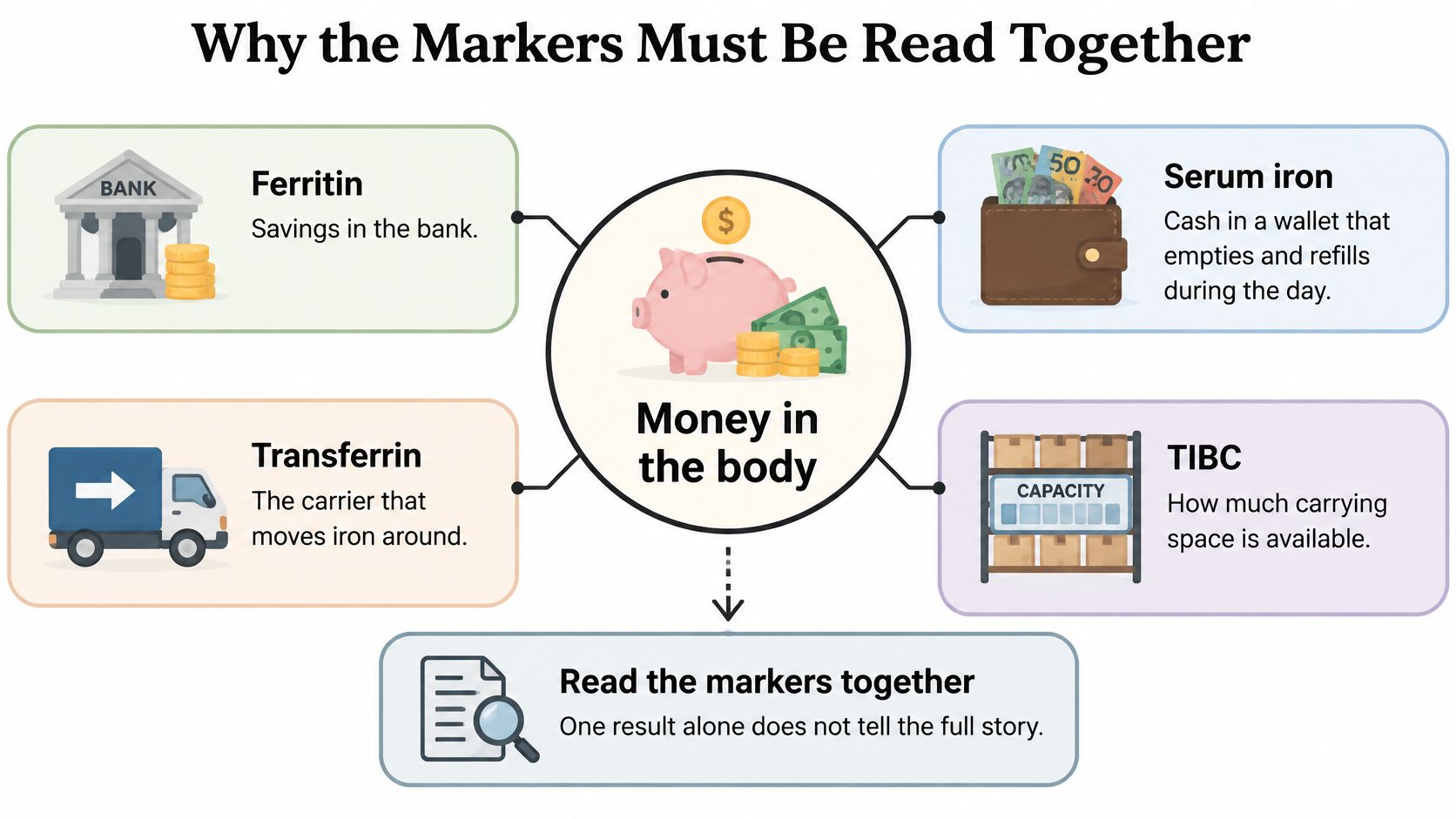
Think of your iron system as a household's money arrangements. Ferritin is savings in the bank, while serum iron is cash in a wallet, which empties and refills during the day.
Transferrin is the carrier moving that cash to where it's needed. TIBC describes how much carrying space is available, and TSAT describes how full that space is. Knowing the size of the wallet doesn't tell you the bank balance, and knowing the bank balance doesn't prove you can access the money today.
This visual keeps those roles separate.
When the results seem to disagree
Say a tired adult receives a report with several flagged results. Instead of asking which flag matters most, their GP checks whether storage and supply tell a consistent story.
- Low ferritin with low TSAT: Both the savings and the money available for use are reduced. This supports depleted iron stores with limited supply for making red cells.
- Normal or high ferritin with low TSAT: The apparent bank balance may look adequate, but access is restricted. Inflammation can limit iron availability, and genuine depletion may coexist.
- High ferritin with high TSAT: Both storage and circulating availability need assessment. This raises different questions, including hereditary haemochromatosis and secondary causes of iron overload.
A high ferritin without raised saturation doesn't carry the same meaning as the last pattern. Your clinician needs to work out why the storage marker is higher rather than assuming that every high result represents excess iron.
Add the effect on the blood
The full blood examination supplies another view: has iron availability affected haemoglobin or red-cell characteristics? It doesn't measure your savings, but it helps show whether the supply problem has affected blood production.
This also separates iron deficiency from iron-deficiency anaemia. Depleted stores can exist before haemoglobin falls, so a blood count within its reference interval doesn't necessarily settle the iron question.
When inflammation and chronic disease are absent, low ferritin is the most reliable laboratory sign of iron deficiency. Serum iron alone can't provide that answer.
Read stores, supply and effect on the blood, then check the inflammatory context. A reassuring-looking line shouldn't cancel a conflicting pattern.
The purpose isn't to make every result fit a neat category. It's to identify which explanation best fits the person, and which uncertainty needs investigation before treatment.
Australian Cut-offs for Deficiency and Overload
Australian interpretation anchors for iron studies
| Situation | Marker pattern | How guidance treats it |
|---|---|---|
| Anaemic adult | Ferritin below 15 µg/L | Diagnostic of iron deficiency in the RACGP guidance summarised in the Australian Government pathology-quality report |
| Anaemic adult | Ferritin 15–30 µg/L | Highly suggestive of iron deficiency in the same guidance |
| Suspected hereditary haemochromatosis | Fasting morning TSAT above 45% | Sensitive screening threshold in RACGP elevated-ferritin guidance, with specificity increasing above 55% |
| Premenopausal woman | Ferritin above 200 µg/L | Abnormal in that RACGP overload assessment |
| Man or postmenopausal woman | Ferritin above 300 µg/L | Abnormal in that RACGP overload assessment |
| Any adult with marked elevation | Ferritin above 1,000 µg/L | Warrants referral to a gastroenterologist, haematologist or physician experienced in iron overload |
Deficiency thresholds answer a specific question
The deficiency rows apply to anaemic adults. They help establish whether iron lack explains the anaemia, but they don't identify why stores became depleted or determine a treatment dose.
The Australian Government report summarises the 2012 Australian Health Survey estimate that approximately 3% of the population was anaemic, with iron deficiency accounting for 71% of anaemia cases. Those figures describe anaemia and its causes, not the proportion of Australians with low iron stores.
A diagnostic threshold also isn't automatically a treatment target. Your clinician must connect the result to symptoms, the blood count, relevant medical conditions and the reason for testing.
Athlete patterns use a different framework
Athlete guidance describes a progression rather than a universal performance target. The RACGP article on iron deficiency describes depleted stores with ferritin below 35 µg/L, iron-restricted erythropoiesis with ferritin below 20 µg/L and TSAT below 16%, and iron-deficiency anaemia with ferritin below 12 µg/L, haemoglobin below 115 g/L and TSAT below 16%.
Here, erythropoiesis means red-cell production. The combined markers distinguish reduced reserves from insufficient supply for producing blood cells and, finally, anaemia.
These athlete patterns shouldn't be converted into a self-directed supplement plan. Recent training, symptoms, diet, bleeding history and the laboratory's reference intervals still matter.
Overload thresholds trigger investigation, not certainty
The overload rows serve another purpose: identifying results that need assessment for excessive iron accumulation. A screening threshold helps decide who needs further evaluation; it doesn't establish hereditary haemochromatosis by itself.
Persistent abnormalities are more informative than an unexplained result obtained under uncertain collection conditions. Family history, supplements, liver health and the relationship between ferritin and TSAT influence the next investigation.
Use these anchors to understand the clinical question, not to replace the performing laboratory's reference intervals. Different patient groups and inflammatory conditions require different interpretation.
When a Normal Ferritin Is Not Reassuring
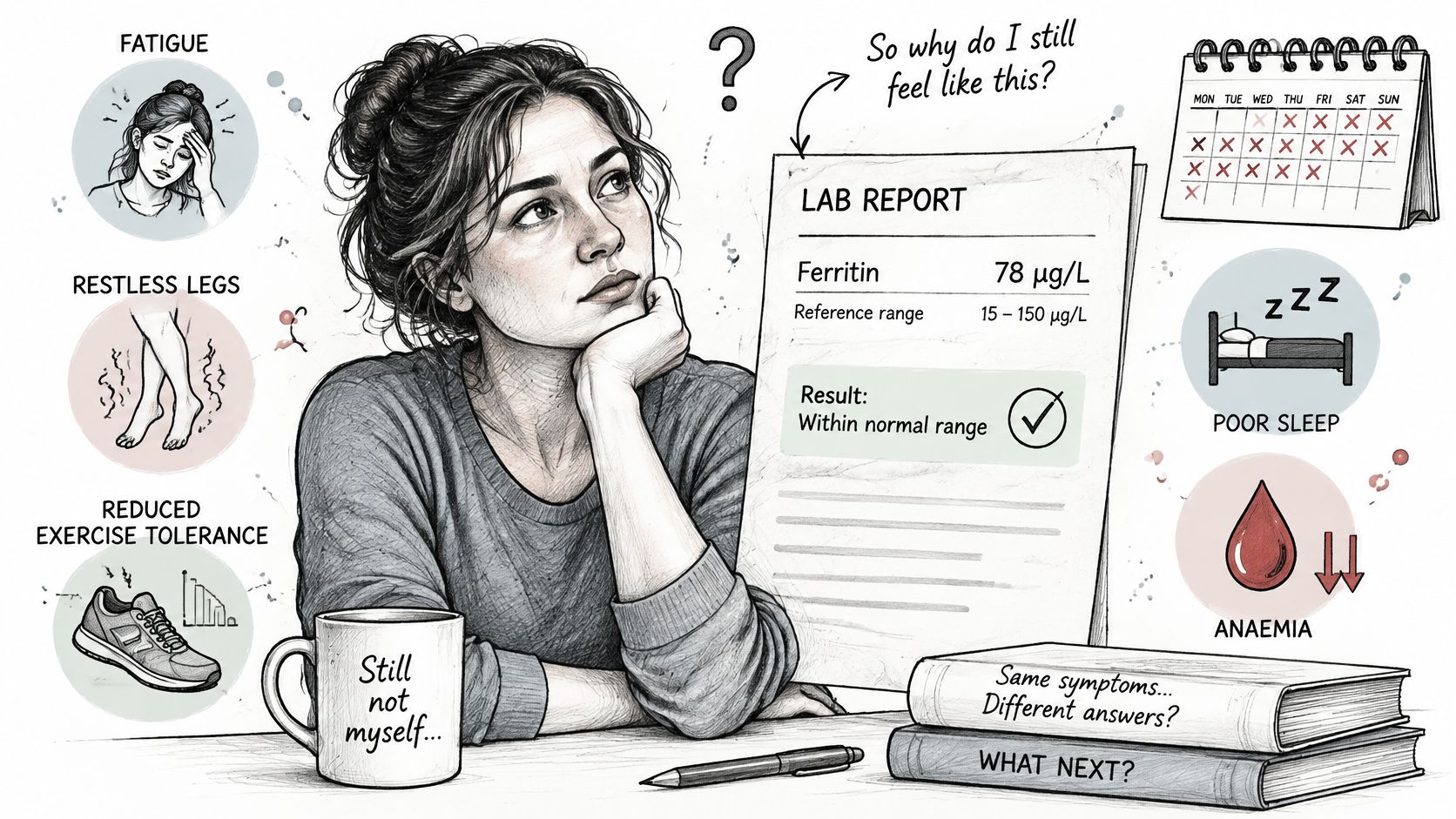
Your ferritin sits inside the reference interval, but you're still fatigued, your legs feel restless, or exercise has become unusually difficult. Does that result settle the question? Not necessarily, especially if inflammation or an abnormal blood count is present.
Ferritin is an acute-phase reactant, meaning its concentration can rise during an inflammatory response. The Royal College of Pathologists of Australasia iron-studies guidance notes that ferritin can remain apparently normal, potentially up to 100 µg/L, when iron deficiency coexists with infection or inflammation.
A report can therefore look reassuring without fully explaining what's happening.
The inflammatory grey zone
The same RCPA guidance states that adult ferritin below 30 µg/L generally indicates deficiency, while 30–100 µg/L may still represent deficiency when inflammatory disease is present. It also identifies TSAT below 20% as helpful evidence of low iron availability, including functional iron deficiency.
Those are context-dependent interpretation anchors, not a reason to collapse every ferritin result into a single rule. The anaemic-adult diagnostic bands and the inflammatory grey zone address different clinical circumstances.
With functional iron deficiency, iron stores may appear normal or high, but iron isn't adequately available to tissues. A person can also have inflammation and depleted stores at the same time, making the pattern less tidy than a simple low-or-normal classification.
This issue is particularly relevant for people with obesity, fatty-liver disease, chronic kidney disease, autoimmune disease or infection. Recent intense exercise and liver disease can also complicate ferritin interpretation.
What a clinician may add
The useful next step is to resolve the uncertainty, not automatically order every available test.
- Full blood examination and red-cell indices: These establish whether anaemia or changes in red-cell characteristics accompany the symptoms.
- C-reactive protein: CRP adds evidence about an inflammatory response that may be influencing ferritin.
- Transferrin saturation: This helps assess whether iron is available despite apparently adequate storage.
- Soluble transferrin receptor: A clinician may use this selectively when the distinction remains unclear and the answer could change management.
A normal flag isn't an all-clear: Persistent symptoms or an unexplained abnormal blood count deserve clinical review, even when ferritin hasn't been flagged.
The reverse is important too: fatigue doesn't prove iron deficiency. If the complete pattern doesn't support iron lack, your GP should consider other explanations rather than escalating iron supplements until a number changes.
Result Patterns and the Next Step
The same symptom can point to different questions. These hypothetical examples show how ferritin, transferrin saturation (TSAT) and the blood count work together; they are not treatment recommendations.
- A tired adult with low haemoglobin, ferritin of 10 µg/L and low TSAT: The pattern supports iron-deficiency anaemia. The next question is what caused the depletion, such as blood loss, low intake or impaired absorption.
- A premenopausal woman with heavy periods, ferritin of 22 µg/L and a borderline blood count: Iron deficiency is possible. Review the full blood-count findings and bleeding history rather than assuming menstruation explains everything.
- A man with obesity, ferritin of 450 µg/L and TSAT of 25%: Raised ferritin without raised TSAT calls for investigation of possible causes, including metabolic health, liver disease, alcohol use and inflammation.
- An adult with a family history of haemochromatosis, fasting TSAT of 52% and ferritin of 380 µg/L: The combined pattern warrants assessment for iron overload. A clinician can consider whether the abnormalities persist and whether hereditary or secondary causes fit.
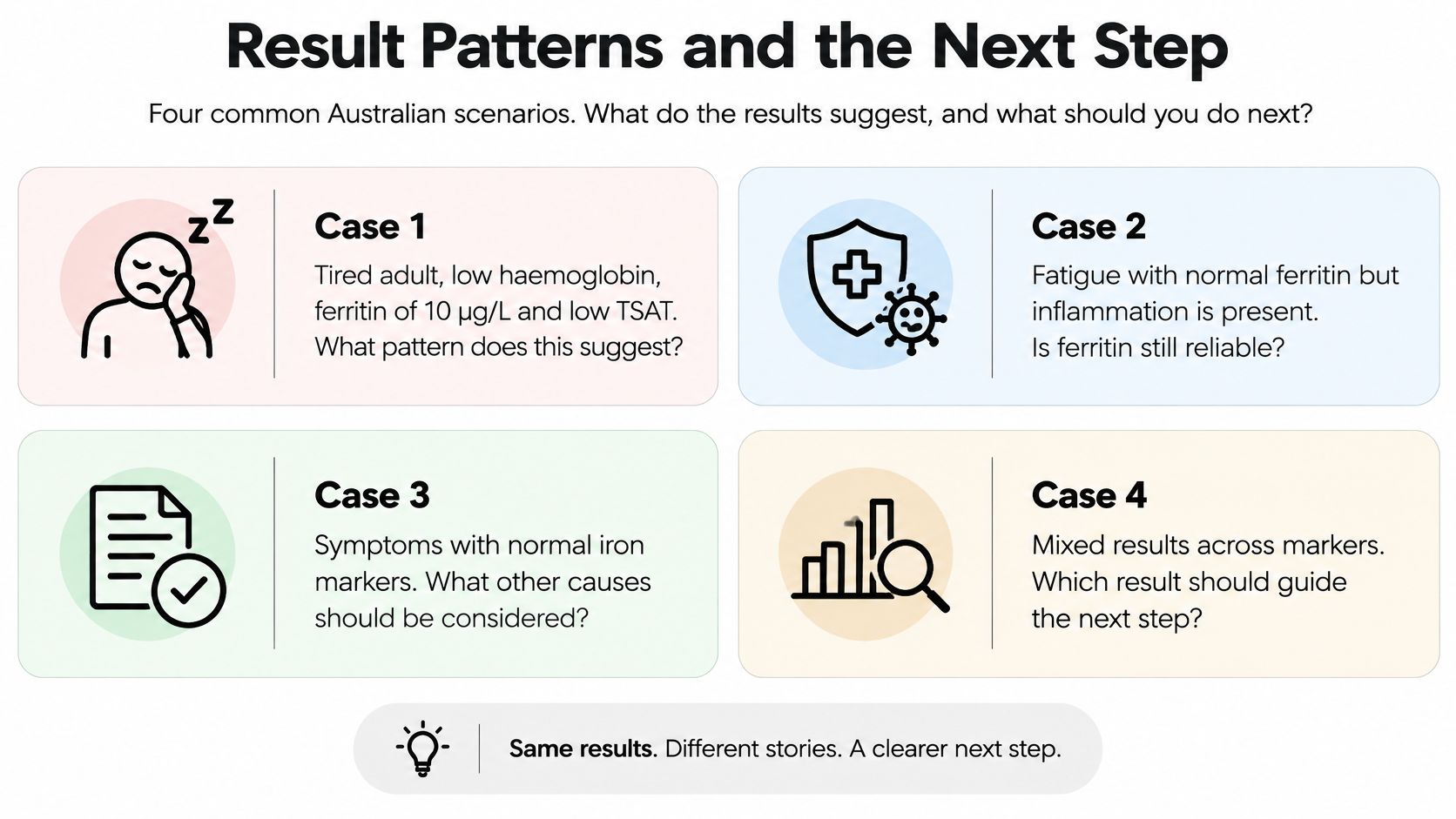
Choose the next step from the pattern
Only about 10% of high-ferritin cases are attributable to iron overload, according to RACGP guidance on elevated serum ferritin. Alcohol use, obesity, metabolic syndrome, diabetes, liver disease, infection, inflammation and malignancy can also raise ferritin.
A high result still needs an explanation. The pattern guides investigation; it does not establish a diagnosis on its own.
Pattern-to-next-step guide for iron studies
| Pattern | Ferritin | TSAT | Next step |
|---|---|---|---|
| Deficiency pattern | Low for the relevant adult clinical context | Low | Review the cause clinically before long-term iron use |
| High ferritin, TSAT not raised | Above the relevant sex and menopausal-status threshold | Not raised | Assess inflammatory, liver, alcohol, metabolic and possible malignancy causes; don't start iron on this result |
| Raised TSAT | Any level | Above the fasting-morning screening threshold | Clinical assessment for overload, especially with family history |
The RCPA ferritin guidance notes that isolated raised TSAT can be an early indicator of iron overload. A modest ferritin should not dismiss persistently raised saturation.
If you take oral iron, ask your clinician whether to withhold it before repeat testing and, if so, for how long.
Investigate the cause before choosing treatment
For a deficiency pattern, discuss why iron may be low and how recovery will be monitored. Menstrual bleeding, other blood loss, food intake and absorption can call for different investigations.
With raised ferritin, taking iron for tiredness may be inappropriate. If TSAT is raised, family history and repeat results can help guide further assessment, including whether genetic investigation is warranted.
If iron markers do not explain persistent symptoms, your clinician may consider other nutritional or medical causes. The guide to low zinc levels covers a separate deficiency question. Similar symptoms alone do not justify taking supplements without assessing the cause.
This video can support a discussion about results, but it does not replace individual interpretation.
A self-ordered result still needs clinical review
A test result is not a diagnosis. Take the complete report, your supplement list and relevant family history to the clinician reviewing it.
Vital iQ Health offers online private blood-test ordering without a GP referral or a separate GP visit. After ordering, you attend a nearby NATA-accredited pathology collection centre. Results from NATA-accredited laboratories are delivered directly to you within 24 to 72 hours.
Before ordering, check that your selected tests include the markers needed to address your question. Then agree on a follow-up plan with a clinician rather than changing treatment based on a flagged result alone.
Vital iQ Health offers private blood testing across Australia, with online ordering and collection at local NATA-accredited pathology centres. Visit Vital iQ Health to review testing options for iron status, check which markers are included and arrange results to discuss with your clinician.