Cortisol Testing Australia: Tests, Timing and Limits
Cortisol testing Australia explained: blood, saliva and urine options, collection timing, and why one result cannot diagnose stress or Cushing's.
The usual advice is to “check your cortisol” when you feel tired, wired at night, or burnt out, as if one blood result were a stress score. That advice treats the hormone as the test. In Australia, the specimen and the clock are the test. A number drawn at the wrong time, into the wrong tube, answers a question you did not ask. More cortisol testing is not automatically better. The right first step is to name the clinical question, then match it to a timed sample.
Cortisol Tests Used in Australia
Six tests cover almost every cortisol question asked in Australia. Each holds a different variable steady: the specimen, the hour of collection, or the full day. Read the table row by row, because the interval printed beside a result only applies to the test in that row.
| Test | Best question | Collection window | Indicative interval | What it cannot do |
|---|---|---|---|---|
| Early-morning serum cortisol | Possible adrenal insufficiency | Within about 1 hour of waking, often before 9 am | Morning peak 200–650 nmol/L; below 200 suggests insufficiency, above 500 generally excludes it | Serve as an untimed check or a stress score |
| Evening serum cortisol | Whether the daily fall has occurred | Around 20:00 | Trough under 50% of the morning peak | Diagnose Cushing's by itself |
| Late-night salivary cortisol | Failure of the overnight fall in suspected Cushing's | 23:00–24:00, following the lab protocol | One service 0–9 nmol/L; one WA lab below 3.0 nmol/L at night, morning 3.0–20.0 nmol/L | Score everyday stress, burnout or recovery |
| 24-hour urinary free cortisol | Total free cortisol produced across a day | Complete 24-hour urine collection | One published interval 0–250 nmol/L, method-specific | Prove anything if the collection is incomplete |
| 1 mg overnight dexamethasone suppression | Whether cortisol can be suppressed | Dexamethasone at night, then morning blood cortisol | Screening result against the performing laboratory's cut-off | Give a definitive diagnosis; abnormal results need specialist confirmation |
| Random serum cortisol | Suspected adrenal crisis or initial pituitary screen | Urgent or untimed sample | Interpret only with the clinical emergency | Assess routine fatigue or wellness |
Read the row before you read the number. The Royal Australian College of General Practitioners names three initial tests for suspected Cushing's syndrome: late-night salivary cortisol, 24-hour urinary free cortisol and the 1 mg overnight dexamethasone suppression test. Yet the Australian review of 272 patients it cites found that 214 people (78.7%, 95% confidence interval 73.2% to 83.3%) were first tested with serum cortisol alone. A routine serum result does not show whether cortisol fails to fall overnight, or whether production across the day is inappropriate.
Why the row beats any single number
Each row exists because no single specimen answers every question. Saliva captures the late-night level, urine totals free cortisol across a day, and the dexamethasone protocol asks whether a small night-time dose can switch production down. That last test is a screen rather than a diagnosis. An abnormal result calls for specialist assessment and a confirmatory investigation.
Intervals deserve the same caution. One Australian pathology specification sets a late-night salivary interval of 0–9 nmol/L at 23:00–24:00 and a 24-hour urinary interval of 0–250 nmol/L, both method-specific and valid only for the laboratory that validated them, as set out in this RACGP review of Cushing's detection. A different assay can print a different cut-off on the same report.
Random daytime serum has a narrow job: suspected adrenal crisis, or a first screen for pituitary insufficiency. It answers whether any cortisol is circulating right now and nothing more. If fatigue is the problem, iron, thyroid and glucose often explain more than an untimed cortisol, which is why some adults start with a private blood panel ordered online, no GP referral or GP visit needed, and add a timed cortisol once the question is clear.
One timed sample, chosen for one question, beats three untimed ones. The interval means nothing until the row is right.
Match the Test to the Clinical Question
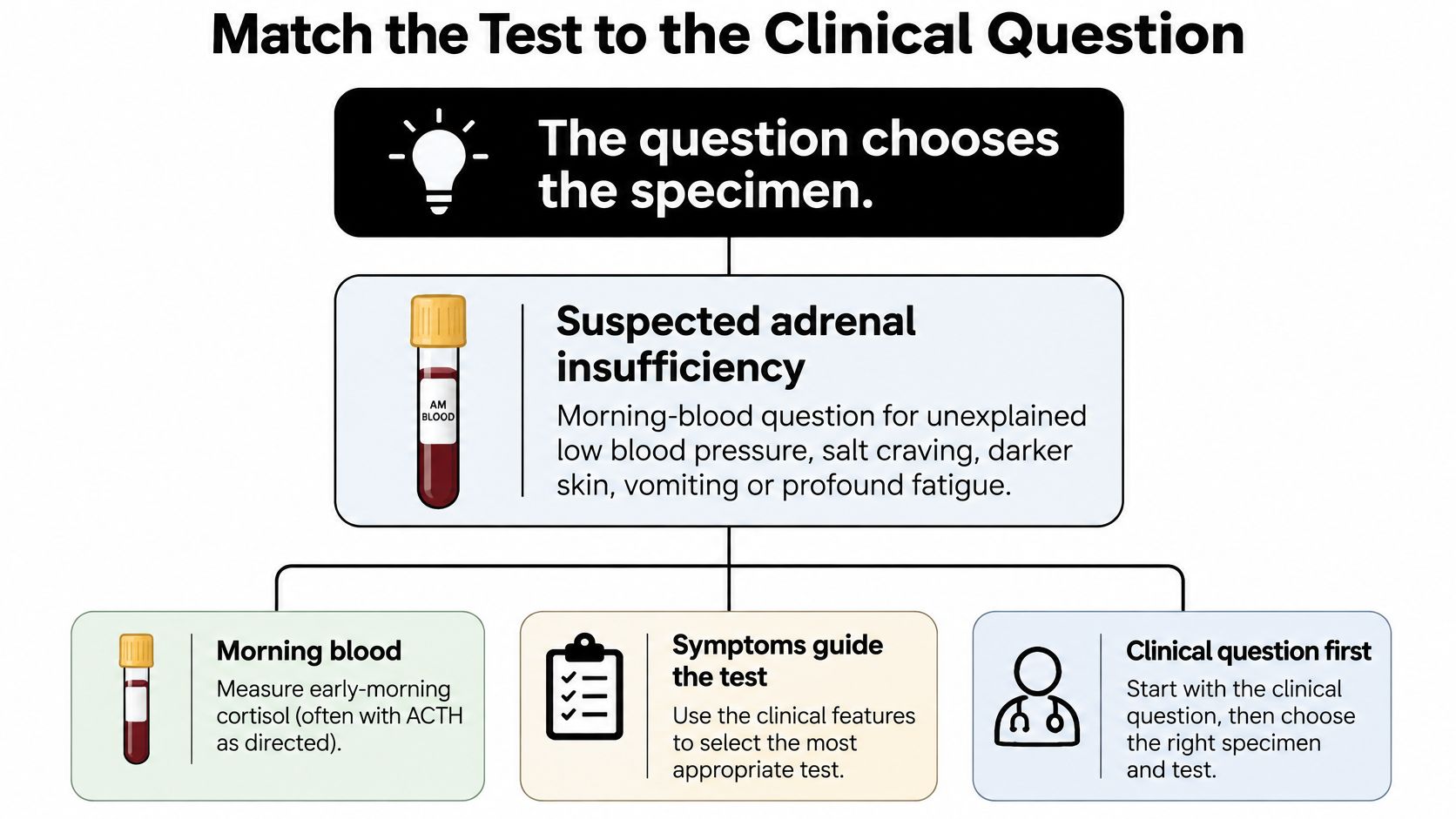
Think of three different questions you might ask a household power bill. “Was the meter running at 8 am?” is not “How much power did we use all day?” and neither is “Does the safety switch trip when we test it?” Cortisol works the same way. The question chooses the specimen.
Three symptom clusters, three test families
Possible adrenal insufficiency is a morning-blood question. The cluster is unexplained low blood pressure, salt craving, darker skin, vomiting, or weakness that is out of proportion to a busy week. Ordinary end-of-day tiredness is not that cluster. An early sample, close to waking, is the measurement that can be compared with decision thresholds. Feeling flat after school pickup is not a reason to label the adrenals as failed.
Suspected Cushing's syndrome is a failure-to-switch-off question. Easy bruising, wide purple stretch marks, new muscle weakness and a change in fat distribution raise that possibility. Late-night saliva asks whether the level is still up when it should be down. A complete urine collection adds free cortisol across 24 hours. Overnight dexamethasone asks whether a 1 mg dose can suppress the morning result. A daytime blood draw, taken while you are awake and stressed about the needle, is the weakest of the three for this question.
A screening abnormality is a referral, not a label. No single test diagnoses Cushing's disease. Blood hormone measurement, urine, late-night saliva and overnight suppression can all become relevant later, once a clinician is confirming or excluding the condition. ACTH sits beside cortisol when someone is separating a pituitary driver from a primary adrenal one. It is not a starter test for feeling stressed.
Practical rule: Write the question in one sentence before you book the sample. If you cannot name it, you are not ready to interpret the PDF.
Preventative or hormone panels can supply a timed measurement to discuss with a clinician. They do not replace urgent care. Collapse, vomiting in someone with known adrenal disease, or rapidly worsening features of cortisol excess belong in conventional medical assessment, not a self-directed panel. Name the question, then book only the family of test that can answer it.
How to Collect a Valid Cortisol Sample
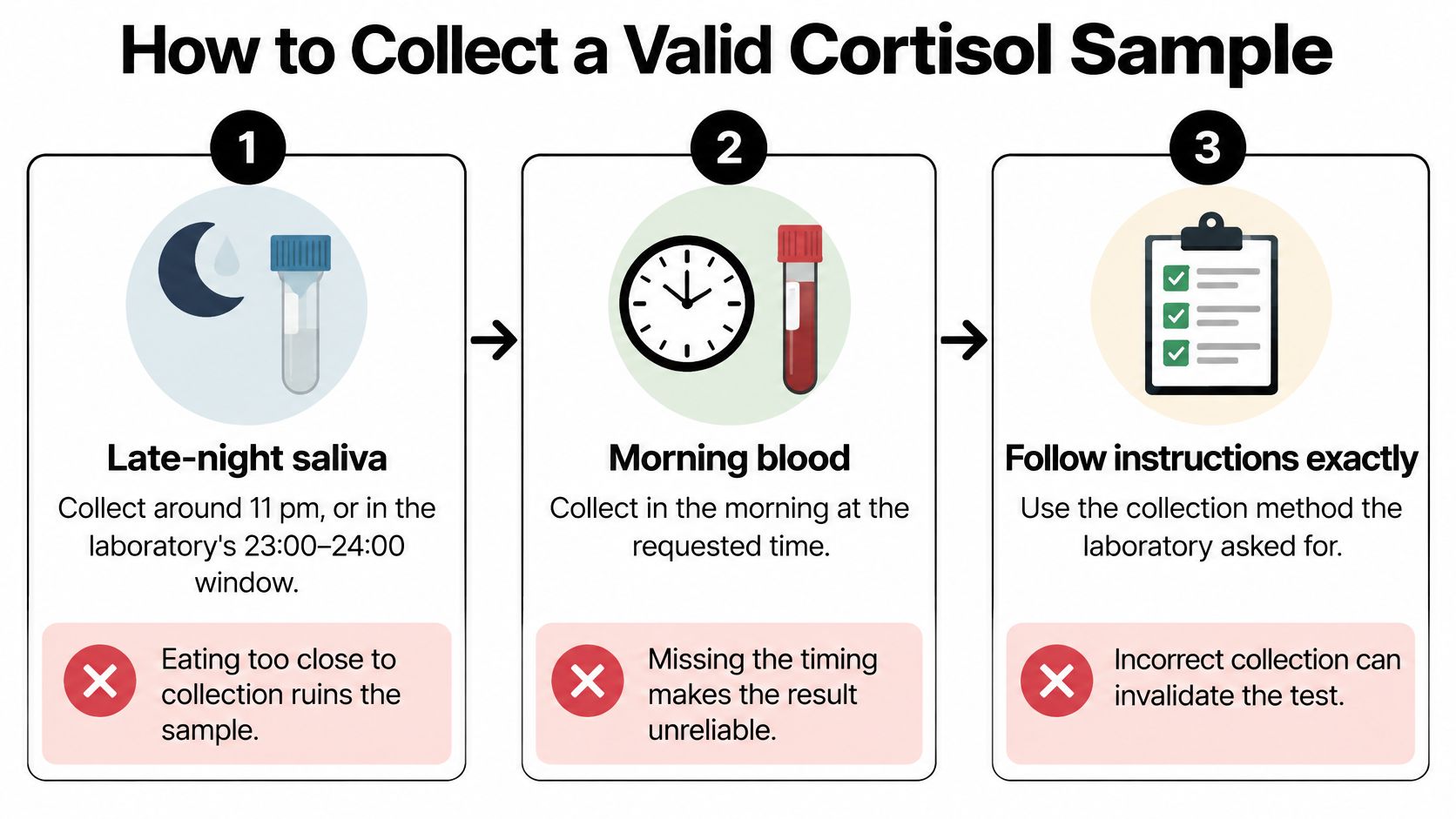
A perfect assay cannot rescue a spoiled sample. Saliva is convenient, and convenience is why people treat it as a wellness marker. Australian pathology practice does not. The Royal Melbourne Hospital pathology handbook places midnight salivary cortisol with overnight dexamethasone suppression and 24-hour urinary free cortisol as investigations for suspected Cushing's syndrome, not as a score for everyday fatigue. The same instructions set collection around 11:00 pm, before brushing teeth, and at least 30 minutes after eating or drinking. One laboratory runs salivary cortisol only twice weekly, so turnaround is not the same as a routine blood test.
Late-night saliva
- Collect around 11 pm, or inside the laboratory's 23:00–24:00 window. A late bedtime does not let you slide the swab to 1 am and still call it a midnight sample.
- Wait at least 30 minutes after eating or drinking. Food or drink in that window is the slip that ruins the swab, because residue changes what the assay measures.
- Do not brush beforehand, and do not collect if your gums are bleeding. Oral blood is contamination, not “a stronger sample”.
- Use the swab kit as printed and write the true clock time, not the time you meant to collect.
- Plan for a slower run. Twice-weekly testing means a Friday swab may sit until the next batch.
Shift work, a missed night, steroid cream, an asthma inhaler, or one isolated abnormal swab are reasons to repeat under instruction. They are not a self-diagnosis. One Western Australian laboratory quotes a late-night reference below 3.0 nmol/L and a morning interval of 3.0–20.0 nmol/L. The same figure can sit inside one window and outside the other. For shift workers, “night” means the biological night you are asking about, not the calendar date on the form.
A short walk-through of why timing changes the meaning of a cortisol result is worth watching before you book a kit.
Twenty-four-hour urine
- Empty your bladder on waking and discard that void. Write the start time. Keeping that first sample is the error that wrecks the clock, because the collection then covers the wrong 24 hours.
- Collect every void until the same time next morning, including the finishing void.
- Store the container as the laboratory directs, usually cool and capped.
- Record any missed void. An incomplete day underestimates production, and the report will not show the toilet you forgot.
Dexamethasone suppression
- Take the prescribed 1 mg dose at the stated night-time. Taking it with breakfast misses the point of an overnight test.
- Attend for the morning blood cortisol on time.
- List steroid tablets, creams and inhalers, and say so if you forgot the tablet or vomited it.
Acute stress, broken sleep and a hard training session can move the result as well. Follow the kit, then let a clinician decide whether the sample is usable.
Reading a Cortisol Number Correctly
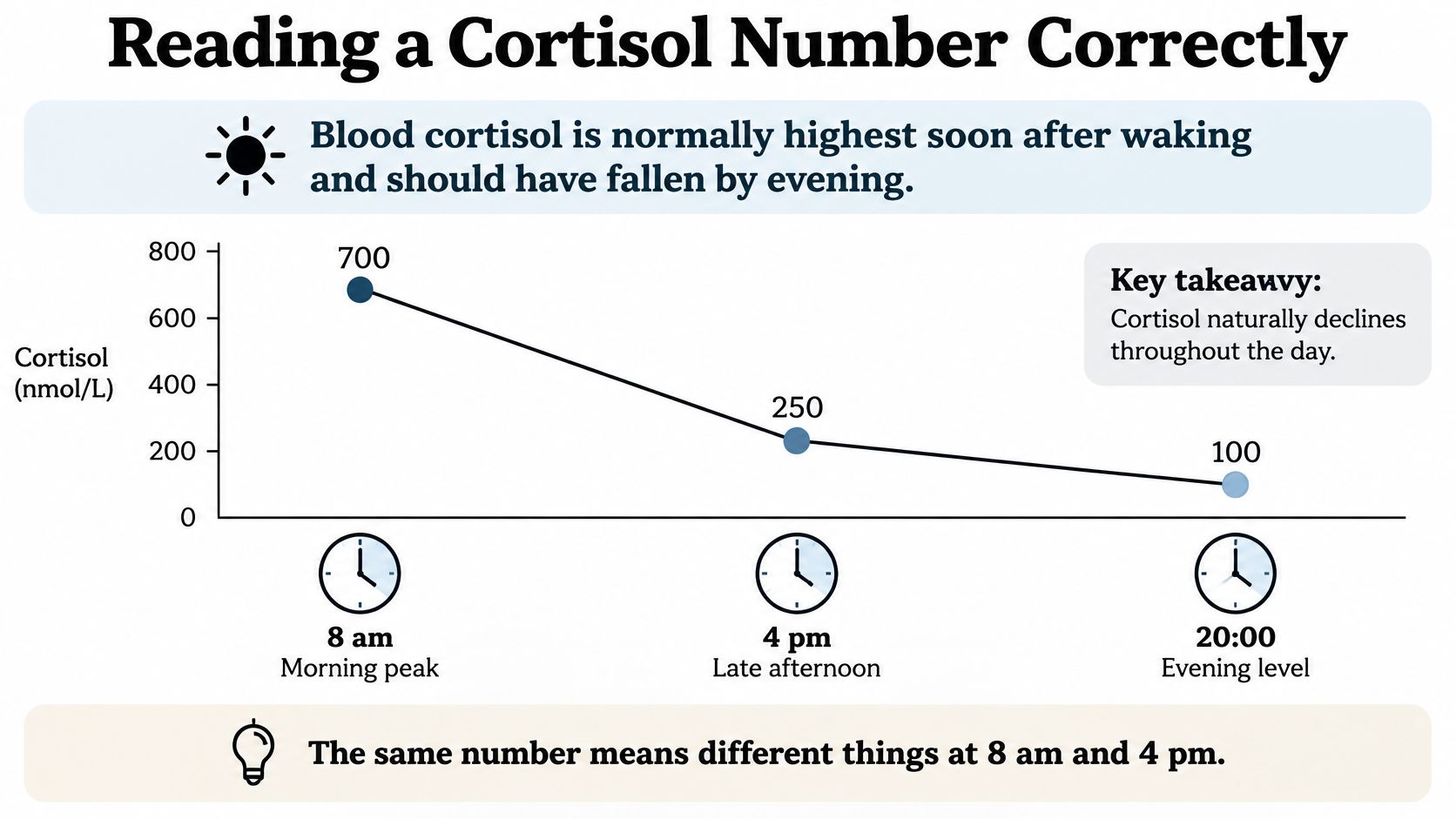
Say a result of 400 nmol/L comes back from an 8 am draw. It sits comfortably in the expected morning range. Now place the same figure on a tube collected at 8 pm and it reads as abnormal, because cortisol should have fallen well below the morning level by then. The clock time printed on the tube is part of the result, and an afternoon draw compared against a morning reference interval can make a healthy gland look sick or a sick one look fine.
Decision bands, not a universal cut-off
The Royal College of Pathologists of Australasia lists an indicative morning peak of 200–650 nmol/L and expects the 20:00 trough to be less than 50% of that morning peak. For suspected adrenal insufficiency, the informative sample is an early-morning plasma cortisol drawn within about an hour of waking. Australian Prescriber thresholds, quoted in that same manual, treat a value below 200 nmol/L as strongly suggesting insufficiency and a value above 500 nmol/L as generally excluding it, sometimes sparing the patient an ACTH stimulation test.
The middle band is where readings go wrong. A morning result between 200 and 500 nmol/L is undecided, and the answer to it is a short Synacthen test, with a baseline cortisol and a stimulated level at 30 and/or 60 minutes. A second random draw on a different afternoon adds nothing.
These bands are decision aids, and the number that lands inside them is easier to move than expected. Oral oestrogen raises cortisol-binding proteins, so total cortisol reads higher without any extra active hormone. Corticosteroid tablets, creams and inhalers can suppress the axis or interfere with the assay. Acute illness, pregnancy, shift work and a hard training session push the result around as well. The request form should carry the clock time and the medicine list, and a borderline result belongs in review alongside ACTH and a dynamic test.
Random cortisol has a narrow job: suspected adrenal crisis, or an initial look for pituitary insufficiency. Fatigue is not on that list.
Why a nonspecific test creates false alarms
Cushing's disease is uncommon, and that rarity is exactly why a test aimed at it misbehaves as a general screen. The Australian Pituitary Foundation estimates about 41 new diagnoses a year, roughly 0.16 per 100,000 Australians, and about 300 to 1,600 people living with it, roughly 1.2 to 6.4 per 100,000. When the disease is that rare, screening a large group of tired adults produces more false alarms than true cases even when the test itself performs reasonably.
The misses run in both directions. Some newly presenting cases still return a normal 24-hour urinary free cortisol, and dexamethasone suppression can be falsely positive or falsely negative. The Foundation states that no single test is 100% capable of diagnosing Cushing's disease, which is why the relevant investigations come as a set: blood hormone measurements, 24-hour urinary free cortisol, late-night or midnight salivary cortisol, and overnight dexamethasone suppression. One normal urine collection does not close the question, and one abnormal result does not open it.
Adrenal fatigue is not an established diagnosis. An abnormal cortisol on its own is neither Cushing's syndrome nor adrenal failure. It is a prompt to check whether the sample, the timing and the question still match.
A cortisol result is strongest when it is read against a named clinical question, the symptoms in front of you, and the medicines that can move the number.
Three outcomes worth leaving with
Reassuring and properly timed. A morning value above the exclusion threshold, in the right clinical setting, can make adrenal insufficiency unlikely and spare you a stimulation test. That is a clinical judgement rather than a certificate of low stress.
Indeterminate. The middle morning band calls for a stimulation test. Repeating an untimed blood draw, or ordering a four-point saliva profile out of frustration, leaves the same question unanswered.
Abnormal screen. A late-night saliva, urine or dexamethasone result outside the performing laboratory's range belongs with an endocrinologist, and the laboratory's own reference interval should go to that appointment with you. Averaging it against a number found online only blurs the signal.
Every order should name the collection time and the relevant medicines. When the story and the number disagree, the better test wins over the repeated poor one.
Three Australian Testing Situations
The 3 pm burnout draw. Say a 44-year-old office worker books a random afternoon blood cortisol after months of late nights and gets a result below the morning reference interval. That tube was never a morning sample, so it neither proves adrenal failure nor measures psychological stress. If insufficiency is suspected, the next action is an early-morning cortisol, collected close to waking. A four-point “stress profile” does not repair an untimed blood test.
Medians are not a pass mark. A woman aged 40–49 and a man of the same age can sit near published member medians and still need a clinical reading. In a 2024–2026 Australian member set, Vively reported a median morning blood cortisol of 311 nmol/L for women aged 40–49 and 318 nmol/L for men aged 40–49, from 1,721 members. Those figures describe people who were tested. They are not a healthy target, and they are not a pathology reference interval. Being near them is not a pass. If you are weighing a wider private screen, a full body checkup cost is a separate decision from whether this cortisol was drawn at the right hour.
The late swab after dinner and toothpaste. A shift worker collects saliva after a late meal and tooth-brushing and sees a high late-night value. Treat that as an invalid screen. The next action is a repeat on a comparable biological night, with the fasting and no-brushing rules kept, or a move to urine or dexamethasone testing if features of Cushing's are present. Do not stack a second kit the same week “to be sure” while still brushing first.
One more mismatch sits beside these. A nurse on oral oestrogen can have a high morning total cortisol because binding proteins have risen, not because the adrenal glands are overproducing. The next action is interpretation in that context, not a label of hormone excess. In every case the useful move is one of three: a retimed sample, a dynamic test, or specialist review. None of the stories above is a diagnosis.
Choose a Timed Test and a Clinician Review
If your question is a timed screening measurement you can discuss later, order that specific test and attend a NATA-accredited collection centre with the clock time and your medicines written down. We arrange private blood tests across Australia without a prior GP referral. You visit a NATA-accredited collection centre near you, and results are generally back within 24–72 hours for a telehealth or usual-GP discussion. That path suits preventative hormone or metabolic monitoring.
It does not suit suspected adrenal crisis, pregnancy with severe vomiting and dizziness, or obvious Cushing's features. Those belong with urgent or specialist care.
Take the laboratory's own reference interval to the appointment. Ask whether an abnormal screen needs Synacthen testing or endocrinology, and avoid repeating random cortisol while you wait. An isolated number still needs symptoms and medicines beside it. A partnered explanation is useful for that reason, not because another PDF will change the physiology.
A private four-point salivary cortisol profile was listed at AUD 108 in 2024 by OptiLabs Australia, with results advertised within 3–5 business days after the laboratory received the samples. Confirm current pricing, and whether a clinician request is required, before you book any kit.
Name the question, book the matching timed sample, and decide who will interpret it before you treat the report as a diagnosis.
Vital iQ Health provides private blood testing across Australia, including hormone-related blood tests you can order online and collect at a NATA-accredited centre, so a timed cortisol request can sit inside a preventative check rather than a vague stress score. Results are aimed at a clinician conversation, not a self-made diagnosis. If you want to arrange testing and plan that review, visit Vital iQ Health.