Full Body Checkup Cost in Australia: What Drives the Price
Full body checkup cost in Australia varies by billing, consult length, panel scope and repeat tests. Learn each cost part and how to get a clear quote.

There is no single national price for a full body checkup in Australia. Budget for the private panel fee, plus any consultation fee and collection charges, minus any Medicare rebate you're confirmed to receive.
The counterintuitive part is that a larger panel isn't automatically better value. The advertised price may cover tests alone, while the clinically useful pathway can also involve a GP consultation, sample collection, results review and follow-up testing. To compare the full body checkup cost, add up the services you'll really pay for, then consider whether each test could change what happens next.
Why There Is No Single Full Body Checkup Price
No single Medicare item covers a full body checkup, so no single national price exists for one. What providers sell under that label is a bundle of separately billed services, and each line follows its own rules. An advertised panel price works like a car's base price before on-road costs: the figure that reaches your account includes charges the sticker never mentions.
A practical budgeting formula is:
Private panel fee + consultation fee + collection or administration charges − eligible Medicare rebate = estimated out-of-pocket total.
Take a worked example. A private panel costs $300, and you book a GP consultation of 20 minutes or more around it. The Medicare Benefits Schedule sets a schedule fee for a consultation of that length, and that schedule fee differs from both the provider's actual charge and your final contribution. If the visit is privately billed, what you pay depends on the provider's own fee and any Medicare benefit that applies. If the panel was ordered without a referral and isn't eligible for a benefit, don't subtract a rebate for it. The $300 remains only one line of the total.
National billing data shows how wide that gap can run. 2024–25 Medicare statistics recorded an average patient contribution of A$83.71 across the reported service mix, alongside a 75.4% national bulk-billing rate. Bulk-billed services are provided at no cost to the patient, yet that average is not a full body checkup price. It blends services operating under different billing rules into one figure.
Before you compare quotes: Ask for the panel fee, consultation fee, collection or administration charges, and any rebate you can expect to receive to be listed separately.
The itemised quote also reveals what each line buys. A consultation fee pays for clinical judgement, a panel fee pays for laboratory work, and a collection charge pays for the draw itself. Comparing two quotes on their headline panel figure misses all of this. The fair comparison is total pathway cost: every service you will pay for, weighed against the decisions those results will inform.
What Is in Your Quote and How to Itemise It
A quote can combine services that follow different billing rules. Use this table to identify what each line covers and what usually drives its cost.
| Component | What it covers | Usually billed as | Main cost driver |
|---|---|---|---|
| GP consultation | History, review and ordering of tests | Medicare schedule fee; $0 if bulk billed | Consult length and provider billing policy |
| Pathology (blood tests) | Laboratory tests with a clinical reason | Medicare benefit if eligible | Referral and clinical indication |
| Private panel fee | Ready-made panel or custom test selection | Private, set by provider | Number and type of biomarkers |
| Collection or administration charge | Sample collection and paperwork | Private, itemised | Collection site and provider policy |
| Telehealth or clinician review | Explaining results and next steps | Private | Whether it's included in the quote |
| Repeat or follow-up tests | Confirming borderline or unclear results | Private, or Medicare if eligible | Result pattern and referral needs |
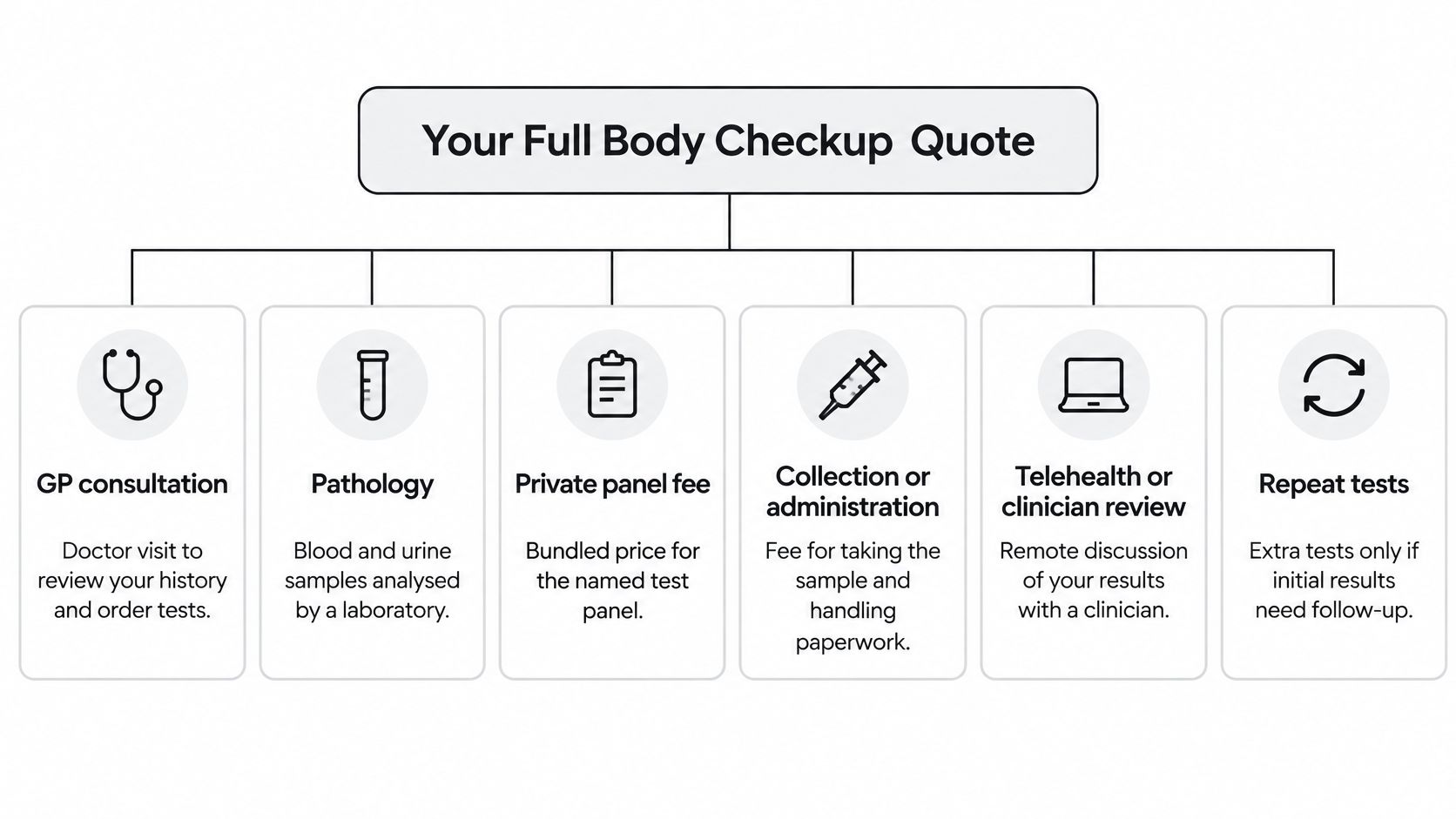
Medicare doesn't define a “full body checkup” as one product. It distinguishes between medically indicated testing and screening for a person without symptoms. A GP-led pathway may combine a consultation, clinically indicated pathology and interpretation, while a private panel may bundle tests, administration and result delivery into a single fee. Medicare benefits vary by item. Eligible out-of-hospital services may attract a benefit, and bulk-billed services carry no patient charge, but a schedule fee alone doesn't tell you what the provider will charge or which rebate applies.
Two people can receive the same quote and end with different net costs. The Medicare Benefits Schedule consultation examples show how the schedule fee for a GP visit changes with consult length in 2025–26, and the Extended Medicare Safety Net may reimburse part of eligible out-of-pocket costs for eligible out-of-hospital services after a patient or family reaches the applicable annual threshold. Neither figure is a package price. Each applies to a single line, which is why the itemised total matters more than the headline panel fee.
Work through these steps before paying:
- Name the question. Write down the symptoms, medicines, family history or health concern the checkup should address. Each proposed test earns its place only if its result could change what happens next.
- Request a test-by-test list. Ask for each test's fee and whether it's eligible for a Medicare benefit. Medicare doesn't automatically subsidise every test in a privately arranged package.
- Clarify the review. Confirm whether a GP or telehealth consultation to explain results is included, and whether that appointment will be bulk billed.
- Check collection and handling charges. Ask whether sample collection or administration is charged separately and how the laboratory bills.
- Confirm the referral position. Medicare generally covers eligible pathology when a doctor provides a referral. Vital iQ Health accepts online orders without a GP referral or GP visit, so check which costs are private before ordering.
- Ask about next steps. Find out who will discuss borderline results and what a repeat test or follow-up consultation would cost.
- Calculate the net total. Add the panel, consultation and collection charges, then subtract only the rebates a provider or Medicare has confirmed apply.
A quote broken into components lets you compare pathways rather than sticker prices. A lower panel fee that leaves out result review or collection can cost more overall once the follow-up appointment is added.
How Billing and Consult Length Change the Price
A quote that lists only a panel price is incomplete. The consultation that orders or reviews the tests is billed as a separate item, and its charge depends on two things: whether the practice bulk bills, and how long the appointment runs.
The consultation line can be $0 if bulk billed or include a private gap. The Medicare schedule fee isn't a promise that a privately billed visit will cost that amount, and the provider's gap fee isn't published as one national figure. Ask the practice for its charge before you book.
| Consultation length | Schedule fee (2025–26) | Patient pays if bulk billed | Patient pays if privately billed |
|---|---|---|---|
| Under 20 minutes | A$45.05 | $0 | Provider-set charge, less any applicable Medicare benefit |
| 20 minutes or more | A$87.10 | $0 | Provider-set charge, less any applicable Medicare benefit |
| 40 minutes or more | A$128.35 | $0 | Provider-set charge, less any applicable Medicare benefit |
The length of the appointment can change the schedule fee and the amount the patient may need to contribute. A short visit to discuss one issue and order a targeted test isn't the same service as a longer review of medical history, multiple concerns and several results. Ask which consultation tier the practice expects to book, and ask for the out-of-pocket gap, not just the schedule fee.
That gap matters as much as the panel price when you compare quotes. A longer, privately billed review can add more to the final total than an extra block of biomarkers, which is why two quotes for the same tests can end up far apart.
Bulk billing rates also change over time. The Australian Institute of Health and Welfare reports that 78% of GP attendances were bulk billed in the first 10 months of 2024, down from a peak of 89% in 2020 and 2021, and that the inflation-adjusted average out-of-pocket cost for non-bulk-billed GP attendances was $43, after a peak of $46 between 2018 and 2022 (AIHW data on bulk billing and out-of-pocket costs). These figures describe GP attendances, not the price of a health-check package.
Location can matter too: out-of-pocket costs for non-bulk-billed GP visits can differ between remote and metropolitan areas. Two people booking a similar consultation may not face the same gap.
Before booking: Ask whether the appointment will be bulk billed, what length is planned and what you'll pay if it's privately billed. If you don't need a private consultation for a clinical reason, ask whether a bulk-billed appointment is available.
What Each Panel Covers and Why Scope Varies
“Full body” does not specify a fixed list of tests. A panel's scope can differ by provider and by the reason for testing, and a long marker list tells you what was measured rather than whether every item earns its place in the bill. Vital iQ Health lists 41 pathology panels and lets customers build a custom selection from over 300 individual biomarkers, so the categories below are starting points that each need a quote before prices can be compared.
| Panel | Main markers covered | Typical reader |
|---|---|---|
| Standard Health Panel | Cholesterol, blood glucose, organ function, iron and key health markers | General preventive screening |
| Men's Health Panel | Hormones, heart health, liver function, kidney function and general wellbeing | Men wanting a broad baseline |
| Women's Health Panel | Female hormones, thyroid function, metabolic health and overall wellbeing | Women with hormonal or thyroid questions |
| Hormone Health Panel | Reproductive, adrenal and thyroid hormones | Men and women investigating hormone concerns |
| Thyroid & Metabolic Panel | Thyroid hormones, metabolic markers and adrenal function | Thyroid or metabolic monitoring |
| Vitamins & Mineral Panel | Essential vitamins, minerals and antioxidants | Suspected nutritional deficiency |
| Sports Performance Panel | Organ function, hormones, cardiovascular health and key blood markers | Athletes and fitness participants |

Some panels overlap. A Women's Health Panel and a Hormone Health Panel both include hormone-related testing, and a Thyroid & Metabolic Panel can duplicate thyroid or metabolic markers from either. Where two panels share a core set, the practical question is which extra markers each one adds and whether those additions match your reason for testing. Compare the actual marker lists side by side before ordering more than one panel, or you could pay twice for the same marker.
More markers mean more laboratory items and more results to interpret. A quote should identify the included tests, whether sample collection is billed separately, and whether any clinician review is part of the price. Panel prices vary, so do not assume any particular panel has a fixed price; request a current quote for each one you are considering.
If you build a custom profile from individual biomarkers, start with a specific health question and select only the markers that answer it. Adding tests because they appear on the menu widens the bill and can return results you have no plan to act on.
When a Broader Panel Costs More Without Helping
A longer test list can raise the price without improving the decision you need to make. The useful question isn't how many biomarkers the panel contains, but whether the results could change your care.
Australian Medicare rules distinguish preventive health assessments from screening services. The Medicare Benefits Schedule description of a comprehensive health assessment includes history, examination, intervention or referral, and a preventive management plan. That's a clinical process, not just a large blood-test menu. A GP can use your age, symptoms, medicines, family history and existing conditions to decide which tests are relevant.
Consider a broad panel that returns one borderline result. The next step may be a repeat test, a GP appointment to interpret the result, or further investigation. Each step can carry its own charge, depending on eligibility and the provider's billing arrangement. The headline package with the lowest price may therefore lead to a higher total pathway cost than a narrower order selected to answer a specific clinical question.
| Approach | Typical scope | When it fits | Main cost risk |
|---|---|---|---|
| GP-led risk-based assessment | Tests chosen from age, symptoms, medicines and family history | Clinical reason or chronic monitoring | Consult fee and gap if not bulk billed |
| Single targeted panel | One area, such as thyroid and metabolic markers | A specific, named question | Repeat tests if the result is unclear |
| Standard or sex-specific panel | General screening markers | Baseline check without symptoms | Borderline results prompting extra tests |
| Custom build from 300+ biomarkers | Any combination the reader selects | Reader with a clear question | Fee rises with each added marker |
| Bundled full body package | Panel, review and administration in one headline price | Buyers wanting one price | Non-indicated tests and administration inside the price |
Population screening and personalised monitoring aren't the same pathway. An eligible population screening service may be bulk billed, but eligibility, referral and provider billing still matter; a person monitoring a chronic condition needs a plan matched to that condition and their prior results. A broad private panel doesn't automatically qualify for the same treatment as a clinically indicated test.
Ask this for every marker: Would this result change what I do next? If the answer is no, leave it out of the order unless a clinician gives you a specific reason to include it.
Choose the Scope That Matches Your Question
Choose the test scope by the decision you need to make. If you have no symptoms and want a baseline, start with a standard or sex-specific panel and check whether a GP consultation is needed to assess your circumstances. If you have a specific concern, such as thyroid symptoms, hormone changes or suspected low iron or vitamin levels, a targeted panel can focus the testing on that question.
For a chronic condition, a GP-led risk-based plan is often a more useful starting point than a broad package. It lets the clinician set which markers to monitor and when a repeat test is warranted, rather than ordering repeats automatically. Athletes considering a Sports Performance Panel should review its marker list and decide whether those measurements match their training or health question.
Vital iQ Health customers can order online and attend a NATA-accredited pathology collection centre for sample collection. The business says results are delivered within 24–72 hours. Those service details don't replace a clinician's interpretation: confirm whether a GP review is included and how you'll discuss findings that need follow-up.
Before paying, request one itemised total covering the panel, consultation, collection charge and confirmed Medicare rebates. That figure is more useful than the headline panel price because it shows what the whole pathway is likely to cost.
Vital iQ Health offers private pathology panels and custom blood-test selections, with online ordering that doesn't require a prior GP referral or visit. Compare the test list and request an itemised total before deciding which scope fits your needs, then visit Vital iQ Health to explore its available panels.