Creatinine Blood Test: Normal Range and What eGFR Means
Creatinine blood test explained: normal ranges, how eGFR is calculated, what moves your result, and when a single abnormal reading needs a repeat test.

Commonly quoted adult creatinine reference intervals are 60–110 µmol/L for males and 45–90 µmol/L for females, but the reporting laboratory's interval takes precedence. If your result sits inside that range, does that mean your kidneys are healthy?
Not necessarily. A creatinine blood test measures a waste product in your blood, not kidney health in its entirety. Your clinician needs to consider how much creatinine your body produces, how effectively your kidneys remove it, and whether urine testing shows evidence of kidney damage.
The important question isn't just whether your number is high or low. It's what that number means alongside your eGFR, urine albumin-to-creatinine ratio and previous results.
Creatinine Blood Test Normal Ranges Explained
The Royal Melbourne Hospital's creatinine pathology guidance provides the context for commonly quoted adult intervals of 60–110 µmol/L for males and 45–90 µmol/L for females, although your reporting laboratory's interval should take precedence.
| Group or result | Typical value | What it can mean |
|---|---|---|
| Adult males | 60–110 µmol/L | Commonly quoted interval; the reporting lab's range takes precedence |
| Adult females | 45–90 µmol/L | Commonly quoted interval; the reporting lab's range takes precedence |
| Above range | Higher than the interval | Reduced filtration, dehydration, recent cooked meat or high muscle mass |
| Below range | Lower than the interval | Low muscle mass, which can hide reduced kidney filtration |
The male and female rows are reference intervals, not boundaries separating healthy kidneys from kidney disease. Laboratories may use different analytical methods and calibration, so a result flagged by one laboratory shouldn't be judged against another laboratory's range.
An above-range result needs context. Reduced kidney filtration is one explanation, but greater muscle mass or temporary influences can also contribute, so a flag isn't a diagnosis.
A below-range result isn't automatically reassuring either. Someone with little muscle may produce relatively little creatinine, allowing the blood concentration to remain low even when filtration is reduced.
What the laboratory actually measures
Creatinine comes largely from normal skeletal-muscle metabolism. Think of it as waste entering a collection system: the amount present depends both on how much waste is produced and how effectively it's removed.
For the test, a collector takes blood from a vein, and the laboratory measures the creatinine concentration. Australian reports generally express that concentration in µmol/L.
Don't compare the numerical value on an overseas report with an Australian interval unless the units match. If your report uses a different unit, ask your clinician or laboratory to interpret it rather than treating the numbers as interchangeable.
Practical rule: Use the reference interval printed beside your own result, then look beyond the flag to the rest of the kidney assessment.
Start by checking the test name, units and reference interval on your report. Our guide to interpreting blood test results can help you distinguish the measured value from the laboratory's flag and explanatory comments.
How eGFR Turns Creatinine Into a Kidney Score
Estimated glomerular filtration rate, usually shortened to eGFR, translates a creatinine result into an estimate of kidney filtration. It isn't another substance measured in the blood, and it usually doesn't require another blood sample.
The laboratory puts serum creatinine, age and sex into an equation, commonly CKD-EPI. Creatinine is the gauge reading; eGFR is the converted estimate that makes the reading more clinically useful.
The calculation follows this sequence.
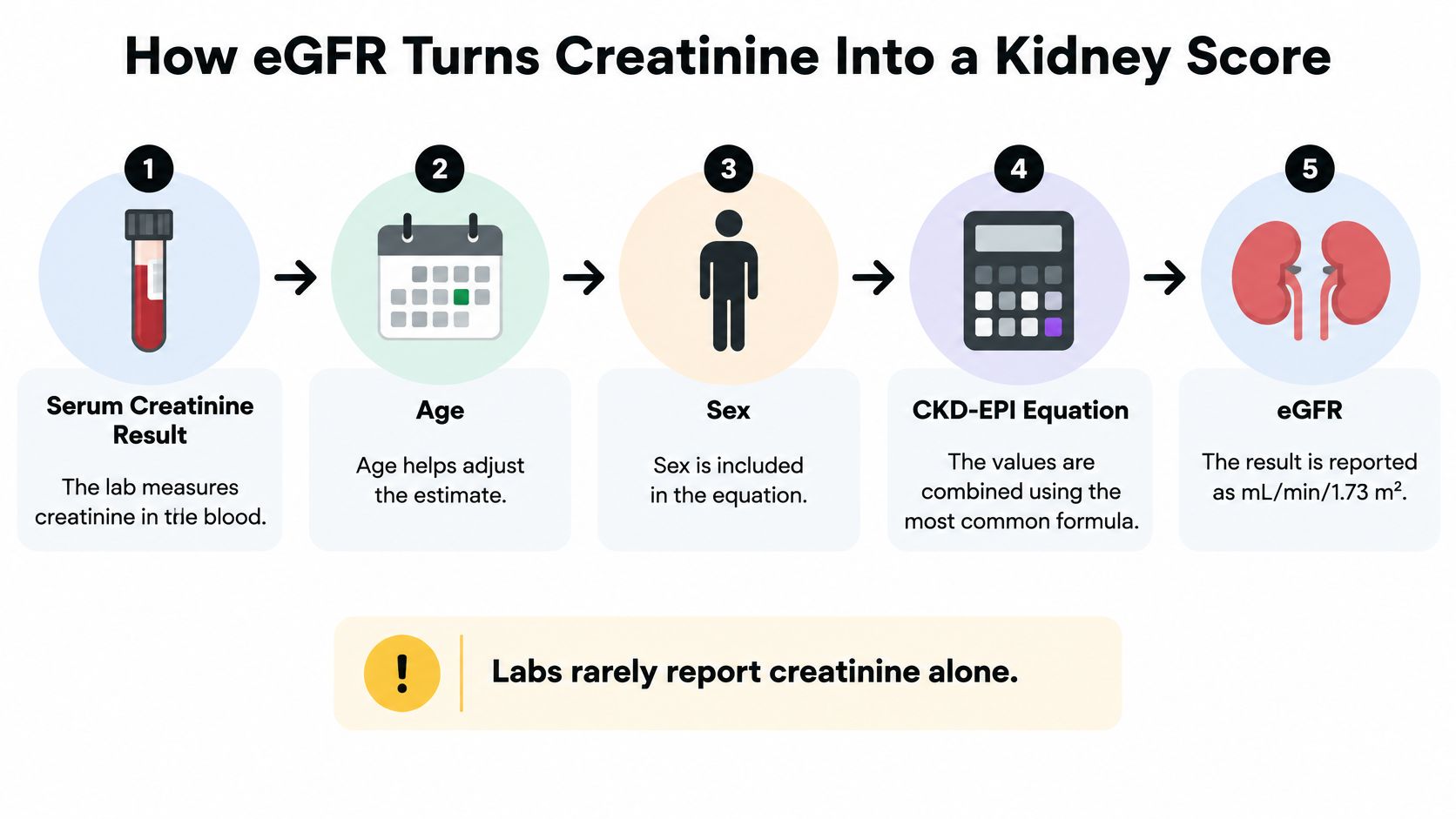
Australian guidance summarised by Healthdirect's chronic kidney disease information describes routine eGFR reporting for adults aged 18 years and older, and identifies persistent eGFR below 60 mL/min/1.73 m² for at least three months as evidence of chronic kidney disease.
The units describe an estimated filtering rate standardised to a body-surface area, rather than the concentration of a waste product. That's why creatinine and eGFR have different units and shouldn't be compared numerically.
Reading the filtration bands
The lower filtration bands help clinicians classify established chronic kidney disease. The upper bands require particular care: a filtration category alone doesn't establish that someone has CKD.
| eGFR (mL/min/1.73 m²) | CKD stage or filtration category | What the band suggests |
|---|---|---|
| 90 and above | G1 | Normal or high filtration; not proof of kidney health on its own |
| 60–89 | G2 | Mild reduction; can be normal in some older adults |
| 45–59 | 3a | Mild to moderate reduction |
| 30–44 | 3b | Moderate reduction |
| 15–29 | 4 | Severe reduction |
| Below 15 | 5 | Consistent with end-stage kidney disease |
A category is not a complete diagnosis. For example, a clinician assessing someone in an upper filtration band still needs to consider evidence of kidney damage before applying a CKD label.
It's also important not to treat eGFR as an exact measurement. The word estimated matters: the equation improves interpretation of creatinine but can't remove every influence affecting the original blood result.
Find the eGFR line on your report and note its category. Then gather earlier reports so your clinician can distinguish a stable pattern from a new change.
A result's direction over time can be more useful than whether today's value has an abnormal flag.
Why Urine Testing Completes the Kidney Picture
A normal-looking blood result can lead people to assume their kidney assessment is complete. That assumption misses a different question: are the kidneys allowing protein to leak into the urine?
Blood and urine samples answer different parts of that question.
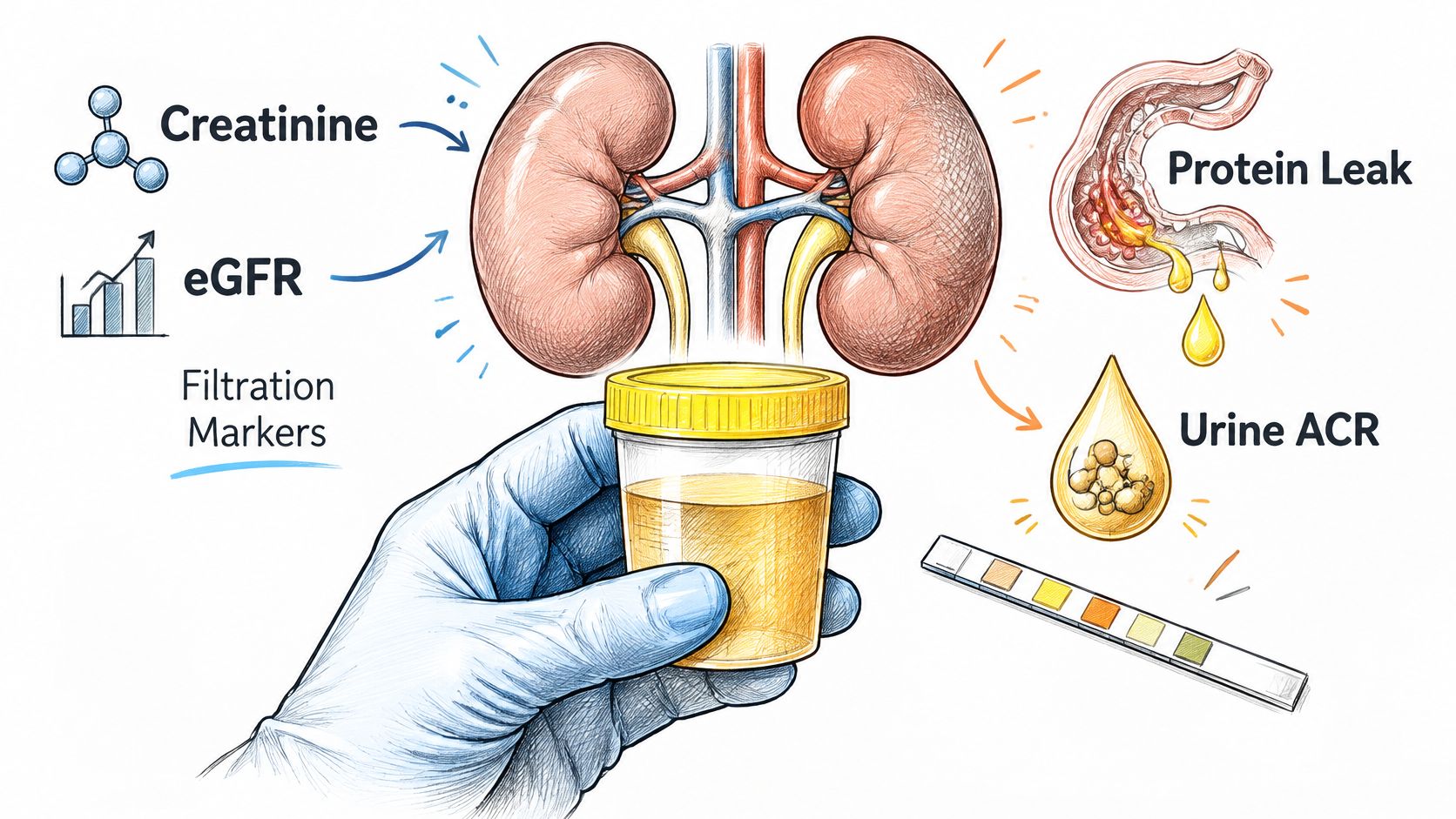
The urine albumin-to-creatinine ratio, or ACR, compares albumin with creatinine in a urine sample. Albumin is a protein, and finding excess albumin in urine can indicate kidney damage even when the blood-based filtration estimate looks reassuring.
Think of a filter that still allows water through at a reasonable rate but no longer holds back everything it should. Creatinine-based filtration estimates describe throughput; urine ACR helps assess leakage.
Why a blood-only check can miss part of the answer
Healthdirect's kidney function test guidance explains why kidney assessment combines blood and urine testing: eGFR above 60 doesn't exclude CKD when urine protein, blood or imaging abnormalities provide evidence of kidney damage.
This matters when ordering preventative tests. A blood marker may answer the specific question you ordered it for without answering every question about kidney health.
Urine ACR also isn't the same test as blood albumin. If you're comparing reports, our explanation of the albumin blood test and low results helps distinguish a blood protein concentration from a urine leakage assessment.
This video offers another way to approach the kidney-testing discussion.
Blood pressure belongs in the same clinical review. Your clinician can interpret it alongside filtration and urine findings rather than treating each result as a separate verdict.
For a fuller discussion, bring or request:
- Serum creatinine with eGFR, to assess estimated filtration.
- Urine ACR, to check for albumin leakage.
- Blood pressure and previous records, to put current findings into context.
Agree with your clinician when these measurements should be repeated. Keeping dated results together makes follow-up more useful than collecting disconnected snapshots.
Why Creatinine Moves and What to Do Next
Creatinine can change for reasons other than established chronic kidney damage. Muscle mass, hydration, recent cooked meat and medicines can all affect how a result should be read.
More muscle can mean greater creatinine production; less muscle can make a blood concentration look deceptively reassuring. Dehydration may raise the reading, while some medicines affect creatinine handling or kidney function.
Mention recent meals, strenuous training, illness and medication changes when discussing an unexpected result. These details help a clinician decide whether a temporary influence is plausible, but they shouldn't become reasons to dismiss an abnormal finding.
Choose between repeat, review and escalate
Kidney Health Australia's eGFR guidance identifies eGFR below 60 mL/min/1.73 m² persisting for more than three months as a chronic kidney disease pattern and cautions that rapidly changing creatinine can make eGFR misleading.
| Result pattern | Likely meaning | Next step |
|---|---|---|
| Single high creatinine | Possible dehydration, recent cooked meat or high muscle mass; reduced filtration also needs consideration | Clinical review and repeat testing under standard conditions |
| Persistently low eGFR meeting the chronicity criterion | Chronic kidney disease, with or without other evidence of damage | GP review and urine ACR testing |
| Rapid rise in creatinine over days | Possible acute kidney injury, where eGFR may mislead | Prompt medical review |
Repeat applies when a clinician considers an isolated result suitable for confirmation. Say your sample followed an unusually strenuous training session and a cooked-meat lunch: explain that timing, then follow the laboratory's preparation instructions for the repeat draw.
Keep your usual hydration rather than deliberately drinking excessive water to influence the result. Don't stop prescribed medicines or supplements without advice.
Review applies when reduced filtration persists. The appointment should establish the likely cause, assess urine findings and blood pressure, and set a monitoring plan rather than attach a stage label.
Escalate applies when creatinine is rising rapidly, particularly if you're passing less urine or developing swelling. Seek prompt medical assessment rather than waiting for a routine private repeat test; if you feel severely unwell, seek urgent care.
Safety point: The chronicity criterion helps distinguish chronic disease. It is not an instruction to wait when a result may reflect an acute problem.
Record the conditions around your next sample
Before repeat testing, write down:
- Food and timing, including your last meal and whether it contained cooked meat.
- Fluid intake and illness, especially vomiting, diarrhoea or difficulty drinking.
- Medicines and supplements, including recent changes and non-prescription products.
- Earlier results, with dates and the corresponding eGFR values.
Ask your clinician to specify the repeat-test timing. The appropriate interval depends on the size of the change, symptoms and your medical history, not merely whether the laboratory printed a flag.
Creatinine Clearance for Medicine Dosing
The kidney estimate used to discuss CKD isn't always the estimate used to choose a medicine dose. Creatinine-based eGFR and Cockcroft–Gault creatinine clearance serve related but different purposes.
Cockcroft–Gault uses age, body weight, sex and serum creatinine. Unlike the standardised eGFR on a routine report, its unnormalised clearance estimate accounts for the individual without expressing the result against a standard body-surface area.
Why the distinction matters
Some medicine-dosing recommendations specify creatinine clearance rather than laboratory eGFR. Substituting one figure for the other can lead to an inappropriate comparison, especially when body size differs substantially from the assumptions behind a standardised result.
This matters for medicines requiring renal dose adjustments, including some antibiotics and anticoagulants. Your prescriber or pharmacist should identify which estimate the particular medicine's dosing guidance requires.
For a dose review, have these details ready:
- Your age and current body weight, rather than an old weight copied from a previous appointment.
- The serum creatinine result, with its collection date.
- Your full medicine list, including dose, frequency and non-prescription products.
Ask whether the dose was assessed using eGFR or creatinine clearance, and whether an unnormalised value is required. Don't adjust the dose yourself because the figures look different; the relevant calculation and the medicine's prescribing guidance need to be considered together.
Decide Which Kidney Test to Order and Review It
Choose testing around the clinical question, not just the name of a familiar marker. A useful result should lead to a clear decision about reassurance, further assessment or monitoring.
Identify what needs checking. A targeted creatinine test may suit a specific follow-up request, while preventative assessment may need urine ACR and blood pressure as well. If you're considering a complete blood panel, check its contents rather than assuming that a broader blood panel includes urine testing.
Confirm what the report will show. Look for serum creatinine, eGFR, units and the laboratory's reference interval. Keep the complete report, including collection dates and laboratory comments, rather than saving only a screenshot of the flagged value.
Prepare consistently. Follow the laboratory's meal and fasting instructions, maintain your usual hydration, and disclose medicines and supplements. Ask specifically about cooked-meat intake and strenuous exercise if either could affect preparation.
Arrange clinical interpretation. Take current and previous results to your GP or clinician so they can consider filtration, urine findings and your health history together. If you're currently unwell, seek assessment rather than using online testing as a substitute.
Agree on follow-up. If the result is abnormal, leave with a repeat-testing or review plan. Know who will review the next report and what symptoms should prompt earlier contact.
Questions to take to your appointment
- Filtration: What does my eGFR mean, and is a CKD stage applicable?
- Urine findings: Is my ACR normal, and does it need repeating?
- Timing: When should I repeat testing or return for review?
- Medicines: Does anything I take need a kidney-dose check?
We offer private blood testing across Australia, with online ordering without a prior GP referral or GP visit and collection at a nearby NATA-accredited collection centre. Visit Vital iQ Health to explore testing options relevant to kidney-function assessment; we deliver results within 24–72 hours so you can take your report to your clinician and agree on the next step.