Fertility Blood Test Guide: What Each Result Tells You
Fertility blood test guide: what AMH, FSH and other hormone tests measure, when to draw them, and why results need clinical context.
Does a fertility blood test tell you whether you can have a baby? Almost everyone carrying a pathology form to a collection centre assumes that's the job it does. The results come back as numbers with a range printed beside them, and it's natural to read them like a scorecard: high or low, reassuring or not.
That assumption is the one to set down before you read your result. A fertility blood test is a panel of hormone measurements taken at a particular hour on a particular day of a cycle that never stops moving. The number is real, but it's a snapshot of a conversation between your brain, your pituitary and your ovaries or testes. It means something different depending on when you drew it, what medication you were taking, how old you are and what question your clinician was asking.
Get that framing right and these tests earn their place in a workup. Get it wrong and people make decisions about IVF, egg freezing or giving up, all from one line on a page.
Fertility Blood Tests and What Each One Measures
A fertility blood test isn't one measurement. It's a small panel of hormones and general health markers, ordered together to answer a specific clinical question, and the question matters more than the panel. Two people can carry identical request forms and need entirely different things from the result.
Here's the lookup most readers want first. Each row names a test, the biology it reflects, the day the draw is worth something, and the limit that keeps the result honest.
Fertility blood tests by what they measure and when to draw them
| Test | What It Measures | Best Timing | What It Cannot Tell You |
|---|---|---|---|
| AMH | Ovarian reserve estimate, the remaining egg supply | Any day of the cycle | Natural conception, time to pregnancy or menopause timing |
| FSH | Pituitary signal driving ovaries or testes | Day 2–3 of the cycle | A cause on its own; needs cycle-day context |
| LH | Trigger signal for ovulation | Day 2–5, or with FSH | Whether ovulation will happen next cycle |
| Oestradiol (E2) | Follicle activity in the ovaries | Day 2–5, with FSH | A reliable reading alone; levels change daily |
| Progesterone | Evidence that ovulation has occurred | About day 21, or 7 days before expected period | Egg quality or pregnancy success |
| TSH and free T4 | Thyroid function that can disrupt cycles | Any time, fasting not required | Fertility alone; needs other tests |
| Testosterone | Androgen levels in men and women | Morning draw, as the clinician advises | Sperm count; semen analysis is still needed |
| Prolactin | Pituitary hormone that can suppress ovulation | Morning, rested and unstressed | Diagnosis alone; a high reading usually needs a repeat |
The last column works as hard as the first. Read down it and you'll notice that no test on this list diagnoses infertility by itself. Each one describes a mechanism.
AMH estimates the egg supply remaining in the ovaries, which is why the day of the draw barely matters, and why it says nothing about whether an egg will be released, fertilised or implant. FSH is the pituitary's signal to the ovaries or testes, and it only becomes readable on day 2 or 3, when the cycle is quiet. LH is the trigger that precedes ovulation, read beside FSH rather than alone. Oestradiol shows how active the follicles are, and because high oestradiol suppresses FSH, a low FSH isn't automatically good news.
Progesterone, drawn about a week before the expected period, is the only common marker that shows ovulation has already happened rather than being predicted. TSH and free T4 check the thyroid, a gland that can disturb cycles with no obvious reproductive symptoms at all. Testosterone describes androgen status in both sexes, and prolactin comes from the pituitary and can suppress ovulation when it runs high.
The Test a Couple Often Needs Together
Blood tests map signalling and hormone production. They don't inspect the tubes, the uterus or the sperm. Semen analysis is a separate test that partners frequently need alongside any hormone panel, so a clear female result never settles the couple's question on its own.
If the LH row is the one your clinician circled, that signal deserves its own explanation, and this guide to LH blood test meaning follows it across the cycle. Find the test you were given, check its timing column, and treat the rest as background until someone asks for it.
How the Fertility Hormones Work Together
Picture a thermostat and a heater. The thermostat sets a target, the heater responds, and a sensor feeds the result back so the system adjusts. Your reproductive hormones run exactly that loop. The hypothalamus and pituitary set the target, the pituitary sends FSH and LH as the messages, and the ovaries or testes reply with oestradiol, progesterone, AMH and testosterone, which travel back to the brain and change what it does next.
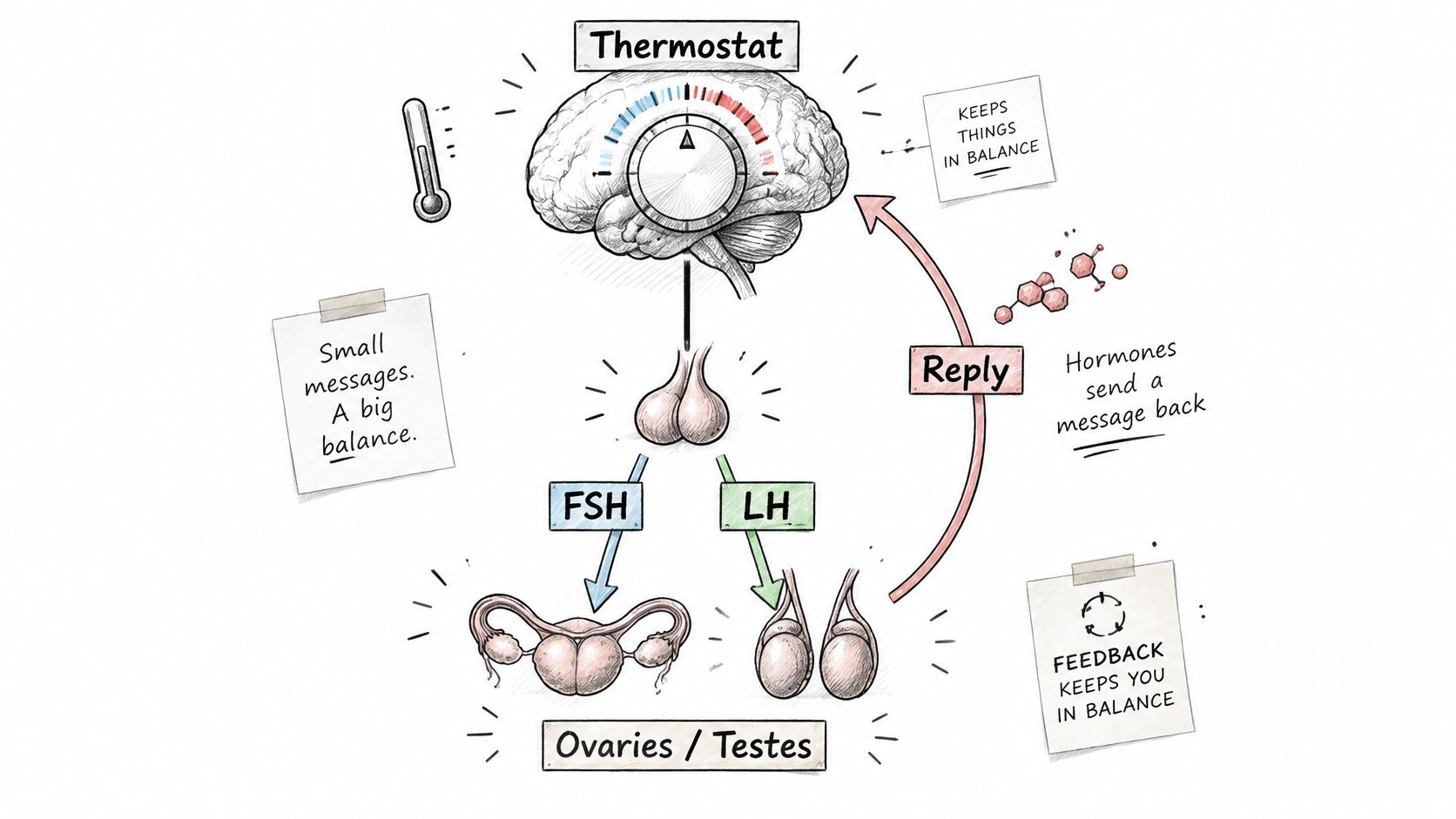
Run the loop through a single menstrual cycle and the snapshot problem becomes obvious. FSH rises early to recruit and grow follicles. As they develop, oestradiol climbs, and once it stays high long enough the brain answers with an LH surge that triggers ovulation. Afterwards, the emptied follicle produces progesterone, which holds the lining in place and tells the brain the job was done. Every one of those steps changes the number you'd get from the same test.
Practical rule: read FSH and oestradiol together. Either one alone can look reassuring or alarming for reasons that have nothing to do with your fertility.
An FSH value on day 3 and the same value on day 14 aren't the same finding. Early in the cycle, a high FSH alongside low oestradiol points to ovaries that need a louder signal. Mid-cycle, both hormones are moving fast, and the reading describes a moment in the surge rather than the reserve behind it.
Men run the same chain with different outputs. FSH supports sperm production, while testosterone is made separately by the testes. That's why a man's hormone panel can look unremarkable and his sperm count still be low, and why semen analysis stays in the picture. A loop that moves this much makes the draw itself part of the measurement.
How to Prepare for Your Fertility Blood Test
The draw is part of the measurement. A hormone that swings across a cycle, or peaks in the morning, will answer differently depending on when the needle goes in. The general principles behind how to test hormone levels apply to any panel, with one addition for fertility work: the cycle day.
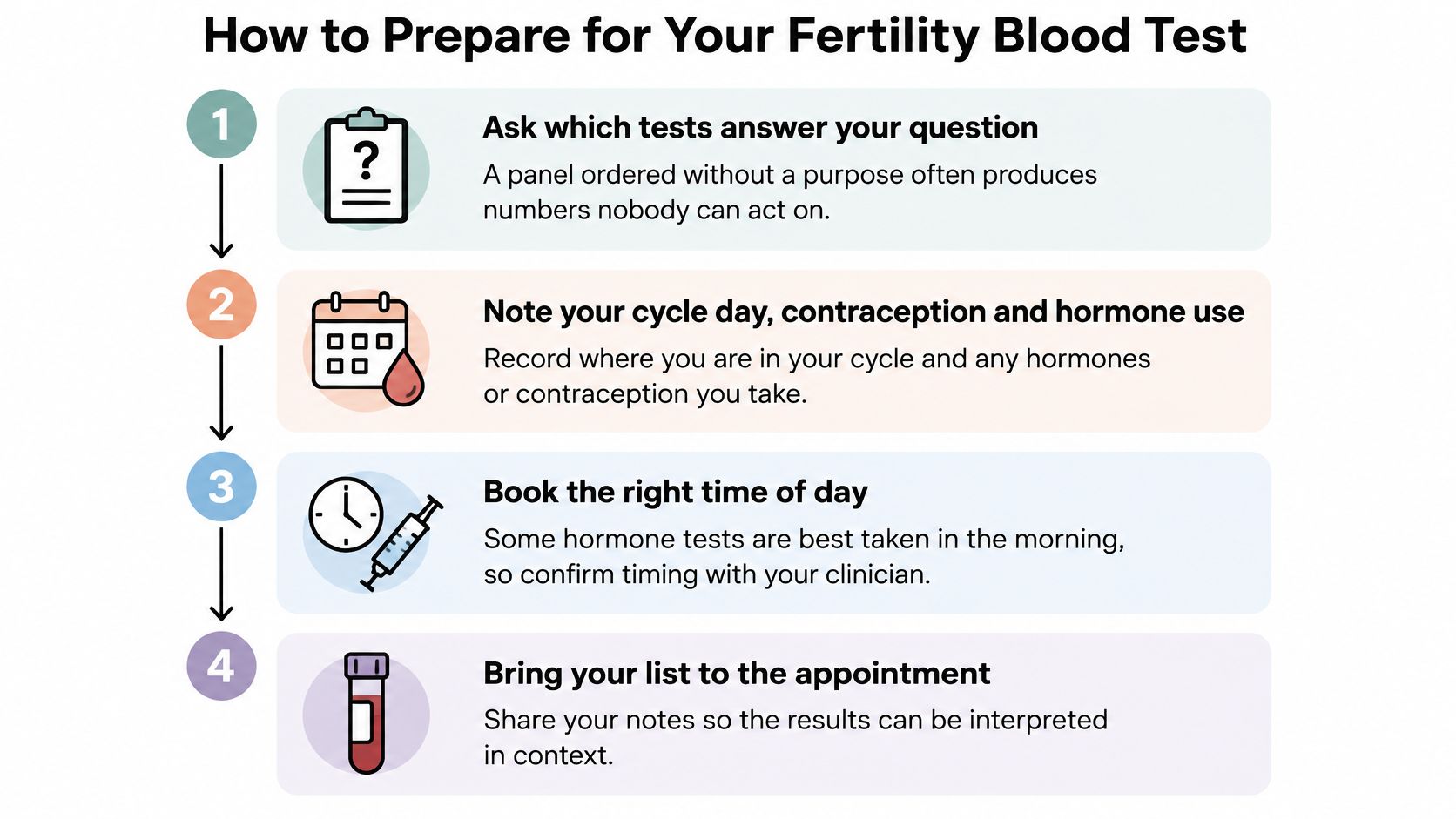
- Ask which tests answer which question. A panel ordered without a purpose tends to produce numbers nobody can act on. Ask your clinician to name the tests, the reason for each, and who will review them.
- Write down your cycle day, contraception and any hormone medicine. Day one is the first day of your period. If you use the pill, a hormonal IUD, HRT or fertility medication, say so, because each of these shifts female readings and changes what the number means.
- Book the day the test needs. Day 2 or 3 for FSH and oestradiol, a morning draw for testosterone or prolactin. A draw on a random day can make FSH look high or low purely because of where you were in the cycle, and that false reading travels into your notes.
- Fast only if you've been asked to. If the laboratory hasn't asked you to fast, eat normally. Never stop a prescribed medicine to "clean up" a result unless the doctor managing that medicine tells you to.
- Follow any instruction about hard exercise. If the lab asks you to avoid strenuous training the day before, treat that as part of the protocol rather than optional advice.
- Take the request form to an accredited collection centre on the booked date. Where you can, arrive rested rather than rushing from a commute, particularly for prolactin, which responds to stress and physical effort.
- Record the context on your own copy. Date, cycle day, pregnancy status, medication and the time of the draw. The person interpreting the result later needs those details as much as the value itself.
What to Expect After the Draw
The result opens a clinician conversation rather than triggering an automatic treatment decision. Turnaround varies between laboratories, so ask when yours is expected before you leave, and plan the review appointment at the same time you book the collection.
Reading a Result Without Misreading It
A flagged result is a prompt to check the context, not a diagnosis. The laboratory's reference interval shows whether a value falls outside the range for that test. A result within range is not an automatic all-clear, either. Read the number alongside the circumstances in which it was measured.
Four checks before you react to a flag
- Which range are you reading? Reference intervals differ between laboratories and assays. Start with the range on your report. This guide to how to interpret blood test results can help you read it, but it cannot replace clinical interpretation.
- Where were you in your cycle? FSH and oestradiol vary across the menstrual cycle. A result without cycle-day context may be difficult to interpret.
- Were hormones or contraception involved? A result taken while using hormonal contraception may reflect its effects as well as your body's own hormone activity.
- Does the result fit your symptoms? Symptoms and test results are pieces of the same picture. If they do not seem to fit, discuss that mismatch with your clinician.
The meaning also depends on which hormone is measured and whose body is being assessed. In women, abnormal FSH may point to changes in ovarian function or ovulation. In men, markedly high FSH may suggest testicular injury or dysfunction, particularly when sperm production is reduced, according to the healthdirect guide to follicle-stimulating hormone. FSH alone cannot reliably distinguish among ovarian, pituitary, hypothalamic or testicular causes. It is interpreted alongside other reproductive hormones and the clinical picture.
If a result does not fit your symptoms, ask whether it should be repeated or interpreted alongside other tests.
Age Sits Beside Every Value
The healthdirect guide to follicle-stimulating hormone explains that AMH, FSH, oestradiol, progesterone and related hormone tests are generally not useful for diagnosing typical menopause in later life. It also describes FSH assessment when premature ovarian insufficiency is suspected, particularly in women under 40. Age helps frame what a result can mean, but it does not make one hormone value a fertility score.
Birth outcomes also vary with age and treatment context. The Australian Institute of Health and Welfare's parental ages release recorded 5,145 mothers aged 40 or more giving birth in 1996, or 2.1% of all Australian mothers that year. Among births to mothers aged 40 or more in 1994–95, 3.9% followed assisted conception, rising to 8.3% for mothers aged 45 or more. These figures describe births, not an individual's chance of conceiving.
Ask your clinician what the result means in your situation, whether another test is needed, whether this one should be repeated and what the next step is. A blood test offers one reading of a changing system, not the whole story.
What AMH Can and Cannot Tell You
Start with the myth, because it's everywhere. AMH isn't an egg count and it isn't a fertility score. If a clinic, an app or a forum has told you it measures your fertility, that's the belief to put down before you read your own value.
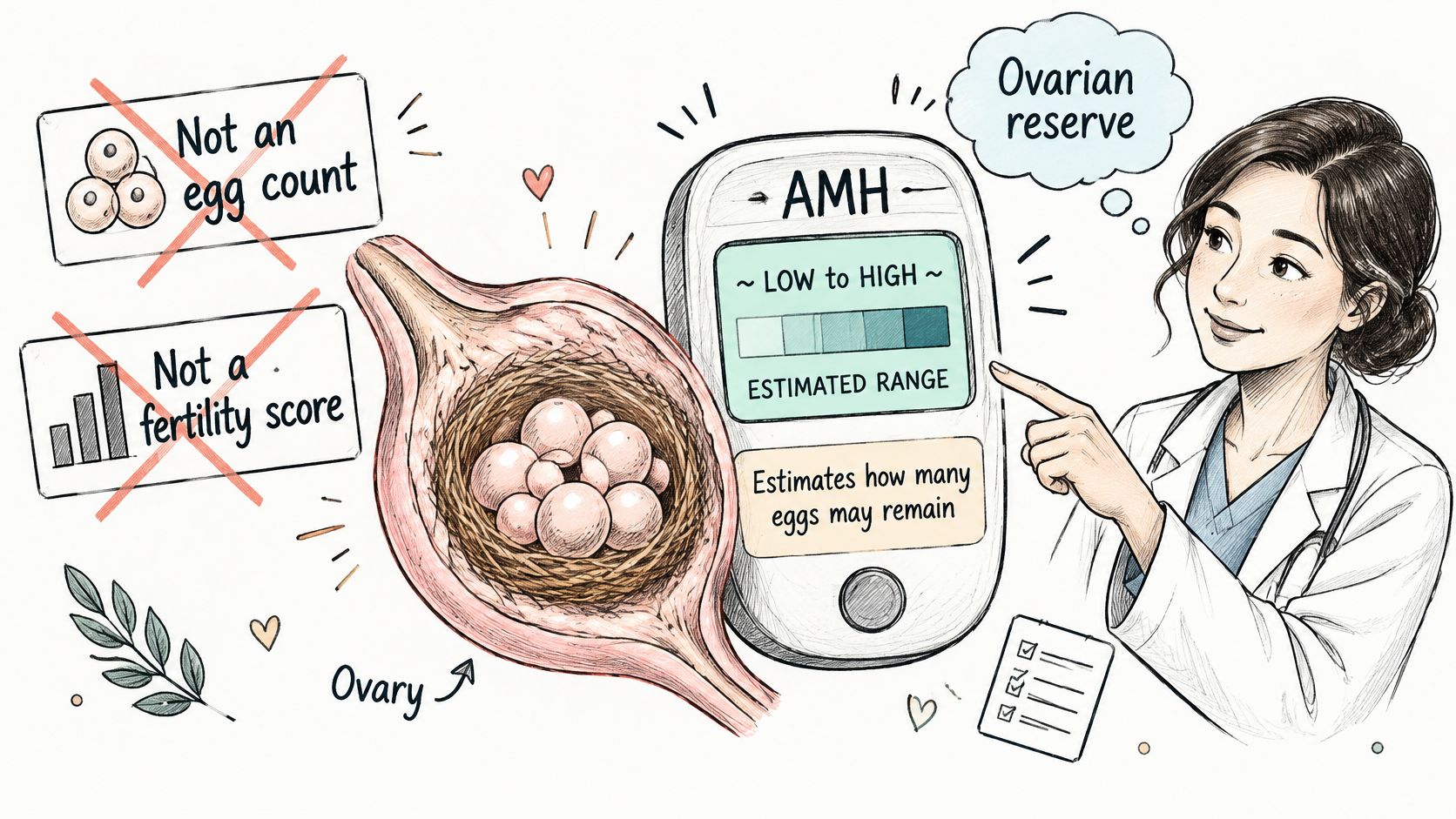
What AMH does well is estimate ovarian reserve. It may help a fertility specialist anticipate the number of eggs retrieved during IVF or egg freezing, and it's stable enough to draw on any day. What it doesn't do, according to the Australian Government's reproductive health guidance, is reliably predict natural conception, time to pregnancy or how many reproductive years you have left.
Plenty of people test anyway, and the numbers explain why. That same guidance reports fertility problems affect about 1 in 9 Australian couples of reproductive age, and that GP requests for AMH testing increased more than 13-fold between 2011 and 2021, despite evidence AMH adds little predictive value beyond age for live birth and shouldn't be used to predict natural conception.
Assisted conception has also become a bigger part of Australian births, which can make a test feel more decisive than it is. The AIHW's IVF birth figures record 2,237 babies born after IVF in 1992, or 0.9% of all births, rising to 4,801 babies, or 1.9% of Australian births, by 2000. Those are treatment outcomes for a population, not a performance measure for your blood test.
AMH tells you about supply. Pregnancy depends on the meeting of egg and sperm, and no hormone value describes that meeting.
Two misreadings cause most of the harm. A low AMH does not automatically mean infertility, and a normal AMH does not guarantee fertility. A clinician weighs your age, your ovulation pattern, sperm factors, fallopian tube health, medical history and how long you've been trying. If you order AMH directly without a referral, have someone qualified explain the number before you act on it.
If you prefer to take this in another format, the short video below covers the interpretation question.
When Results Change and When to Repeat
Two blood draws taken months apart can produce different AMH readings. That does not automatically mean one test was wrong. Hormone results are snapshots, and their meaning depends on the circumstances around each draw.
Why the Same Test Gives a Different Number
Polycystic ovary syndrome and hormonal contraception can affect hormone readings. If you take the pill, for example, a result may reflect its effects rather than your usual cycle. A clinician can decide whether repeating the test after stopping contraception is appropriate.
A result can also be misread when it is treated as a fertility score. AMH is one part of a wider assessment, not a direct measure of whether you can conceive. A low or high reading alone cannot explain every change in your fertility or determine what will happen next.
Repeat rule: Repeat a test when your clinician recommends it, or when the result does not fit the wider clinical picture. Testing repeatedly without a reason may add numbers without clarifying what they mean.
Repeat or escalate by situation
| Situation | Action |
|---|---|
| Result conflicts with symptoms | Ask your clinician whether a repeat test is appropriate |
| Irregular or absent periods | Discuss an assessment of ovulation |
| Possible premature ovarian insufficiency under 40 | Discuss clinician-led FSH assessment |
| Couple trying for 12 months | Discuss assessment of both partners, including semen analysis |
| PCOS or hormonal contraception use | Review the result with a clinician, who can advise whether to repeat it |
How long you have been trying is one part of deciding when to seek help. Irregular or absent periods, a known risk factor, or concern about premature ovarian insufficiency may make an earlier clinical assessment appropriate.
Consider three different situations. A 34-year-old with a low AMH result after four months of trying may need an assessment of ovulation and both partners, rather than an automatic referral for IVF. A 29-year-old with normal AMH and irregular periods may need ovulation assessed, since the AMH result does not explain the cycle pattern. And when a couple has been trying for a year with normal female hormone results, semen analysis may add information that repeating the same hormone tests cannot provide.
A single result is one reading in a changing process. Repeat testing can help when a clinician has a specific question to answer, but no result on its own rules out a fertility problem.
Confirm Your Next Step Before You Book
Before you order anything, get the plan from a person who can act on it. A GP or fertility clinician should name the tests, the day to draw each one, and who will review the results and any repeat. If a GP appointment is weeks away, a telehealth consultation covers the same ground sooner.
Once the tests are named, ordering is simpler than expected. You can order private blood tests online without a GP referral or a GP visit, then attend any NATA-accredited pathology collection centre near you for the sample. If your clinician's list spans reproductive, adrenal and thyroid hormones, our Hormone Health Panel covers those for men and women.
Bring the results back to your clinician rather than acting on them alone. A clear plan says what each result means, what needs repeating and who reviews it, and then you book the tests your clinician supports, timed the way the table above describes.
If your clinician has named the tests, Vital iQ Health lets you order them online and attend a NATA-accredited collection centre near you, with results delivered in 24 to 72 hours and a telehealth GP available to explain what the numbers mean in context. You don't need a GP referral or a separate GP visit to get started, and you can compare panels and individual biomarkers before you order. Visit Vital iQ Health to check what's available in your area and book the tests your clinician has named.