LH Blood Test Meaning: What Your Result Really Shows
Understand the LH blood test meaning: what luteinising hormone measures, how results vary by sex, cycle and age, and why doctors read LH with FSH.
Ask anyone what their LH result means and they'll read out the number. Ask what that number means for them, at their age, on that day of their cycle, and the answer changes. Luteinising hormone doesn't hold a fixed meaning the way a temperature does. It's a moving signal from the pituitary gland to the ovaries or testes, and its significance comes from the circumstances of the blood draw.
Two people can be told their LH is "a bit high" in the same week. One needs nothing further. The other needs a repeat test and a proper conversation about their periods. The number barely differed; the context did.
This guide works through that context in the order it matters, so you can read your own report with a clearer head.
What an LH Result Means for Your Situation
Your LH result means nothing yet. Not until you know five things: your sex, where you are in your menstrual cycle, your age, whether you're pregnant, and what medicines you take. A clinician reading an LH value checks those five things before forming any opinion about the number itself.
Here's the mapping. Find your row, and you'll see what the pattern usually points to and which test is normally read alongside it.
| Context | Typical LH pattern | What it can indicate | Usual companion tests |
|---|---|---|---|
| Premenopausal woman, early cycle | Lower, relatively steady | Baseline pituitary signalling | FSH, oestradiol |
| Premenopausal woman, mid-cycle | Sharp surge before ovulation | Timing of ovulation | Progesterone later in the cycle |
| Woman past menopause | Higher and fluctuating | Ovaries no longer responding to pituitary signal | FSH only when clinically indicated |
| Man | Stimulates testosterone production | Testicular response to pituitary signal | Testosterone, FSH |
| Pregnancy or hormone medicines | Can shift the result | Medicines or pregnancy alter the reading | Clinician to confirm before interpreting |
Read your row and you have the first layer of meaning. A premenopausal woman tested early in her cycle is showing her clinician a picture of baseline pituitary signalling, which makes most sense next to FSH and oestradiol. The same woman tested mid-cycle may instead be catching the surge that precedes ovulation, and that surge is confirmed later in the cycle by progesterone, not by LH itself.
A woman past menopause sits in a different frame entirely. Her ovaries have stopped responding to the pituitary's signal, so LH runs higher and moves around, which is why one post-menopausal reading rarely changes what a doctor does. For a man, LH is read as the strength of the signal telling his testes to make testosterone, so the testosterone result completes the sentence.
The range printed on your report beats any internet chart
Every laboratory publishes its own reference interval for LH, and most publish separate intervals for different phases of the cycle. A value of 12 means one thing on day 3 and something else on day 13. The interval printed beside your number was calculated for the population that laboratory serves, using that laboratory's assay. A chart pulled from a website can't account for either.
Pregnancy and hormone medicines belong in the same conversation. Both can shift what the laboratory measures, and your prescriber needs to know about them before anyone interprets the result.
Before the draw: note the first day of your last period and every medicine you take, including contraception, hormone replacement, steroids and fertility treatment. Ask for both to be recorded on the request form.
If you want a broader walkthrough of the page itself, our guide to how to interpret blood test results sets out which parts to check first.
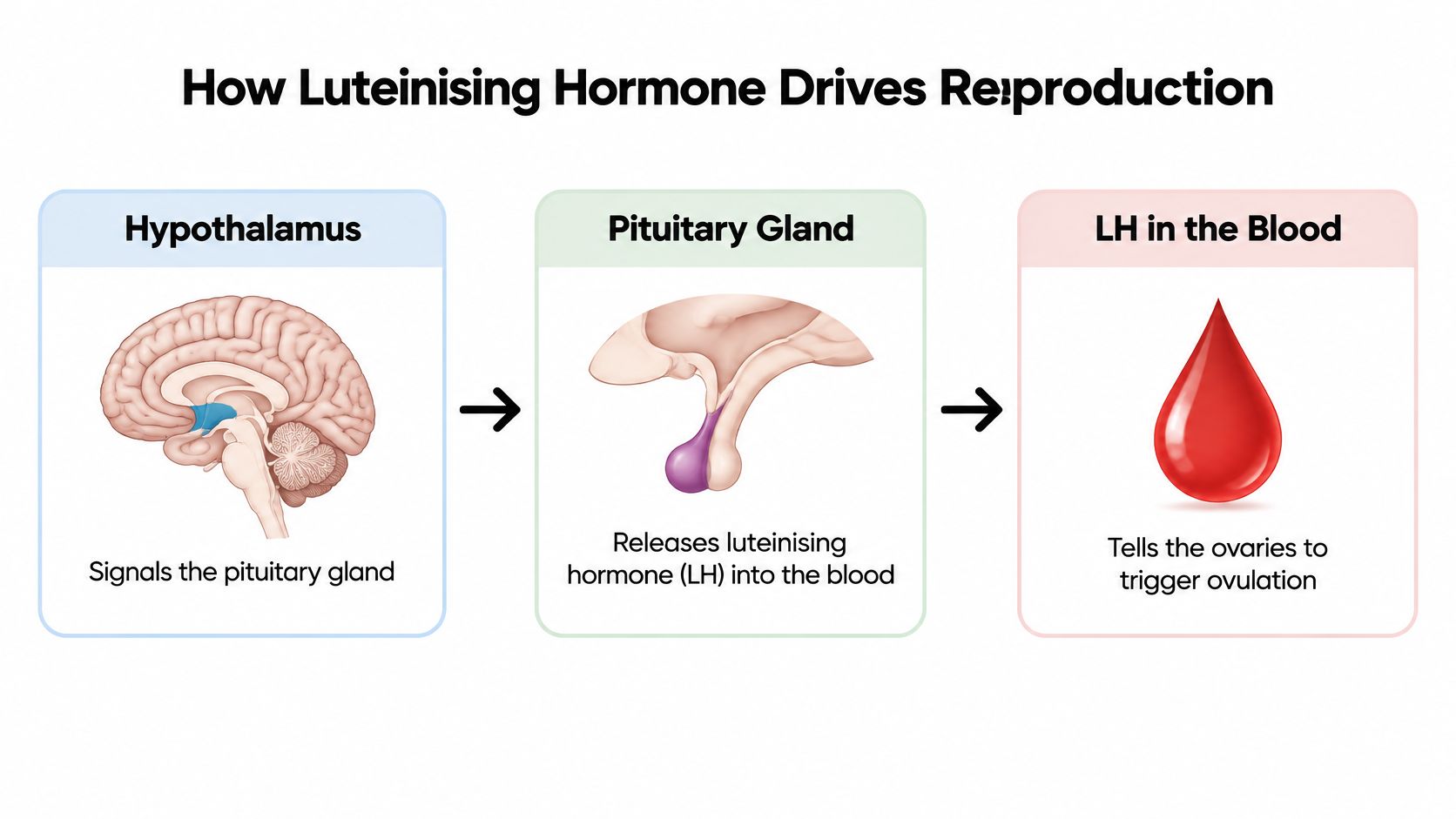
How Luteinising Hormone Drives Reproduction
Picture a relay with three legs. The hypothalamus, a region deep in the brain, releases a signal. The pituitary gland, a small structure at the base of the brain, receives it and releases luteinising hormone into the bloodstream. The hormone then travels to the ovaries or the testes and tells them what to do. Australia's healthdirect explains that the pituitary produces LH and that LH and FSH together help control periods, which is the foundation for anything a result can tell you.
In women, LH works with follicle-stimulating hormone (FSH) to regulate the menstrual cycle, and a sharp mid-cycle surge of LH is what triggers ovulation. In men, LH stimulates the testes to produce testosterone, which drives sperm production. It's the same hormone doing two different jobs, decided entirely by which gonads are listening.
The relay runs in both directions, which is the part most explanations skip. The ovaries and testes send hormones back to the brain, and the pituitary adjusts its output in response. Think of a thermostat: when the room cools, the heater runs longer. When the ovaries produce less oestradiol, the pituitary raises LH and FSH to compensate. When ovarian output is strong, the signal quiets down.
This is why the direction of an unusual result is informative without being conclusive. A raised LH can appear when the ovaries or testes aren't responding adequately to pituitary stimulation, so the pituitary calls louder because nobody is answering. A low LH can reflect reduced pituitary or hypothalamic signalling, meaning the call was quiet to begin with.
Follow one cycle through the relay and the logic becomes concrete. Early in the cycle, FSH recruits a group of follicles and pushes one to dominance. That follicle produces rising amounts of oestradiol, which eventually flips the pituitary's response from restraint to release. LH surges, the follicle ruptures, and the leftover tissue becomes the corpus luteum, which produces progesterone. Every step depends on the gland before it.
Because the loop involves at least three structures, one hormone measurement rarely identifies where the strain sits. LH tells you how loudly the pituitary is signalling. It doesn't tell you why, and it can't tell you whether the ovary or testis responded. Everything that follows applies that loop to specific readings.
Why One LH Reading Can Mislead
A single LH reading is one of the most over-interpreted numbers in a hormone panel. Many people assume the value is a stable personal setting, like a blood type. It isn't.
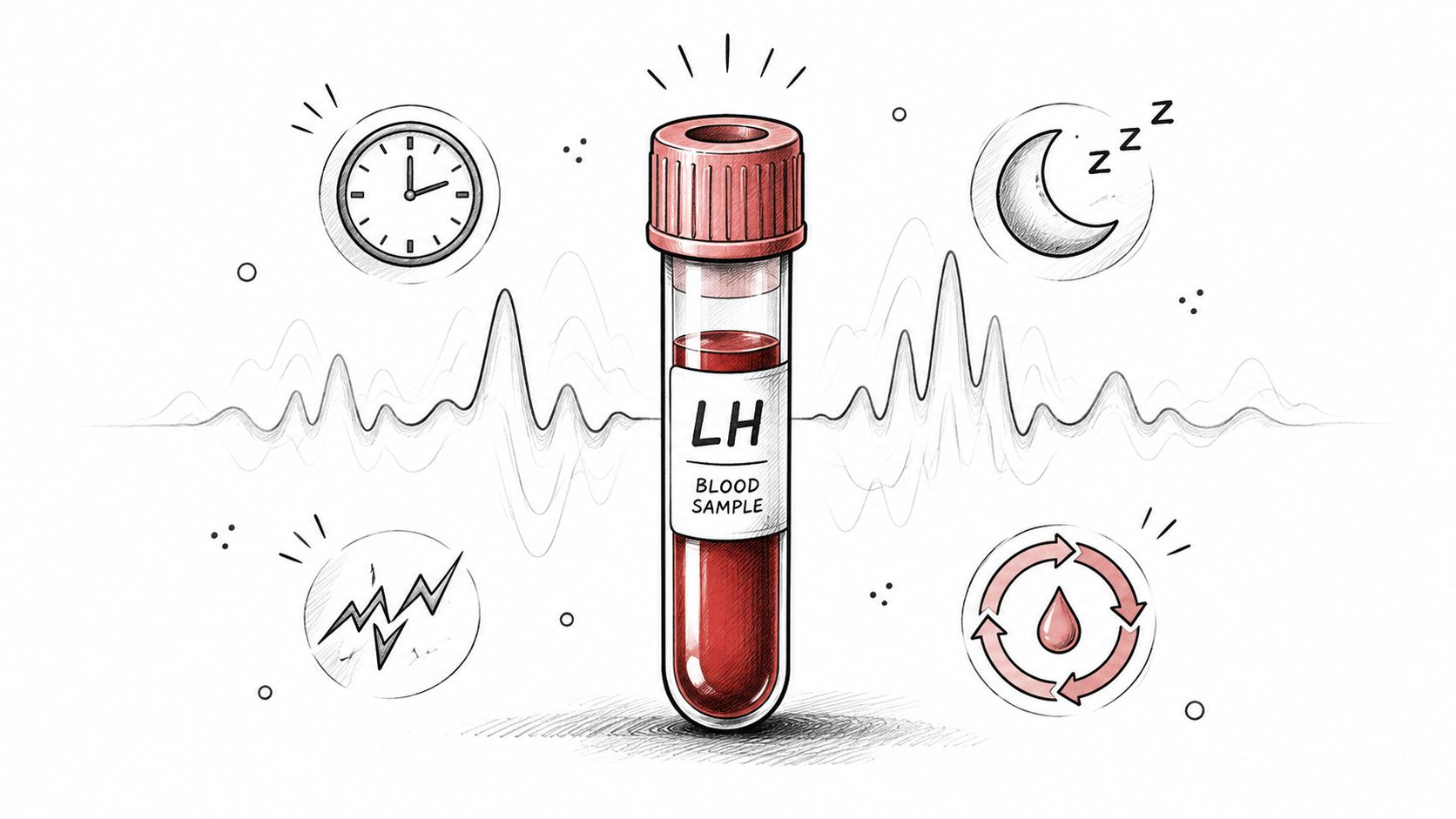
The Royal College of Pathologists of Australasia notes that LH secretion is pulsatile, meaning it's released in bursts rather than a steady trickle. One blood sample may not represent your usual level at all. Interpretation depends on age, sex, menstrual-cycle stage, the assay method the laboratory used, and whether the result is read alongside FSH and clinical history.
What changes the reading
- Cycle stage: a sample taken early in the follicular phase reads very differently from one taken near ovulation, so the date of the draw is part of the result, not background detail.
- The assay: laboratories use different methods with different calibration, which is why one lab's interval doesn't transfer to another lab's report.
- Pulsatility: a burst of LH that happens to coincide with your appointment can lift a value above the interval without anything being wrong.
- Companion results: LH on its own can't distinguish a pituitary problem from an ovarian one; FSH and the clinical picture usually can.
The polycystic ovary syndrome question deserves its own correction. An increased LH-to-FSH ratio can occur in PCOS, but it isn't diagnostic by itself, and current international PCOS guidance doesn't rely on the ratio because many people with PCOS have normal LH and FSH values. The widely shared idea that a ratio above 2:1 confirms PCOS doesn't hold up.
Blood and urine testing also answer different questions and can't be swapped. A urine ovulation predictor kit is built to catch a threshold crossing before ovulation. A blood test returns an exact number at a single moment, which is why the same hormone gives two very different kinds of information.
Here's a short walkthrough of what each part of a report is showing.
Three questions to ask about any report
- At what cycle phase was the sample taken, and does the laboratory have that on file?
- Which reference interval did this laboratory use for that phase?
- What else was ordered alongside it, and were those results available to the person interpreting it?
Then look at the page itself. Check the units printed beside the value, because a number means nothing without them. Find the interval the laboratory applied and the high or low flag if there is one. A value inside the interval isn't automatically normal for you, and a value outside it isn't automatically a diagnosis.
Practical rule: a single flagged LH result gets repeated or reviewed by a clinician, not acted on alone.
If your panel also included a cortisol measurement, the same timing logic applies in a different way, and our guide to cortisol testing in Australia covers the daily rhythm that shapes those readings.
Reading LH Alongside FSH and Other Hormones
LH is almost always read as half of a pair. Both hormones come from the same pituitary signal and both respond to feedback from the ovaries, so the two results together say far more than either one alone. FSH recruits and matures follicles; LH triggers the events that follow. When they move in step, the story is usually about the ovary. When they diverge, the story is often about the pituitary.
Four combinations cover most of what a clinician looks at.
| Pattern | LH | FSH | Usual reading and next step |
|---|---|---|---|
| Both raised | High | High | Ovaries may not be responding; review with symptoms and cycle history |
| LH raised, FSH normal or low | High | Normal or low | Seen in PCOS but not diagnostic alone; clinical assessment needed |
| Both low | Low | Low | Reduced pituitary or hypothalamic signalling; further testing usually follows |
| LH normal, FSH raised | Normal | High | Repeat testing and history review before any conclusion |
None of those rows is a diagnosis. They're starting points that tell a clinician where to look next, and each one gets read against symptoms, age and cycle pattern.
What else usually goes on the panel
The companion tests aren't padding. Each one closes a gap that LH and FSH leave open.
Testosterone and oestradiol establish the sex hormone output the pituitary is trying to regulate. For a man, a low testosterone with a high LH points towards the testes; a low testosterone with a low LH points towards the pituitary. For a woman, oestradiol tells you whether the ovary is responding to the signal at all.
Prolactin matters because a high level can suppress the pituitary's reproductive signalling and produce low LH and FSH as a secondary effect. It's a common and treatable cause that gets missed when only LH is ordered.
Thyroid function completes the picture, since both overactive and underactive thyroid states can disturb cycles and distort reproductive hormone results. A clinician ordering an LH will often add TSH for that reason.
What to bring to the appointment
- The full report, not a screenshot of one line, so the reference intervals and units travel with the number.
- Cycle dates for the last three months, including the first day of each period and roughly how long each cycle ran.
- A medicine list, covering hormonal contraception, hormone replacement, fertility treatment and anything else taken regularly.
- Any earlier results, because a pattern across two or three draws is more useful than any single value.
A pattern is what a clinician can work with. A single value in isolation is a conversation starter at best.
When an LH Test Helps and What Younger Patients Need
LH testing is often ordered when it answers nothing. For a woman over 45 with typical menopausal symptoms, measuring reproductive hormones, including LH, FSH, anti-Müllerian hormone, oestradiol and testosterone, is generally not recommended, because the results fluctuate so much that they're unlikely to change management. That's the Australasian Menopause Society position reproduced through healthdirect's information on hormone testing.
The Society's 2025 practitioner toolkit for managing menopause puts it plainly: menopause is diagnosed on symptoms in typical presentations, and LH, progesterone and AMH have no diagnostic value there. FSH and oestradiol are generally considered only for atypical presentations, or for people under 45.
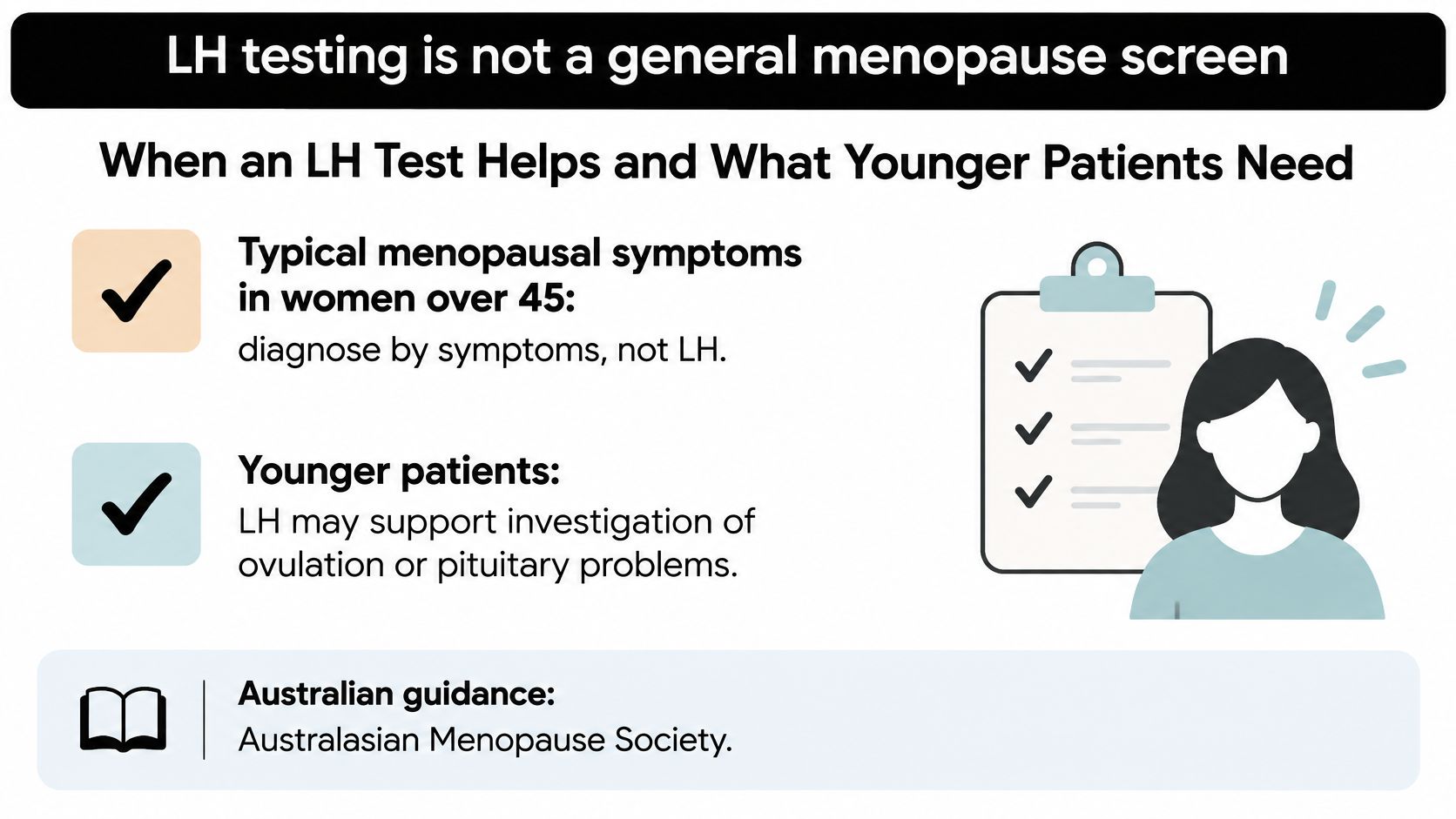
That's a contrarian message in a market where a hormone panel is easy to buy. For ordinary perimenopausal symptoms, an LH result usually adds cost and anxiety without adding information. Hot flushes, disturbed sleep and cycle changes are the evidence that matters.
The exception the guidance is built around is premature ovarian insufficiency, considered when menopause occurs before age 40. Here the testing is targeted and the standard is specific: high FSH should be demonstrated on two occasions 4 to 6 weeks apart. One result is a starting point, never a conclusion.
The younger patient who is told everything is normal
A woman in her early thirties with irregular or absent periods is a different case entirely, and a single "normal" LH should not reassure her. Guidance in this situation points to FSH as the more informative test, alongside oestradiol and a proper history. The question isn't whether her LH is inside a range. It's whether her ovaries are responding to the pituitary signal at all, and whether that response is consistent across months.
For suspected PCOS, no single hormone value confirms the diagnosis. A raised LH shows up in some people with PCOS and not in others, so clinicians work from clinical features, ultrasound findings and the broader hormone picture rather than from one number.
When LH is ordered as part of a fertility work-up, a pituitary assessment or a gonadal investigation, it functions as one input among several. Healthdirect notes that pathology results are assessed alongside all aspects of a person's health, which is another way of saying the number doesn't stand alone.
The test that gets ordered matters less than the question behind it. If nobody can state the question, the result is unlikely to help.
Four steps before you request anything
- Log three months of cycle dates, noting the first day of each period and the length of each cycle. You can't interpret a hormone result without this, and no one can reconstruct it afterwards.
- Write down your symptoms in plain terms, such as hot flushes, night sweats, sleep disruption, mood shifts, acne, hair changes or unusual bleeding. Symptoms carry real diagnostic weight in this area.
- List every medicine and any recent pregnancy, including hormonal contraception stopped in the last few months. Both change what the laboratory sees.
- Ask whether a repeat is booked, and if so at what interval. For suspected ovarian insufficiency the answer should be four to six weeks after the first draw, not the following week.
An LH test earns its place when a clinician has a specific question it can answer. It adds very little when the only question is whether menopause has started, because symptoms already answer that.
Confirm Your Test Timing Before You Book
The decision in front of you is narrower than it looks. It isn't whether to test your hormones at all. It's which hormones, on which day, and whether a repeat is part of the plan. Get those three right and the result is interpretable. Get them wrong and you've paid for a number nobody can use.
Start with your GP or specialist. Ask which hormones are needed for your situation, which cycle day the draw should fall on, and whether a repeat is due. Those questions take a few minutes and they decide whether the sample is worth taking.
Some people prefer to order a private panel first rather than waiting for a GP appointment. Vital iQ Health allows customers to order private blood tests online without a GP referral or a GP visit, with results delivered within 24 to 72 hours and partnered telehealth GPs available to walk through the findings and recommend next steps. That's one route to a clinician's interpretation, not a substitute for one. Any unexpected or concerning value still belongs with a doctor.
Three things to do before you book.
- Write down the question you want the test to answer, in one sentence. If you can't, the test probably isn't ready to be ordered.
- Confirm the companion tests and cycle timing that apply to you, including whether FSH, oestradiol, testosterone, prolactin or thyroid function should be on the same request.
- Take the result and this guide to the appointment, with your cycle dates and medicine list attached.
For a wider view of how hormone testing fits together across the panel, our guide to how to test hormone levels covers the practical side of timing and preparation.
If you've read this far, you already know the number needs context, and Vital iQ Health can supply it alongside the result. Our Hormone Health Panel covers reproductive, adrenal and thyroid hormones for men and women, ordered online without a GP referral and collected at a NATA-accredited centre near you, with results in 24 to 72 hours and a telehealth GP to talk them through. Visit Vital iQ Health to see the panels and choose what fits the question you're asking.