How to Test Hormone Levels in Australia
Learn how to test hormone levels in Australia: pick the right marker, time the draw, and read the lab range.

You're tired, your periods have changed, or your libido isn't what it used to be. You open a hormone-testing menu and wonder whether ticking every box would finally explain what's going on.
Learning how to test hormone levels starts with a smaller, more useful question: what decision would this result change? In Australia, good testing means choosing the right marker, collecting it under suitable conditions, and interpreting it against the reporting laboratory's own reference interval. More measurements don't automatically mean clearer answers.
Choose the Hormone Test That Answers Your Question
A hormone panel isn't a general scorecard for how well your body is working. Each measurement needs a clinical question, such as whether thyroid dysfunction could explain your symptoms or whether a low testosterone result is persistent.
Start by describing what's changed, when it began, and what you're taking. Include prescription medicines, contraception, hormone therapy and supplements, rather than asking for a panel before discussing the context.
Start with the marker that guides the next decision
Thyroid testing provides a useful Australian example. The Australian Commission on Safety and Quality in Health Care's thyroid investigations guide reports approximately 5.5 million TSH tests and 2.3 million broader thyroid-function tests nationally in 2016–17, while recommending TSH as the single first-line blood test when thyroid dysfunction is suspected.
Thyroid-stimulating hormone, or TSH, helps a clinician decide whether further thyroid measurements are needed. Free thyroxine, called free T4, and free triiodothyronine, called free T3, are generally added when TSH is abnormal or a particular clinical situation warrants them.
That's different from assuming all thyroid markers must be measured together. Pregnancy, medicines and the suspected condition can change the approach, but those are reasons for a specific request, not an automatic panel.
Practical rule: Before ordering a marker, finish this sentence: “If this result is abnormal, the next step would be…”
First hormone test by clinical question
Use this as a discussion guide, not a self-diagnosis checklist. The first marker and any additions should match your symptoms and circumstances.
| Question | Start with | Add when | Usually skip |
|---|---|---|---|
| Suspected thyroid dysfunction | TSH | Free T4 and/or free T3 if TSH is abnormal or a specific situation justifies them | Automatic full thyroid panel |
| Thyroxine dose just changed | TSH after the prescribed settling interval | Free T4 only if clinically needed | A repeat immediately after the change |
| Suspected male hypogonadism | Early-morning total testosterone, repeated on a separate morning if low | SHBG and albumin when total testosterone may mislead | One random daytime result |
| Cycle, ovulation or fertility question | The marker tied to the question and cycle phase, such as mid-luteal progesterone or serial oestradiol | FSH, LH or androgens only if they would change care | An untimed broad female panel |
| Typical menopause symptoms in the usual age group | Symptom and menstrual-history assessment | Thyroid tests if another condition could explain symptoms | Routine FSH, oestradiol, AMH, progesterone, LH or androgens |
| Possible premature ovarian insufficiency | FSH, with confirmation directed by a clinician | Clinician-directed related tests | A single FSH interpreted without considering hormonal contraception or menopausal hormone therapy |
For suspected testosterone deficiency, the question isn't whether testosterone falls below a number. It's whether compatible symptoms and properly collected results support a persistent problem.
For cycle-related concerns, the marker needs to answer something specific. Investigating ovulation isn't the same task as investigating irregular bleeding, and neither is answered reliably by collecting every reproductive hormone on an arbitrary day.
If you're also considering broader screening, our guide to a complete blood panel can help you distinguish general health measurements from targeted hormone testing. Keep the reason for each test separate.
Write down your intended decision before ordering: for example, whether to investigate thyroid dysfunction further, confirm an unexpected result, or arrange a reproductive-health assessment. If you can't name the decision, a clinical conversation is more useful than adding another marker.
Skip Tests That Will Not Change Care
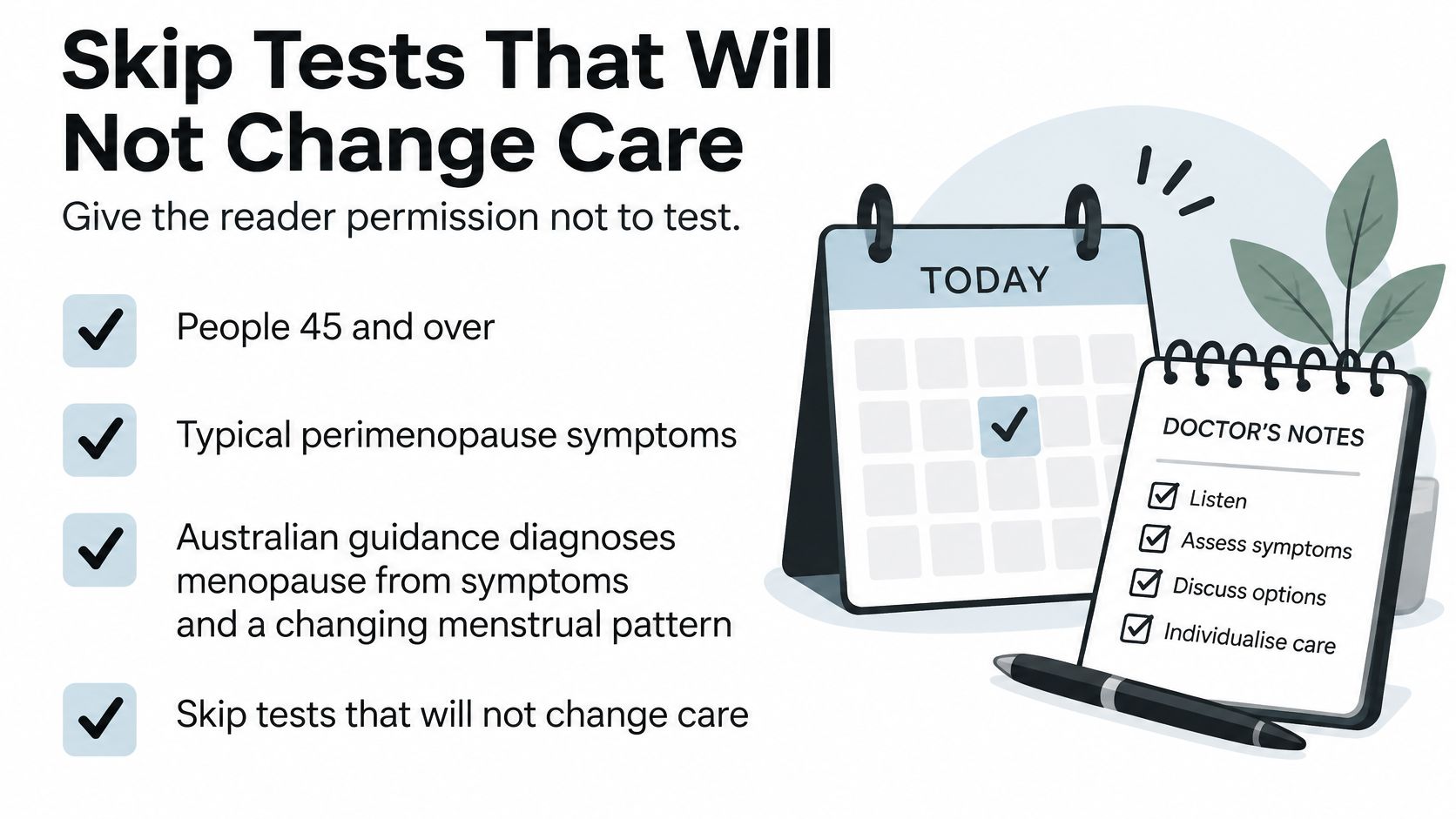
You don't need a laboratory result to make your symptoms worth discussing. Sometimes the better decision is to skip a hormone panel and spend the appointment working through symptoms, menstrual changes and possible alternative explanations.
For people 45 and over with typical symptoms, Healthdirect's menopause guidance supports assessment based on symptoms and menstrual history rather than routine hormone testing; when premature menopause is suspected, increased FSH should be confirmed on two occasions, 4–6 weeks apart.
Why a menopause panel can confuse rather than clarify
During perimenopause, hormone concentrations fluctuate. A result within the laboratory interval doesn't necessarily exclude the transition, and a high result doesn't automatically explain every symptom.
Routine FSH, oestradiol, AMH, progesterone, LH and androgen measurements are therefore unlikely to change care in a typical presentation. A clinician can discuss symptom management without requiring a blood test to validate what you're experiencing.
Testing can be more useful when symptoms occur earlier than expected, premature menopause is suspected, or a hysterectomy makes menstrual history less informative. It can also help investigate another explanation, such as thyroid disease, when the symptoms and examination point that way.
The distinction matters: testing for another possible condition isn't the same as ordering a menopause panel. Your clinician should be able to explain which possibility the requested test addresses.
Check whether the result will be interpretable
Hormonal contraception and menopausal hormone therapy can alter the measurements you're hoping will reveal your untreated baseline. Don't stop either on your own to obtain a different result; discuss whether testing is useful while you're taking them.
Other temporary circumstances can make testing less informative too. An unexpected testosterone result during an illness, for example, needs a different interpretation from a planned collection when you're well.
Before paying for testing, run through this decision gate:
- Decision: Could the result change treatment, further investigation or follow-up?
- Stability: Are illness, disrupted sleep or a recent treatment change likely to complicate interpretation?
- Timing: Have you been given the right collection window for this marker?
- Comparison: Can future monitoring use the same laboratory and comparable collection conditions?
If the first answer is no, ask for a symptom-focused review instead. Bring a record of bleeding changes, sleep problems, flushes and the effect on daily life, alongside your medicine list.
Choosing not to test isn't choosing not to investigate. It's choosing an assessment that can lead to useful care.
Prepare for Collection and Give the Sample
Once a test has a clear purpose, preparation becomes part of obtaining a useful result. The aim isn't to produce the best-looking number; it's to collect a sample that fairly represents the situation your clinician is investigating.
Healthdirect's testosterone-test guidance explains the role of testosterone testing and notes that preparation may include fasting. Follow the instructions for your actual request rather than applying a generic rule to every hormone test.
Make the collection plan before you arrive
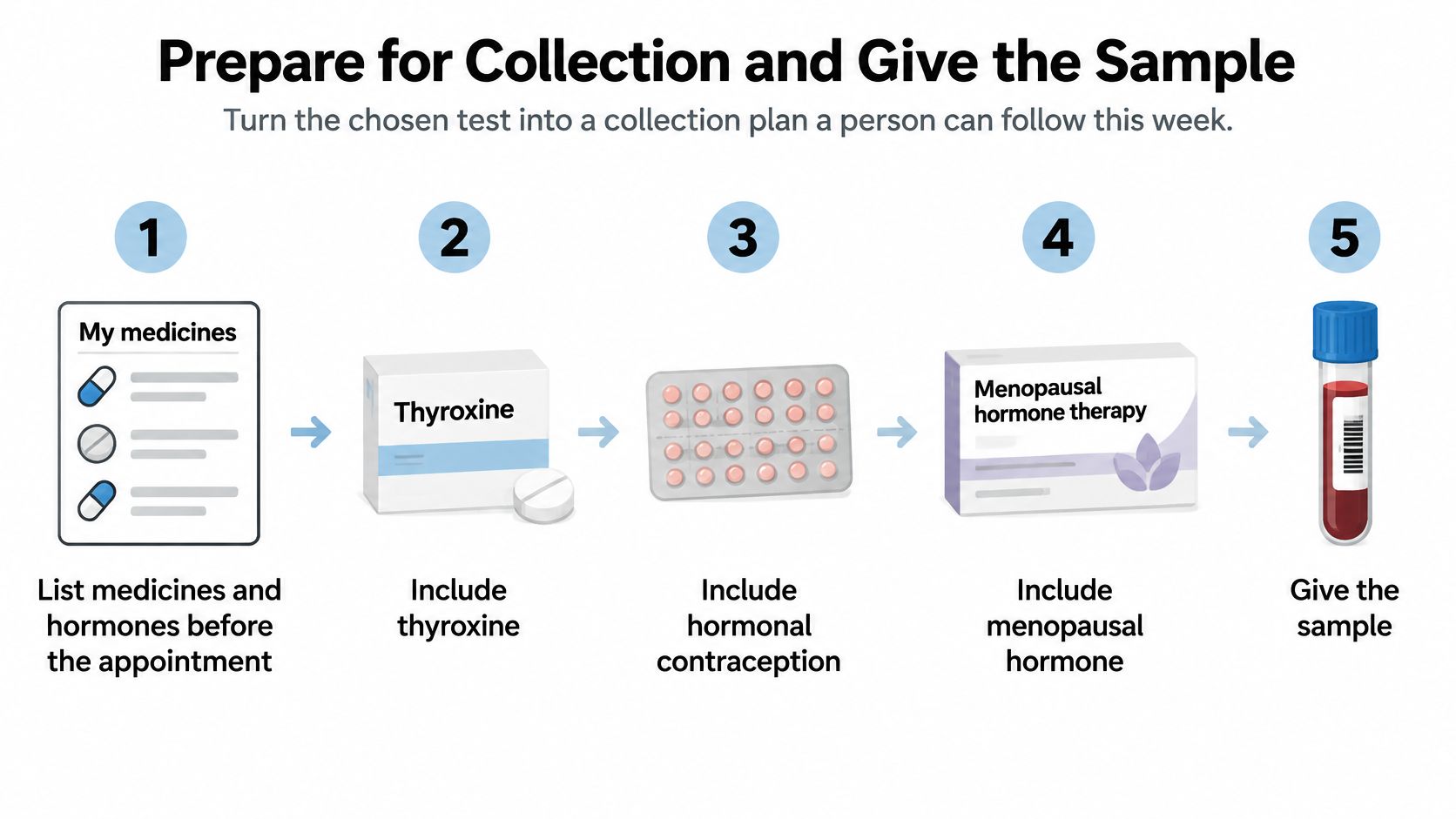
Write a complete medicine and hormone list. Include thyroxine, hormonal contraception, menopausal hormone therapy, testosterone, anabolic steroids and supplements, including products containing biotin. Record prescribed and non-prescribed use. The common slip is leaving out something because you don't think of it as medicine.
Check dose-related instructions. Ask the requesting clinician or laboratory whether the sample needs to be collected before or after a usual dose. Don't skip, delay or stop prescribed treatment unless you've been specifically instructed to do so.
Arrange the correct collection. For suspected male hypogonadism, plan a venous blood draw in the early morning, when testosterone concentrations are generally highest. A convenient afternoon appointment doesn't provide the same standardised assessment.
Confirm fasting requirements. Check the pathology request and collection instructions. If fasting is requested, clarify how it applies to your medicines rather than deciding to miss them.
Record anything that could change the interpretation
Tell the clinician if you're unwell or sleeping poorly. Acute illness and substantial sleep disruption can complicate testosterone assessment. Ask whether a non-urgent collection should be postponed; don't delay a test requested to investigate an acute problem without advice.
Bring the context with the request. Record symptoms, age, sex where relevant, pregnancy possibility, cycle phase or bleeding pattern, and the last hormone dose. Keep your own note of the collection time so you can reproduce the conditions later.
Attend the collection centre with your pathology request. After ordering through us, you visit any nearby NATA-accredited pathology collection centre for sample collection. The request form tells the collector what has been ordered; your preparation instructions tell you how to arrive ready.
Plan follow-up rather than reacting immediately. A low testosterone result should be repeated on a separate morning before it's treated as persistent deficiency. Review an unexpected result with a clinician rather than adjusting treatment yourself.
Binding proteins may also matter. Sex-hormone-binding globulin, or SHBG, and albumin help a clinician assess cases where total testosterone doesn't adequately represent biologically available testosterone.
Comparable monitoring means keeping the laboratory, collection time and preparation conditions consistent wherever practical.
Save the request, preparation instructions and eventual report together. A result is much easier to interpret when the circumstances of collection aren't missing.
Time Each Hormone Draw Correctly
A correctly chosen test can still be difficult to interpret if it's collected at the wrong point in a cycle or treatment plan. The appointment should follow the clinical question, not the next available booking.
For ovarian hormones, the collection date needs meaning. Cycle phase, bleeding pattern, pregnancy possibility and hormone use belong on the request because they help explain what the measured concentration represents.
Use a timetable that fits the marker
Healthdirect's oestrogen blood-test guidance notes that monitoring may require serial testing over weeks or months because levels change through the menstrual cycle. A planned series answers a different question from an isolated measurement.
Oestradiol, FSH, LH, progesterone and androgens can change across the cycle. A laboratory result without its cycle context may look reassuring or concerning for the wrong reason.
The collection windows below are practical planning rules. Your clinician may give different instructions when investigating a particular disorder or monitoring treatment.
When to collect common hormone tests
| Marker | Best window | Repeat rule | Do not draw |
|---|---|---|---|
| TSH | Any usual collection time, unless instructed otherwise | Allow the prescribed settling interval after a thyroxine dose change | Immediately after a dose change simply to assess the new steady state |
| Free T4 or free T3 | With the clinically indicated thyroid assessment | Repeat according to the clinical question; pregnancy needs trimester-specific interpretation | Automatically as first-line testing when TSH is normal and clinical risk is low |
| Total testosterone | Early morning | Separate morning if the first result is low | During acute illness or after badly broken sleep without discussing suitability |
| Oestradiol | Named cycle phase or a planned series | Follow the monitoring plan | On a random day and treat it as representative of the whole cycle |
| Progesterone | Mid-luteal when assessing ovulation | A later cycle may be needed if timing was uncertain | Without considering when ovulation likely occurred |
| FSH for suspected early menopause | A clinician-planned collection addressing ovarian insufficiency | Confirm an elevated result after the appropriate interval | While using hormonal contraception or menopausal hormone therapy if the aim is to diagnose typical menopause |
Turn cycle timing into an actual booking
For progesterone used to assess ovulation, ask the clinician to translate mid-luteal into a booking window for your cycle. Don't assume a standard calendar day works if your periods are irregular or your ovulation timing is uncertain.
Say you're tracking ovulation and your cycle length changes from month to month. Give the clinician your bleeding dates and ovulation observations so they can plan the sample, rather than choosing a date based only on your previous cycle.
Hormonal contraception and menopausal hormone therapy can suppress or reshape the pattern being measured. Make the treatment part of the question: is the clinician investigating your underlying ovarian function, monitoring something during treatment, or considering a different cause of symptoms?
Other hormone investigations need their own collection instructions. If cortisol is being considered, use our guide to cortisol testing in Australia to prepare questions for the requesting clinician rather than borrowing a reproductive-hormone timetable.
Keep a short collection note ready: marker requested, last hormone dose, cycle phase or trimester, and collection time. That small amount of context can prevent a result from becoming an unexplained number.
Read Results Against the Reporting Laboratory
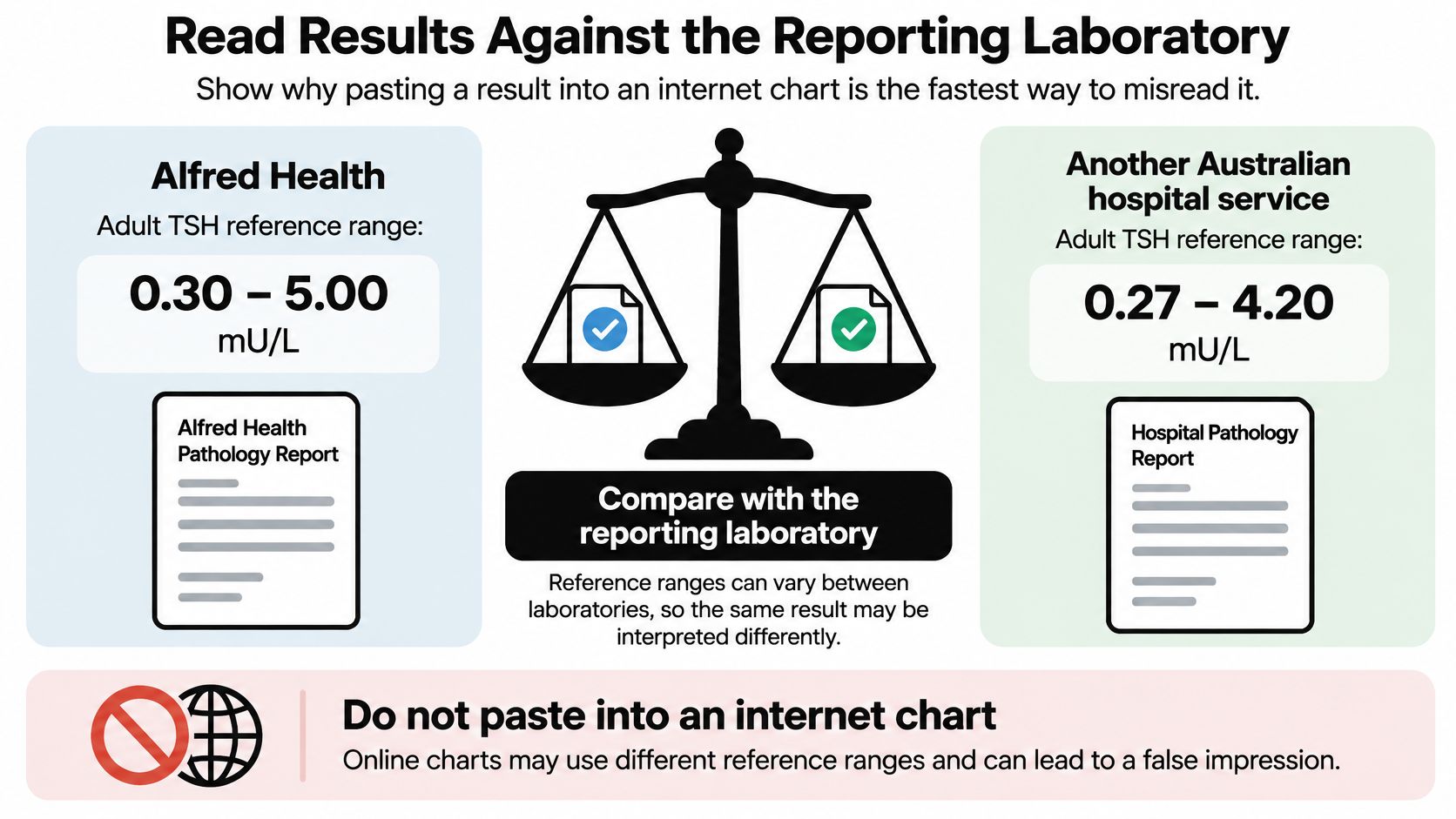
A TSH result can fall within one laboratory's interval and outside another's. The number only makes sense beside the reference interval printed on the report from the laboratory that tested your sample.
TSH and other hormone intervals can differ with the laboratory's assay, the population used to set the interval, and the person's age or pregnancy stage. Each lab's own interval is the one to use. Don't average figures from internet charts or apply an interval from another service.
Follow the meaning, not just the flag
Suppose a TSH result is close to the upper end of the interval on your report. Its interpretation may depend on the applicable interval, your symptoms, treatment and physiological context, including pregnancy.
A flagged result is a prompt, not a diagnosis. An unflagged result does not automatically explain ongoing symptoms.
For testosterone, check whether the report gives total testosterone or calculated free testosterone. A calculated free testosterone result depends on the relevant SHBG and albumin inputs and the calculation used. A number from an online calculator may not be comparable if those inputs are incomplete.
Keep the full report handy when discussing the result:
- Laboratory and units: Use the complete report, not just a copied number.
- Applicable interval: Check that relevant details, such as age or pregnancy, are reflected.
- Collection context: Note the timing, cycle context, medicines and recent illness.
- Earlier results: Tell the clinician if they came from a different laboratory.
A change between reports may reflect a different assay or interval, as well as a change in your hormone level. Your clinician can compare the results in context rather than treating every numerical difference as a biological change.
Order the Test and Review It With a Clinician
Your request should now be something more precise than wanting your hormones checked. It should identify a symptom or monitoring question, the marker that addresses it, and the circumstances needed for a useful sample.
For example, you might be investigating whether thyroid dysfunction could explain persistent symptoms, or arranging a standardised assessment of suspected testosterone deficiency. That purpose should remain attached to the result when it's reviewed.
Choose the ordering route without losing the clinical question
You can take the plan to your usual GP, who can assess whether testing or another investigation is appropriate. Alternatively, we offer online private blood-test ordering without a GP referral or GP visit, with sample collection arranged through an accredited collection centre.
Direct access changes how you obtain a test. It doesn't remove the need for clinical judgement about what the result means.
If you're comparing targeted testing with broader screening, our guide to full-body check-up costs can help frame that choice. Keep the scope tied to your health question rather than treating a longer marker list as a better investigation.
Make the review part of the plan
Before collection, decide who'll review the report and what information they'll need. Our partnered telehealth GPs can walk you through results, answer questions and recommend next steps from home.
Bring more than the flagged values to that appointment:
- Your original question: Explain what you hoped testing would clarify.
- Your symptoms: Include their timing, progression and impact on daily life.
- Your collection notes: Supply medicine use, recent illness and relevant reproductive context.
- Your previous reports: Keep laboratory names, units and intervals attached.
The review is where a clinician decides whether an unexpected value needs confirmation, a different investigation or no further testing. It's also where persistent symptoms deserve attention even when the requested markers fall within range.
Don't change thyroxine, testosterone or menopausal hormone therapy from the report alone. If a repeat is recommended, leave with clear instructions about the laboratory, preparation, collection window and who will act on the result.
The useful outcome isn't having hormone numbers alone. It's knowing whether those numbers answer your original question and what, if anything, should happen next.
Vital iQ Health offers private hormone blood testing online without a prior GP referral, with collection at a nearby NATA-accredited pathology collection centre. Visit Vital iQ Health to arrange testing matched to your clinical question, and use our partnered telehealth GPs to discuss your report and next steps.