Cholesterol Levels LDL Explained: Targets by Risk
Cholesterol levels LDL explained: what counts as high, Australian targets by risk, and when a result needs a doctor's review.
90.9% of Australian adults found to have abnormal LDL cholesterol reported that they didn't have high cholesterol, according to the Heart Foundation's Heart Health Tracker. Feeling well, or assuming your cholesterol is fine, isn't a reliable guide to your blood result.
But finding your LDL number is only the beginning. The right response depends on whether you've had cardiovascular disease, what other risk factors you have and whether you're already taking treatment. There isn't one LDL target that suits everyone.
LDL Cholesterol Targets by Risk Situation
Australian LDL goals are set by risk category, so the first step in reading your result is working out which row of this table describes you.
| Situation | LDL-C target or trigger | Guidance context |
|---|---|---|
| Primary prevention, no established cardiovascular disease | Below 2.0 mmol/L | Queensland clinical guidance |
| Coronary stent or previous stroke or TIA | Below 1.8 mmol/L | Queensland clinical guidance |
| Established disease after acute coronary syndrome | Below 1.4 mmol/L and at least 50% reduction from baseline | Australian acute coronary syndrome guideline |
| Untreated adult LDL-C above 4.9 mmol/L | Consider familial hypercholesterolaemia | Australian FH guidance |
| Very high paediatric LDL-C or early xanthomas | Possible homozygous FH; urgent lipid-specialist review | Paediatric specialist assessment |
Queensland's dyslipidaemia guidance lists LDL-C below 2.0 mmol/L for primary prevention and below 1.8 mmol/L for people with a coronary stent or previous stroke or transient ischaemic attack (TIA). Each remaining row describes a different clinical situation and calls for a different action.
A target is a treatment goal. A trigger is a reason to investigate. The first three rows work like destinations on a map: levels a treatment plan aims to reach. The last two work like warning lights: results that prompt your clinician to look for an inherited cholesterol disorder. Read a trigger as a prompt to investigate, never as a level to aim for.
Primary prevention means preventing a first cardiovascular event. Secondary prevention means reducing the chance of another event in someone who already has cardiovascular disease. A clinician chooses your goal within that context.
Applying the table to your result
Say your LDL-C is 2.1 mmol/L. It sits above the primary-prevention target, yet the next step is still an assessment of your overall risk. For someone with a coronary stent, the same 2.1 mmol/L is also above the more intensive 1.8 mmol/L target, so accepting it because the laboratory hasn't flagged it would miss the clinical question.
Now consider a result of 4.0 mmol/L. If you haven't started treatment, your clinician needs to establish your baseline risk and investigate reasons for the elevation. If you're already taking cholesterol-lowering medicine, they also need to review your earlier results, medication strength, missed doses and response to treatment.
Baseline means the level before treatment. An on-treatment result tells you what has been achieved so far. It can't show how high your LDL would run without medication. The 50% reduction in the acute coronary syndrome row is measured against that baseline, so your pre-treatment result stays relevant for years.
Practical rule: A result inside the laboratory reference range isn't automatically the best result for your cardiovascular history.
Choosing the right row
Choosing a less intensive row because its target looks easier gives you the wrong goal entirely. Tell your clinician about previous heart attacks, stents, strokes and TIAs, even if they happened long ago and you now feel well.
Bring these questions to your appointment:
- My situation: Which target row applies to me, and why?
- Sample conditions: Was my sample fasting, and does that affect its interpretation?
- Follow-up: When should I repeat the test, and what change are we looking for?
What LDL Cholesterol Is and How Common High LDL Is
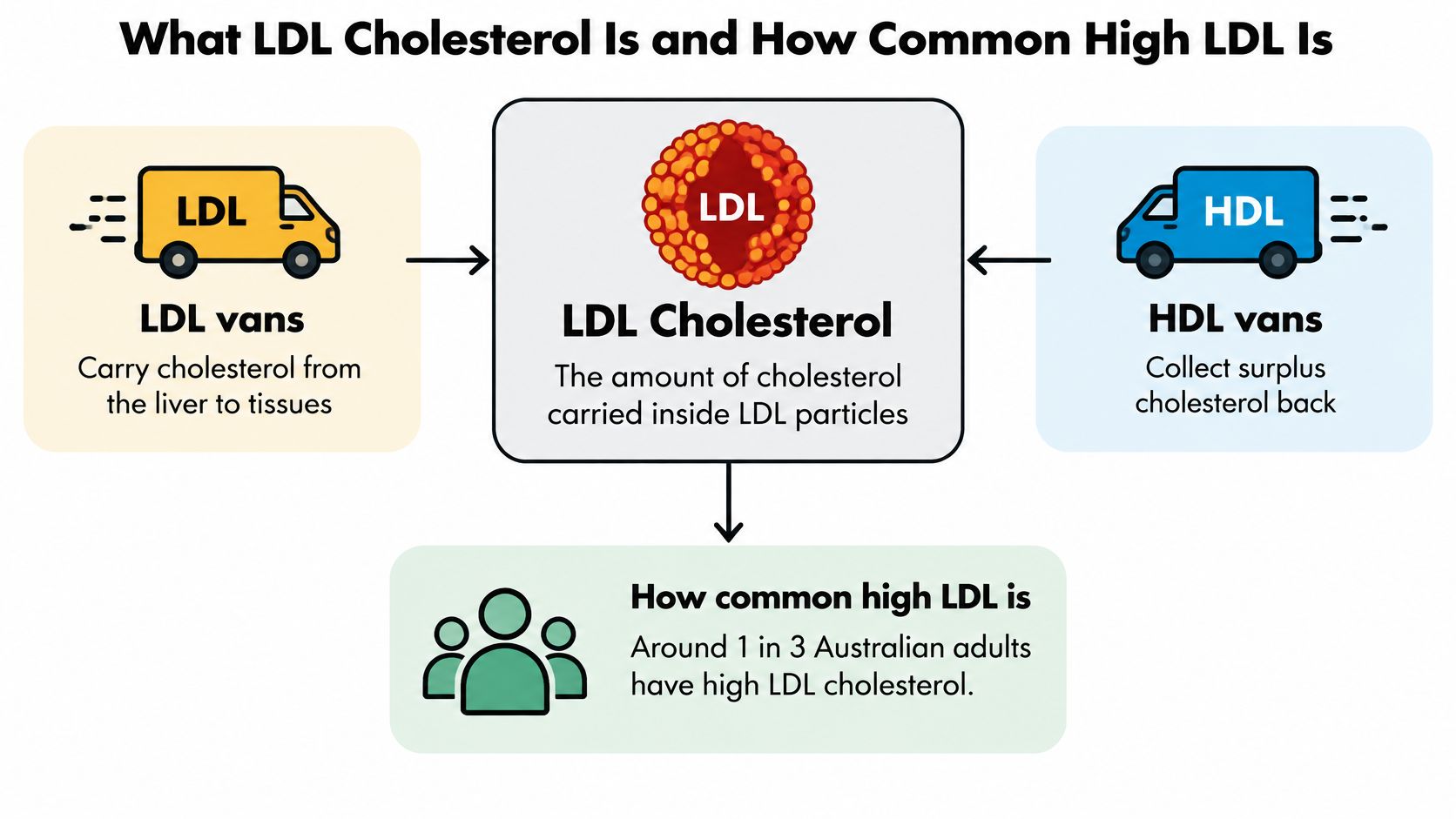
LDL particles work like delivery vans, carrying cholesterol from the liver out to tissues that need it. HDL particles run the return route, collecting surplus cholesterol and taking it back towards the liver.
LDL-C means the amount of cholesterol carried inside low-density lipoprotein particles. It doesn't count the particles themselves, and it isn't the same figure as total cholesterol.
Your body needs cholesterol for cell membranes and hormone production, so the van analogy has limits. LDL isn't a foreign poison, and the goal is never to remove all cholesterol from your body.
The diagram summarises those transport roles.
Why excess LDL matters
When too many LDL particles circulate, the cholesterol they carry can lodge within artery walls. The body's inflammatory response builds around those deposits and forms atherosclerotic plaque, which gradually narrows the artery and restricts blood flow.
A plaque can also rupture. When that happens, a blood clot may form over the break and block the artery, causing a heart attack or stroke. Plaque doesn't build up the way grease coats a pipe. It develops inside the artery wall itself through an active biological process involving the particles and inflammation.
Early build-up causes no symptoms. A lipid blood test measures circulating cholesterol, but it doesn't directly show whether an artery contains plaque. If your history or symptoms suggest cardiovascular disease, your clinician may arrange other assessments to answer that question.
The Australian picture
The Australian Bureau of Statistics National Health Measures Survey 2022–24 found that 27.8% of Australians aged 18 years and over had abnormally high LDL, defined as at least 3.5 mmol/L. Another 19.0% sat in the borderline band of 3.0 to less than 3.5 mmol/L, so high and borderline results together covered 46.8% of adults. Among adults aged 45 years and over, 32.8% had abnormal LDL.
| Survey measure | All adults | Men | Women |
|---|---|---|---|
| Australian Health Survey 2011–12, abnormal or high LDL | 33.2% | 35.0% | 31.6% |
| National Health Measures Survey 2022–24, LDL at least 3.5 mmol/L | 27.8% | 29.5% | 26.3% |
A decade earlier, the ABS Australian Health Survey 2011–12 recorded abnormal or high LDL in 33.2% of adults, including 35.0% of men and 31.6% of women. The two surveys used different methods and definitions, so the lower 2022–24 figure can't be read as a straightforward national improvement.
Keep one thing in mind as you read those figures. The survey cut-off of 3.5 mmol/L is a population measure, and Australian LDL targets are set by cardiovascular risk rather than by a single "normal" number. The same result can be acceptable for one person and too high for another with a different history. What an abnormal result does signal is that LDL deserves attention alongside blood pressure, diabetes, smoking, age, family history and any previous heart disease.
How Doctors Measure LDL on a Lipid Panel
A lipid panel, also called a lipid profile, measures related blood fats from a blood sample. LDL is usually one part of that panel, rather than a completely separate test.
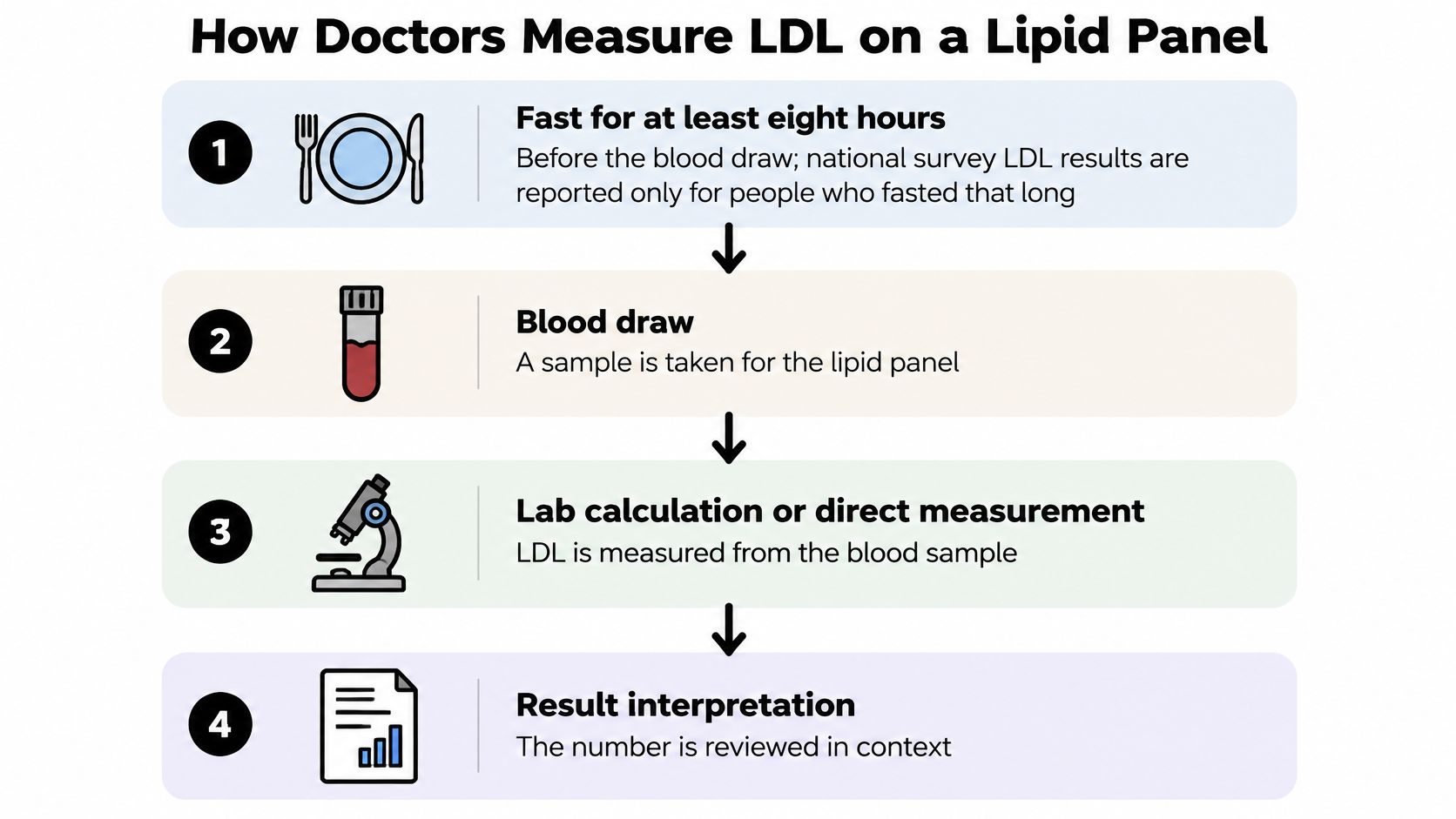
The process involves preparation, collection, laboratory analysis and clinical interpretation.
- Confirm your preparation instructions. Some lipid testing can be performed without fasting; your clinician may request fasting when triglycerides or an inherited lipid disorder need closer assessment. Don't assume the preparation rules used in a population survey apply to every clinical test.
- Attend the blood collection. The collector takes a sample from a vein. Tell them if you haven't followed the requested preparation, rather than trying to guess whether it matters.
- The laboratory measures the panel. Total cholesterol, HDL cholesterol and triglycerides are measured, and LDL is commonly calculated from these results. Some laboratories measure LDL directly when a calculated estimate may be unsuitable.
- A clinician interprets the findings. They check the laboratory comments, compare earlier results and consider whether the result answers the clinical question. A repeat sample may be needed before deciding what to do.
For preparation questions, our guide to which blood tests require fasting explains why instructions differ between tests. Don't stop prescribed medicines to prepare for a cholesterol test unless your treating clinician tells you to.
This diagram outlines the collection and interpretation process; confirm whether its fasting preparation applies to your own request.
Reading the panel labels
- Total cholesterol: The overall cholesterol measurement across the different circulating particles.
- LDL-C: Cholesterol carried in LDL, commonly the main cholesterol-lowering treatment target.
- HDL-C: Cholesterol carried in HDL. A favourable HDL result doesn't cancel out high LDL.
- Triglycerides: Another type of blood fat, which can affect the reliability of calculated LDL.
A report marked calculated LDL isn't automatically less useful than a directly measured result. However, high triglycerides or an unusual sample can make the estimate less reliable, so laboratory comments matter.
Checking the units
Australian reports commonly use mmol/L, while some overseas reports use mg/dL. These are different scales, not different types of cholesterol.
| Threshold | mmol/L | mg/dL, approximately |
|---|---|---|
| Primary prevention target | Below 2.0 | Below 77 |
| Coronary stent or previous stroke or TIA | Below 1.8 | Below 70 |
| After acute coronary syndrome | Below 1.4 | Below 54 |
| Abnormal prevalence cut-off in national survey | At least 3.5 | At least 135 |
| Borderline range in national survey | 3.0 to under 3.5 | 116 to under 135 |
| FH consideration in an untreated adult | Above 4.9 | About 190 |
These rounded equivalents help orient an overseas report, but treatment decisions should use the original result and its stated units. Ask your clinician whether your LDL was calculated or directly measured, whether a repeat is necessary and which personal target they're using.
Why the Same LDL Result Means Different Things
Consider two hypothetical people with an LDL-C result of 3.2 mmol/L. One has no known cardiovascular disease and doesn't smoke; the other has already had a heart attack. The laboratory number is identical, but their clinical starting points are not.
The comparison below illustrates why medical history changes the response.
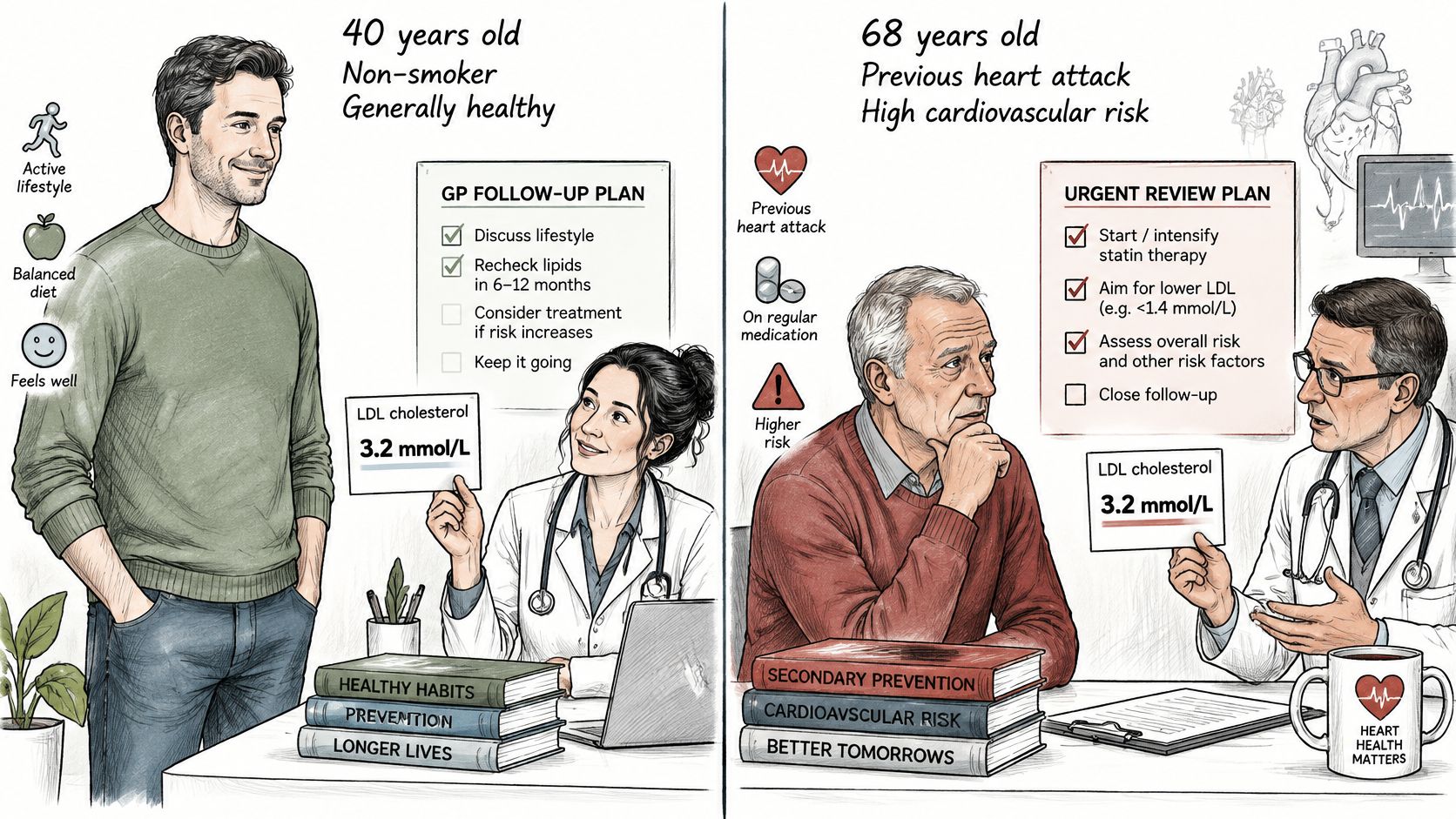
For the person without known disease, a clinician considers the likelihood of a first cardiovascular event. That assessment includes blood pressure, age, diabetes, smoking, kidney disease and family history, rather than assuming that feeling healthy means having low risk.
For the person who has had a heart attack, the clinician already knows that cardiovascular disease is present. The task is to reduce the chance of another event, not to establish whether the person might eventually develop disease.
The absence of a laboratory flag doesn't override a history of cardiovascular disease.
Treatment after acute coronary syndrome
The 2025 Australian acute coronary syndrome guideline recommends LDL-C below 1.4 mmol/L together with at least a 50% reduction from baseline, and reassessment of LDL-C and total cholesterol 4–6 weeks after treatment initiation or intensification. It also states that each 1.0 mmol/L reduction in LDL-C lowers the risk of myocardial infarction, stroke, coronary revascularisation and vascular death.
After acute coronary syndrome, high-potency statin treatment, such as atorvastatin or rosuvastatin, is started or continued early regardless of the baseline LDL result. This is why a patient may receive cholesterol-lowering medicine even when their admission result doesn't look particularly high.
If the agreed target isn't reached, a clinician may add ezetimibe or consider a PCSK9-directed medicine. They also review whether the prescribed treatment is being taken consistently and whether side effects or access problems have interrupted it.
For an additional explanation of cholesterol and clinical risk, the following video offers another learning format.
What this means for your appointment
A lower result after treatment can show that medicine is working. It doesn't necessarily mean the underlying need for treatment has disappeared, so don't stop a statin because your latest report looks reassuring.
Bring your medication list, previous results and any difficulties taking treatment to your review. Our guide to how to interpret blood test results can help you organise the report, but your treating clinician needs to make the risk-based decision.
Food choices and physical activity remain important. They shouldn't become a reason to postpone prescribed treatment after a cardiovascular event or to manage a concerning result without clinical review.
When High LDL Points to Familial Hypercholesterolaemia
Untreated adult LDL-C above 4.9 mmol/L should prompt consideration of familial hypercholesterolaemia, particularly with premature cardiovascular disease or a family history, according to the RACGP's familial hypercholesterolaemia guidance. This is a reason for assessment, not a diagnosis made from the number alone.
Familial hypercholesterolaemia, usually shortened to FH, is an inherited condition that affects how the body clears LDL from the blood. Someone with FH can feel healthy, exercise regularly and eat well while still having markedly high LDL.
That distinction matters emotionally as well as medically. A high LDL result isn't a measure of effort or a verdict on someone's lifestyle.
What a clinician needs to investigate
The assessment combines cholesterol results, personal history, family history and sometimes genetic testing. Your clinician also checks for other explanations rather than assuming that every very high result is inherited.
Prepare the following information:
- Earlier untreated results: Find cholesterol reports from before you started medication. Don't stop treatment to recreate an untreated baseline.
- Possible secondary causes: Discuss thyroid, kidney and liver conditions, along with prescribed medicines and supplements.
- Repeat testing: Ask whether another sample is needed and whether it should be fasting.
- Family history: Record relatives with early heart disease, very high cholesterol or a known FH diagnosis. Include their relationship to you and approximate age when problems began.
- Relatives who may need assessment: Ask about cascade screening, which involves assessing close biological relatives after FH is identified in a family.
Genetic testing can support diagnosis and family assessment, but it isn't a substitute for reviewing the clinical picture. A clinician or lipid specialist can explain what a result would change and how to discuss testing with relatives.
Children need a separate assessment
Adult thresholds shouldn't be applied to children. Paediatric assessment considers the child's cholesterol, family history and physical findings, and may require a specialist even when the child appears entirely well.
Very high paediatric LDL or early xanthomas, cholesterol deposits that can appear as lumps in skin or tendons, warrant urgent specialist assessment. A possible severe inherited disorder shouldn't be managed through dietary experimentation alone.
Broader childhood and life-course detection approaches have been proposed, but proposals aren't the same as a universal screening programme. If FH is suspected in your family, don't assume that routine childhood care has already excluded it.
Bring these questions: Is FH likely? Who in my family should be assessed? Would genetic testing change our care?
Next Steps After an LDL Result
A useful response to an LDL result ends with a clear clinical plan, not just a decision that the number is good or bad. Keep the full report, including laboratory comments and the other lipid measurements.
Use this sequence to prepare for review:
- Record the result accurately. Note LDL-C, its units, the collection date and whether you were taking cholesterol-lowering treatment. Keep a copy rather than relying on memory.
- Check the sample details. Confirm whether you followed the requested fasting instructions and whether this is your first result or part of a series. Tell your clinician about any preparation issues.
- Gather your risk history. Bring your medication list, blood pressure information if available, relevant diagnoses and family history. Include previous cardiovascular events, even if they no longer affect your daily life.
- Arrange a GP review. Ask for your personal LDL target, the recommended action and a follow-up plan. Leave knowing who will review any repeat result.
Don't wait for a cholesterol appointment if you develop chest pain, significant breathlessness or stroke symptoms, such as sudden facial drooping, arm weakness or difficulty speaking. Seek emergency care straight away.
Turning the result into a plan
Your clinician may recommend repeat testing, changes to food and activity, medicine, or a combination. The choice should reflect your circumstances, including other medical conditions, treatment preferences and any difficulty taking medication.
Ask for the plan in practical terms. What are you changing? What result would show that it's working? Who should you contact if you experience side effects?
If you're waiting for a report, our guide to how long blood test results take in Australia explains factors that can affect availability. Receiving results and having them clinically interpreted are separate steps, so organise both.
Choosing a testing pathway
A GP-led assessment is one route, particularly when you already have cardiovascular disease or a result that needs investigation. Private testing is another option for people seeking preventative screening or monitoring.
At Vital iQ Health, our Standard Health Panel includes cholesterol, and we offer Cardiovascular Assessments that can be ordered without a prior GP referral. Samples are collected through accredited centres, and our partnered telehealth GPs can explain findings and recommend next steps.
Whichever pathway you choose, make sure a clinician who knows your full risk profile reviews the result before treatment is decided.
Our cholesterol testing options can help you establish a baseline or monitor an existing care plan, with partnered telehealth GP support to understand the findings. Visit Vital iQ Health to explore our Standard Health Panel and Cardiovascular Assessments, then arrange a clinical review to agree on the LDL target that fits your history.