How Long Do Blood Test Results Take Australia: 2026 Guide
How Long Do Blood Test Results Take Australia? Routine results usually arrive in 1–2 days, while specialist panels can take longer. See the timelines.

Most routine blood test results in Australia are available within 1–2 days after the sample reaches the laboratory, while specialist, reference-lab and multi-part tests usually take longer. That's the laboratory's usual processing window, not a promise about when your doctor will call or when you'll see the report online.
The most useful way to understand the wait is to separate three clocks: laboratory processing, clinician review and patient access. Knowing which clock you're waiting on makes it easier to ask the right person for an update, rather than repeatedly refreshing a portal that can't yet show your result.
Typical Result Times for Common Blood Tests
Most common blood-test results are generally available within 1–2 days after the sample reaches the laboratory, according to Healthdirect's blood-testing guidance. That's a useful baseline for routine blood counts, glucose, cholesterol, liver, kidney and thyroid investigations, although the test and laboratory workflow affect the actual turnaround.
The important starting point is arrival at the laboratory, not the moment you leave the collection centre. Your sample may still need transport before testing can begin.
Typical turnaround for common Australian blood tests
The routine estimates below use Healthdirect's general benchmark. They aren't separate guarantees for every assay, and the final column distinguishes testing delays from delays in receiving an explanation.
| Test | Typical timeframe | What can extend it |
|---|---|---|
| Full blood count (FBC) | Routine baseline of 1–2 days | Repeat testing or blood-film review |
| Blood glucose and HbA1c | Routine baseline of 1–2 days, confirm the HbA1c schedule locally | Batch-processing schedules |
| Lipid profile (cholesterol) | Routine baseline of 1–2 days | Sample handling and transport |
| Liver function | Routine baseline of 1–2 days | Repeat testing |
| Kidney function and electrolytes | Routine baseline of 1–2 days | Doctor review can extend the wait for an explanation |
| Thyroid (TSH) | Routine baseline of 1–2 days | Additional investigations such as free T4 |
| Hormone panels (reproductive or thyroid) | Use the laboratory's expected date for the slowest assay | Referral to a specialist laboratory |
| Vitamin D | Confirm the laboratory's assay schedule | Referral or batch processing |
| Oral glucose tolerance test | A timed collection visit, followed by laboratory reporting | Completion of all scheduled samples |
| Rapid HIV screen | An initial result during the visit | Reactive results need laboratory confirmation |
Don't assume every hormone or vitamin test needs referral. Ask whether your particular assay is processed locally and when the complete report is expected. There isn't a single supported national turnaround that applies to every specialist panel.
Match the estimate to your actual request
A request described as a health check may contain several individual tests. Your FBC could be complete while a separate hormone investigation remains pending, so ask about the whole order, not just whether results have arrived.
Our guide to a complete blood panel can help you recognise the difference between a panel name and its individual components. Use the names on your pathology request to identify the relevant rows, then confirm the expected reporting date with the clinician who ordered them.
A report also needs interpretation. Reference ranges, previous results and the reason for testing all affect what a number means for you.
Where the Time Goes From Collection to Your Result
Think of your sample like a tracked parcel. Collection starts the journey, but it doesn't mean the parcel has reached its destination, been checked or been opened by the intended recipient.
NSW Health Pathology's patient FAQs say standard tests are normally processed within 48 hours and sent to the requesting doctor. Notice the endpoint: sending a report to your clinician isn't the same as explaining it to you.
The collection-to-release journey looks like this.
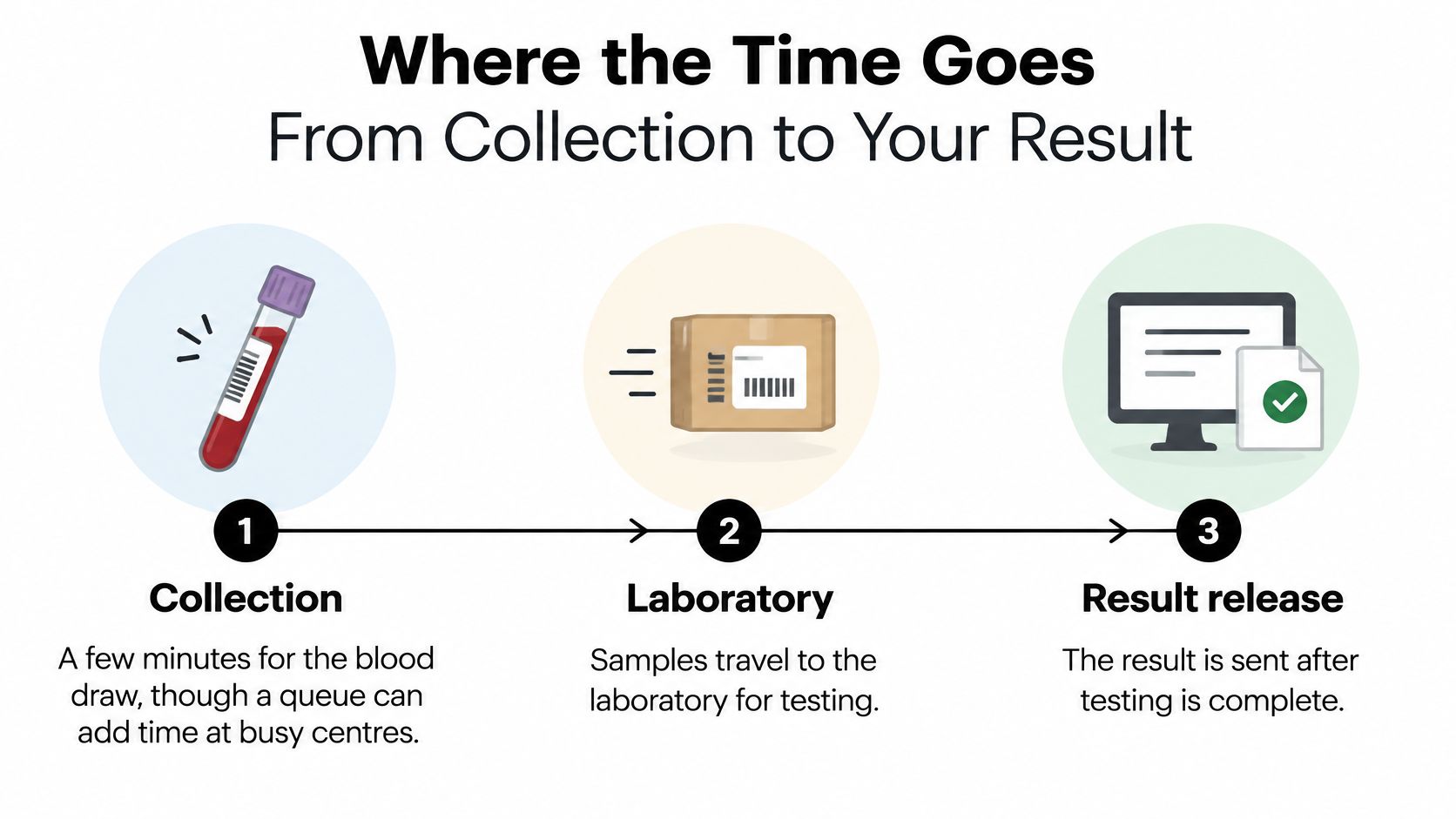
Follow the handovers
- Collection and transport: The collector labels your sample and arranges its journey to the laboratory. A completed collection appointment doesn't establish that testing has started.
- Laboratory processing: Staff check the sample, perform the requested tests and verify the findings. A referred test needs another handover to the laboratory performing it.
- Clinician receipt and review: The requesting practitioner receives the released report and considers it alongside your symptoms, history and previous findings.
- Patient access: You receive a call, attend a review or gain access through the relevant digital service.
Say the collection centre confirms your sample arrived, but the clinic has no report. You're probably asking about laboratory processing or release, not a portal problem.
If the clinic has received the report but you haven't heard anything, ask whether a clinician has reviewed it and how you'll receive the explanation. The useful question is which handover has happened, rather than whether the test is ready.
A completed laboratory report, a reviewed result and a patient-visible result are different milestones.
Before collection, ask your doctor: When will the result be released to me, and will you call me or should I check online?
Why Some Results Take Longer Than Expected
A short blood draw doesn't necessarily mean a short testing process. The method matters: some investigations need repeated samples, additional measurements, confirmation or specialist interpretation before the laboratory can finish the report.
An oral glucose tolerance test shows the distinction clearly. Healthdirect's blood-glucose testing guidance describes fasting, drinking a glucose solution and repeat samples at approximately one and two hours, making the collection visit itself about two hours before laboratory reporting begins.
A collection appointment can be part of the test
For a straightforward blood draw, leaving the collection chair usually means the sampling is finished. For a timed investigation, staff need to collect the required samples in sequence.
That's why you should confirm the appointment instructions rather than treating every pathology request as a quick walk-in visit. Ask whether you need to stay at the centre, whether fasting is required and whether the investigation needs a booking.
The time spent collecting samples and the time spent analysing them are separate. An estimate for laboratory reporting doesn't replace the appointment duration.
A panel finishes when its slowest component finishes
Consider a request containing routine chemistry, reproductive hormones and a nutrient marker. The routine components may appear first, while the laboratory continues processing the remaining assays.
That doesn't necessarily mean a result has gone missing. It may mean the order contains tests with different processing schedules.
Several practical factors can extend the wait:
- Test method: Additional measurements or confirmation can be necessary before a finding is final.
- Batch schedules: Some assays are processed in groups rather than continuously.
- Referral arrangements: Another laboratory may perform a specialised component.
- Specialist review: A report may need interpretation before release.
Weekends and public holidays can also affect routine transport, batching and follow-up arrangements. Don't add a fixed delay yourself, because the effect isn't identical across laboratories or tests.
Rapid HIV screening illustrates another potential misunderstanding: an initial screening result isn't always the final diagnostic answer. A reactive rapid result requires laboratory confirmation, so the speed of the initial screen doesn't tell you when the investigation will be complete.
Planning rule: Use the expected completion date for the whole panel, not the first result that appears.
If your result seems late, establish whether the order was a single assay or a multi-part panel, and whether anything went to another laboratory. A longer turnaround alone doesn't establish that something is wrong with your health.
How Results Reach You Online and in Your Health Record
Digital access has its own timing. A laboratory can finish a report before it appears in the place you're checking, and your clinic's portal isn't necessarily the same service as My Health Record.
This diagram shows the handovers between testing, clinical care and your digital record.
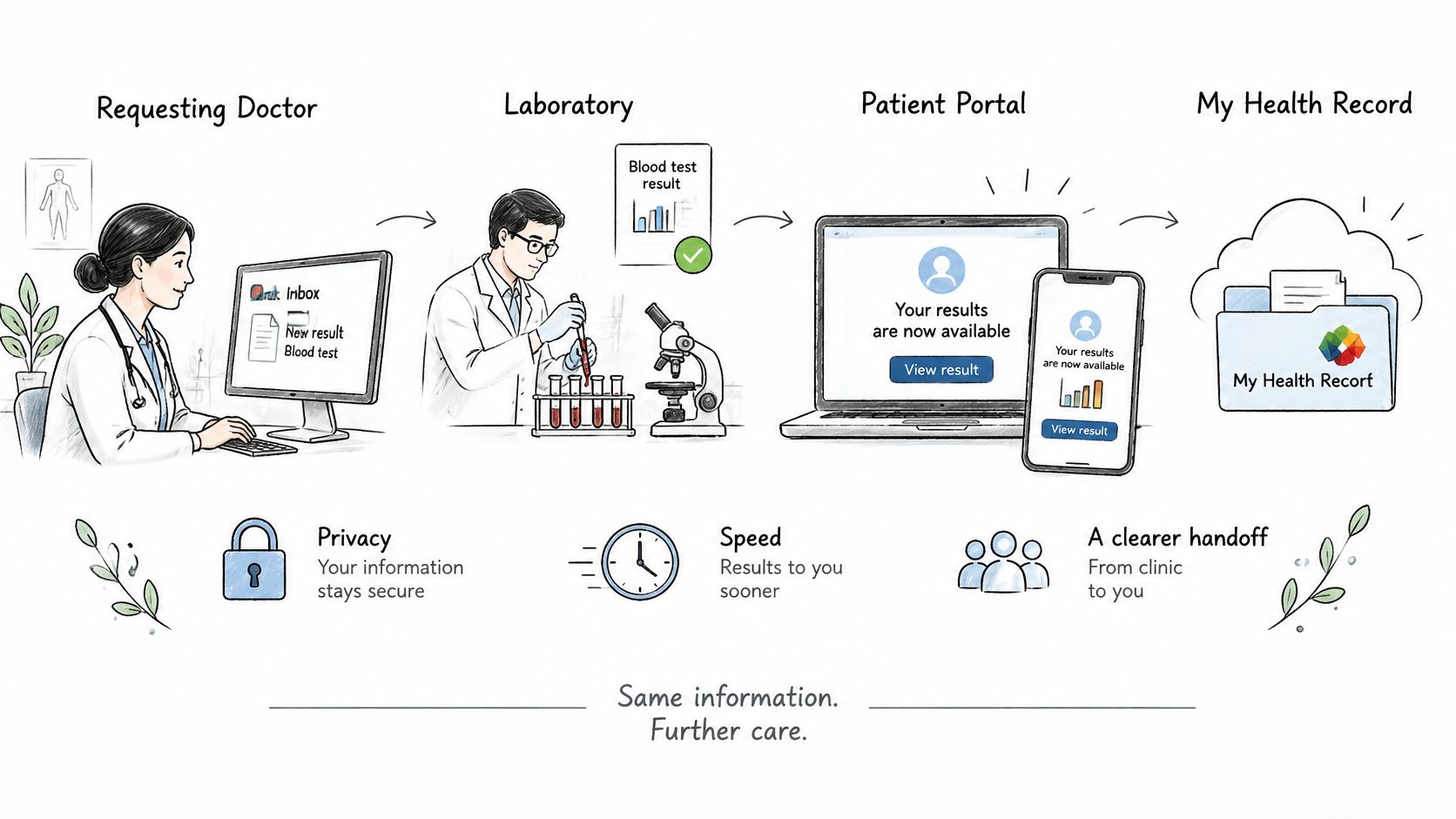
PathWest's results guidance states that from 1 July 2026, most pathology results must be uploaded to My Health Record within 24 hours after being finalised. That upload timeframe starts after finalisation, not after collection, and the word most matters: it shouldn't be read as an unconditional promise for every report.
Check the destination before chasing the result
An emailed notification, a clinic portal and My Health Record serve different purposes. Establish where you've been told your report will appear, and make sure you can sign in before you need to retrieve it.
- Check the intended service after the expected date. Look in My Health Record or the nominated laboratory or clinic portal, rather than assuming every service will display the same information.
- Ask what was released if the report is missing. If the laboratory says testing is complete, ask which report was issued, when it was issued and where it was sent.
- Contact the requesting clinician if the status remains unclear. The clinic can establish whether it received the report and whether a review or follow-up appointment is needed.
A partial report can also create confusion. Check whether all requested tests are listed before assuming that the visible document represents the complete order.
For more context on digital health information, the following video provides another resource.
Access isn't interpretation. Our guide to how to interpret blood test results can help you prepare questions, but your clinician still needs to connect the findings with your circumstances.
Don't change prescribed treatment solely because a portal flags a value. Ask what the finding means and whether it changes your care.
What to Do If Your Result Is Overdue or Urgent
Urgent or critical results are prioritised and communicated once released; routine results are delivered as testing is completed. Neither pathway makes it safe to ignore new or worsening symptoms while you wait.
Chest pain, sudden weakness or difficulty breathing shouldn't wait for pathology results. Seek urgent care now, and call 000 in an emergency. If symptoms are worsening without an obvious emergency, contact your treating clinician rather than relying on a pending report.
The distinction between routine follow-up and urgent action is shown below.
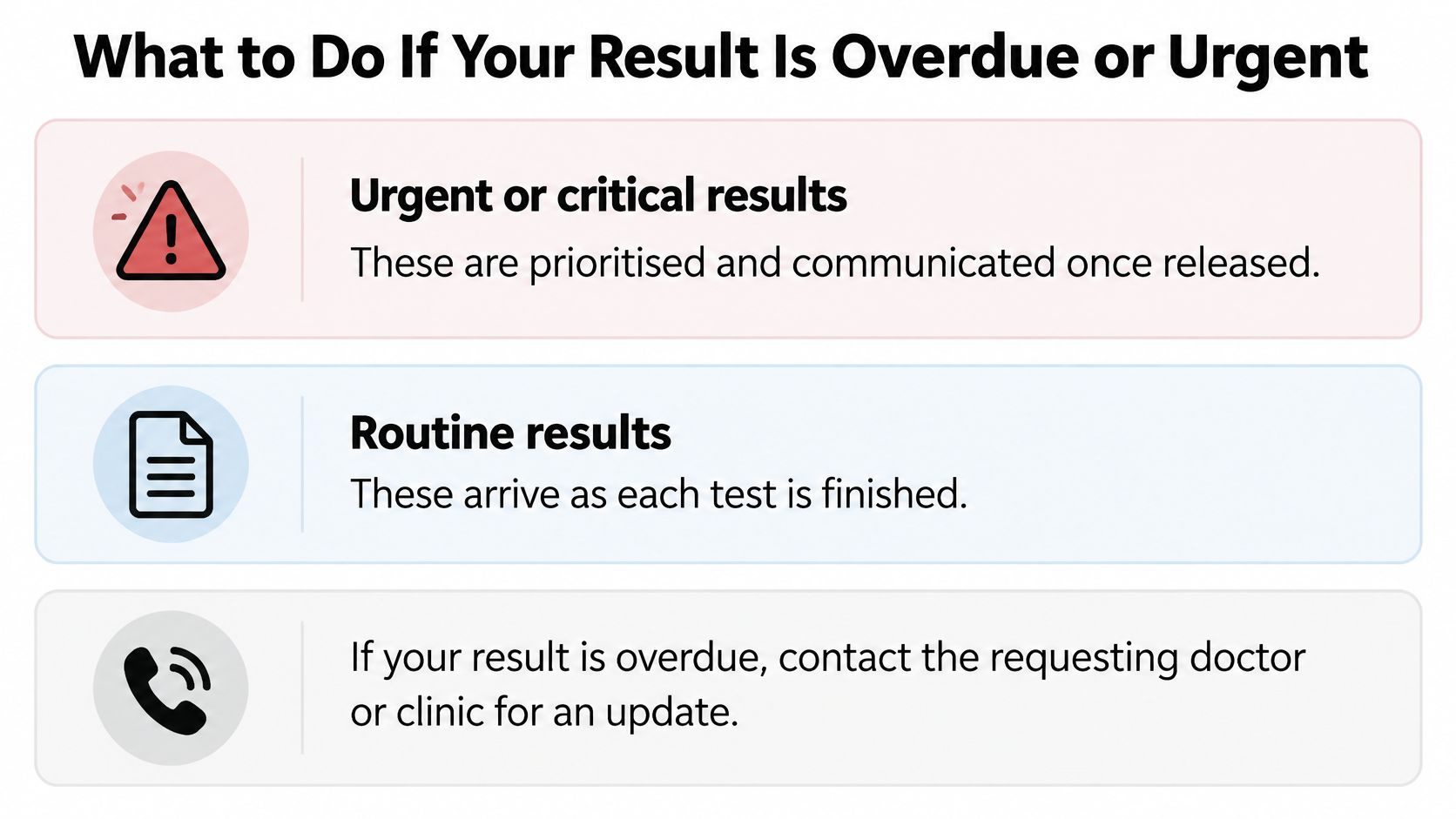
Routine or urgent, what to expect and what to do
| Situation | Typical timing | What to do |
|---|---|---|
| Routine test, normal workflow | Within the laboratory's routine reporting window | Follow the agreed review plan and check the nominated portal |
| Routine test past the expected date | Past the date the laboratory or doctor gave | Call the laboratory, then the requesting doctor |
| Urgent or critical result | Prioritised and communicated once released | Respond to contact and ask the doctor for the care plan |
| Severe symptoms while waiting | Not a waiting scenario | Seek urgent care now; call 000 in an emergency |
A delay can reflect specialist testing, referral arrangements or reporting requirements rather than the result itself. The Australian Digital Health Agency's guidance on faster access to health information explains that reports can take days or weeks to finalise, depending on the type of investigation.
Your chase checklist
- Confirm the outstanding tests. Ask which requested tests have been reported so you can identify the missing component.
- Check sample receipt and referral status. Ask the collection provider whether the laboratory received the sample and whether another laboratory is involved.
- Request a revised expected date. Ask the requesting clinician when the remaining report and clinical review should be available.
- Follow up when that date passes. Contact the clinic so an unresolved delay doesn't remain unnoticed.
Keep the conversation specific. Asking whether your hormone assay is still pending is more useful than asking whether your blood tests are back.
Before calling, write down the test name, collection date and laboratory reference number, if you have it. Also note any changed symptoms, because your clinical needs may have changed while testing was underway.
Book Your Test Around the Slowest Result
Before booking, list every test on the request and organise your review around the slowest expected result. A consultation scheduled for the first routine result may be too early to discuss the complete order.
The aim isn't to build in an arbitrary waiting period. It's to leave enough room for the actual tests, their reporting arrangements and a meaningful clinical discussion.
Set up the appointment in the right order
- List the individual tests. Use the pathology request rather than relying only on the panel's marketing name.
- Identify specialist components. Treat a referred assay as a potential scheduling constraint until its expected date is confirmed.
- Check calendar effects. Ask whether weekends or public holidays affect the relevant collection, transport or reporting arrangements.
- Leave room before review. Arrange the follow-up for when the complete report is expected, with some flexibility if a component remains pending.
Preparation matters too. Check which blood tests require fasting and follow the instructions attached to your request rather than fasting automatically for every test.
Apply it to a mixed request
Say you have an FBC and TSH collected on Monday, alongside a hormone panel that needs referral. Don't book the discussion solely around when the routine tests are expected, because the referred component may still be pending.
Tell the clinician what you want the appointment to achieve. If the purpose is to review the complete hormone and general-health picture, ask whether the consultation should wait until every component is available.
With our service, private blood testing is available across Australia through nearby NATA-accredited collection centres. We deliver results directly to customers within 24 to 72 hours from NATA-accredited laboratories, and our partnered telehealth GPs can explain findings, answer questions and recommend next steps from home.
Keep the delivery window separate from your review appointment. Receiving the document gives you the information; discussing it helps you decide what to do with it.
Know the slowest test, know who releases the result, and know who to call if it's late.
Vital iQ Health offers online private blood testing across Australia, with collection through NATA-accredited centres and results delivered directly to you. Visit Vital iQ Health to explore testing options, locate a collection centre and arrange partnered telehealth GP support to understand your results and next steps.