Normal Thyroid Levels: What Your Blood Test Results Mean
Check normal thyroid levels for TSH, free T4 and free T3 in Australia, why lab ranges differ, and what to do with a borderline result.
For most adults in Australia, a normal thyroid-stimulating hormone (TSH) result sits between 0.4 and 4.0 mIU/L, and plenty of reports print a working range closer to 0.5 to 4.0 mIU/L. The interval printed beside your own result overrides those figures, because each laboratory validates its own method and sets its own limits.
Thyroid results carry more weight than their size suggests. The Royal Australian College of General Practitioners reports that recognised thyroid disease affects approximately 10% of Australians aged over 50 years, with a further 3.6% carrying unrecognised thyroid dysfunction found through an abnormal TSH result, as healthdirect's guide to thyroid function tests records.
The catch is that "normal" isn't one fixed number. It depends on the laboratory that ran the test, on whether you're pregnant, and on what else is happening in your body, which is why a single borderline TSH is usually confirmed with a repeat test rather than treated on the spot. Reading a thyroid panel well comes down to three habits: know what each marker measures, read the markers as a pattern rather than one at a time, and confirm a borderline value before acting on it.
Normal Thyroid Level Ranges at a Glance
The Royal College of Pathologists of Australasia lists an adult TSH reference interval of 0.4–4.0 mIU/L, and notes that the applicable interval can vary with the laboratory method used (RCPA Manual, thyroid-stimulating hormone). Many Australian reports print a range closer to 0.5–4.0 mIU/L, which is the same idea in slightly different clothes.
TSH is the message your pituitary sends to your thyroid, and it's normally the first test ordered because it responds more sensitively than free thyroxine (FT4) to changes in thyroid status. When thyroid output drifts, TSH moves first and moves furthest, so it works as an early alarm.
| Marker | Adult reference interval | What it tells you |
|---|---|---|
| TSH (thyroid-stimulating hormone) | 0.4–4.0 mIU/L (RCPA); often reported as about 0.5–4.0 mIU/L | First-line screen of thyroid function; responds sensitively to small changes |
| Free T4 (FT4) | 12–22 pmol/L (example Victorian public laboratory) | Circulating thyroid hormone; read with TSH to separate primary from mild disease |
| Free T3 (FT3) | 3.1–6.8 pmol/L (example Victorian public laboratory) | Active thyroid hormone; usually ordered when an overactive thyroid is suspected |
Reference limits are not diagnostic cut-offs
Those figures describe where most healthy people sit. They aren't diagnostic cut-offs that sort you into well or unwell on their own. Laboratories use different assays, and age, pregnancy, treatment status, acute illness and pituitary disease all shift how a result should be read.
A number sitting a hair outside the interval is not automatically a diagnosis, and a number sitting a hair inside it is not a guarantee. Both are information to read alongside your symptoms, your history and the other markers on the report.
Three details to check on your own report
- The marker name. TSH, free T4 and free T3 are three different measurements, and a report that lists "T4" may mean total T4 rather than the free fraction. Read the label before the number.
- The unit. TSH appears as mIU/L on some reports and mU/L on others. The two are used interchangeably, so don't read a unit change as a change in your health.
- The interval beside the result. This is the only range that applies to the assay that measured your blood.
Read first, worry second: find the interval printed next to your result before you compare the number to anything you've read online.
A result inside that printed interval is reassuring, and in a person with no thyroid symptoms it usually means the thyroid is working as expected. It's still read alongside how you feel, what medicines you take and why the test was ordered.
What TSH, Free T4 and Free T3 Tell You Together
Think of the system as a thermostat and a heater. The pituitary is the thermostat, and TSH is its request for heat. Free T4 is the warmth the thyroid delivers; free T3 is that warmth in the form it gets used around the body.
A thermostat calling loudly while the heater struggles shows up as high TSH with low free T4. A thermostat that goes quiet because the room is already too warm shows up as low TSH with high free T4. When request and delivery are both in range, the system is running as it should.
| TSH result | Free T4 result | Usual meaning |
|---|---|---|
| High | Low | Primary hypothyroidism; the thyroid is not producing enough hormone |
| High | Within range | Mild or subclinical hypothyroidism; confirm before treating |
| Low | High | Possible overactive thyroid; free T3 is often added |
| Within range | Within range | Primary thyroid dysfunction is unlikely |
A raised TSH with FT4 below the laboratory interval supports primary hypothyroidism, while a raised TSH with FT4 still inside its interval indicates mild or subclinical hypothyroidism, as the RACGP's Australian Journal of General Practice guidance on thyroid diagnostic tools explains. In someone with a low chance of thyroid disease, a TSH inside the interval generally excludes clinically significant dysfunction and usually doesn't need repeating for several years.
Free T3 isn't part of most screening panels. It earns its place when an overactive thyroid is suspected, or when TSH is low and the picture needs filling in. And a normal TSH doesn't fully rule out a pituitary problem, because a damaged pituitary can fail to send the signal at all; convincing symptoms with a normal TSH deserve a second look rather than a shrug.
If your TSH stays high, the next question is often whether your immune system is targeting the gland, which is what thyroid antibody testing is designed to detect. Find the row in the table above that matches both of your results before you draw any conclusion from one number alone.
Why Normal Ranges Differ Between Laboratories
Ask three pathology services for their normal TSH range and you can get three different answers, all correct for the method each one uses.
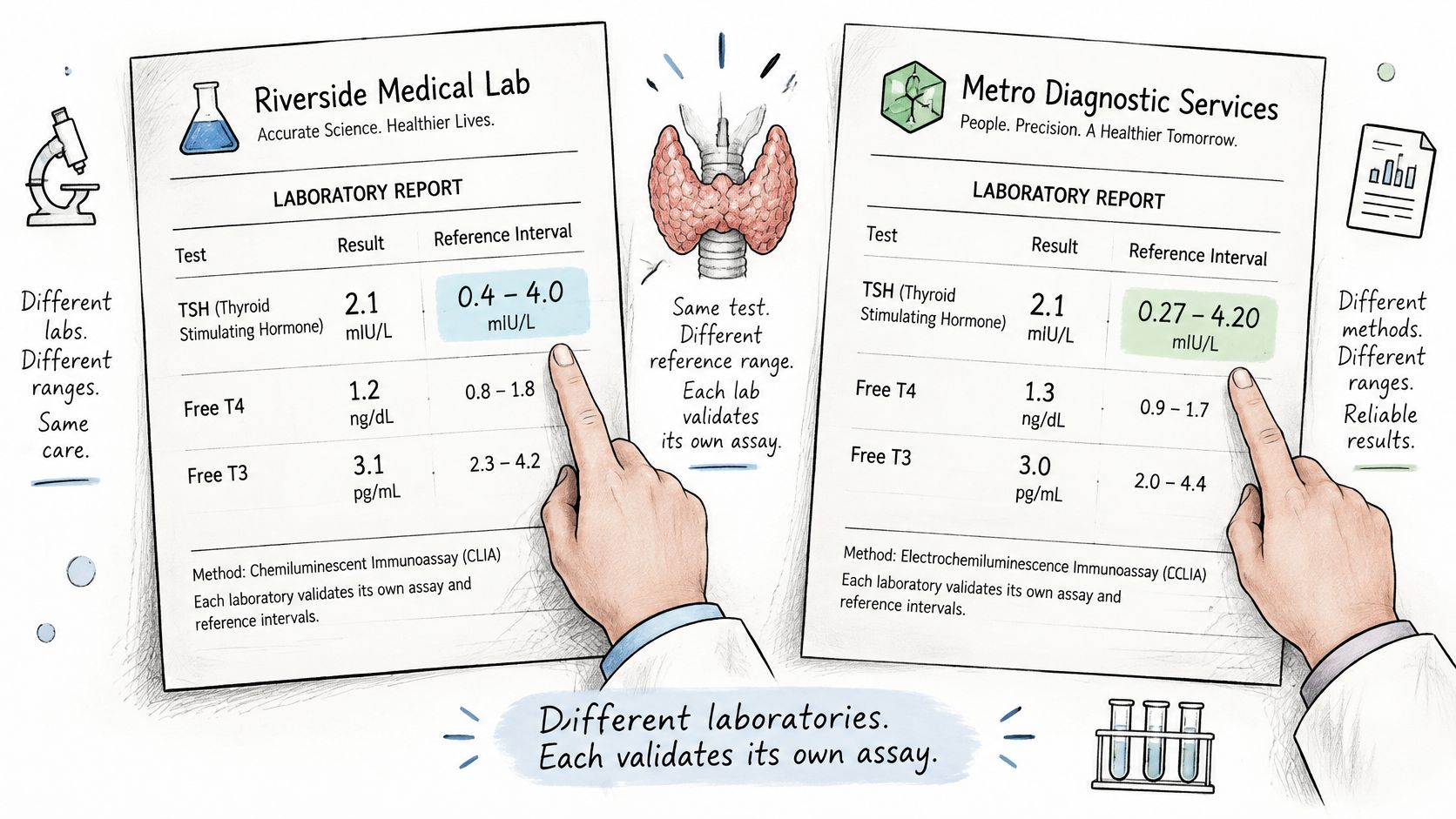
A reference interval works like a clothing size chart. Each manufacturer measures its own population, so a "medium" from one brand can differ from a "medium" from another, and both can be accurate. Laboratories do the same thing. Each one validates its own assay against its own reference population, then prints the resulting interval on your report. Because the assays and the populations differ between laboratories, so do the intervals, which is why the range that applies to your result is the one printed beside it (Australian Prescriber, thyroid function tests).
This has a practical consequence. A TSH sitting just outside one laboratory's interval can fall inside another's, so the same blood sample can be read as borderline on one report and unremarkable on the next. That is one reason a single borderline result is usually confirmed with repeat testing before anyone talks about treatment.
Reference interval or treatment target
These are two different things, and mixing them up causes a lot of unnecessary worry. A reference interval describes the range where most healthy people in that laboratory's population fall. A treatment target is a narrower figure your clinician sets for you personally, usually because you're taking levothyroxine, are pregnant, or have another condition that changes what "good" looks like.
Age, medicines, acute illness and pituitary disease all shift interpretation. So does the reason the test was ordered: a result from a screening panel and a result from a diagnostic workup get read differently. Here is a short walkthrough of how results are read in practice.
Symptoms matter less than many expect. Fatigue is nonspecific and correlates poorly with thyroid hormone deficiency, which is why persistent tiredness with a normal TSH should send you looking at sleep, iron, mood and other causes rather than straight to thyroid treatment. Learning how to interpret blood test results in general makes this easier, because you start with the interval and the pattern rather than the number alone.
A reference interval is a guide; your clinician interprets your individual result.
Normal Thyroid Levels During Pregnancy
The adult range stops applying once you're pregnant. A TSH that would be unremarkable outside pregnancy can matter during it, because pregnancy stimulates the thyroid axis and the growing foetus depends on your thyroid hormone. Think of the adult interval as a wide doorway: pregnancy makes that doorway narrower, so a result near the edge deserves closer attention.
The Royal Australian College of General Practitioners gives approximate trimester ranges that sit lower and narrower than the adult interval (RACGP, thyroid disease in the perinatal period).
| Trimester | Approximate TSH range |
|---|---|
| First trimester | 0.1–2.5 mIU/L |
| Second trimester | 0.2–3.0 mIU/L |
| Third trimester | 0.3–3.0 mIU/L |
Your own report may print different pregnancy limits, and units may appear as mIU/L or mU/L. Use the interval beside your result, in the same unit, rather than a generic adult table or a table in an article.
If you take levothyroxine
Pregnancy often changes dose requirements, so monitoring becomes tighter rather than looser. Australian guidance uses lower TSH targets before conception and during pregnancy, but the exact target is set by your clinician using your history, dose, symptoms and laboratory range.
- Testing frequency: TSH and FT4 are checked roughly every 4 to 6 weeks during the first half of pregnancy.
- Timing: arrange a thyroid check as soon as pregnancy is confirmed, rather than waiting for the next routine visit.
- Dose changes: never adjust your own dose after a single reading; contact your clinician promptly, especially if the result is clearly outside the pregnancy interval or symptoms change.
A value outside the pregnancy interval warrants prompt clinical review, because pregnancy context can turn a borderline adult number into a result that needs action.
What to Do With a Borderline TSH Result
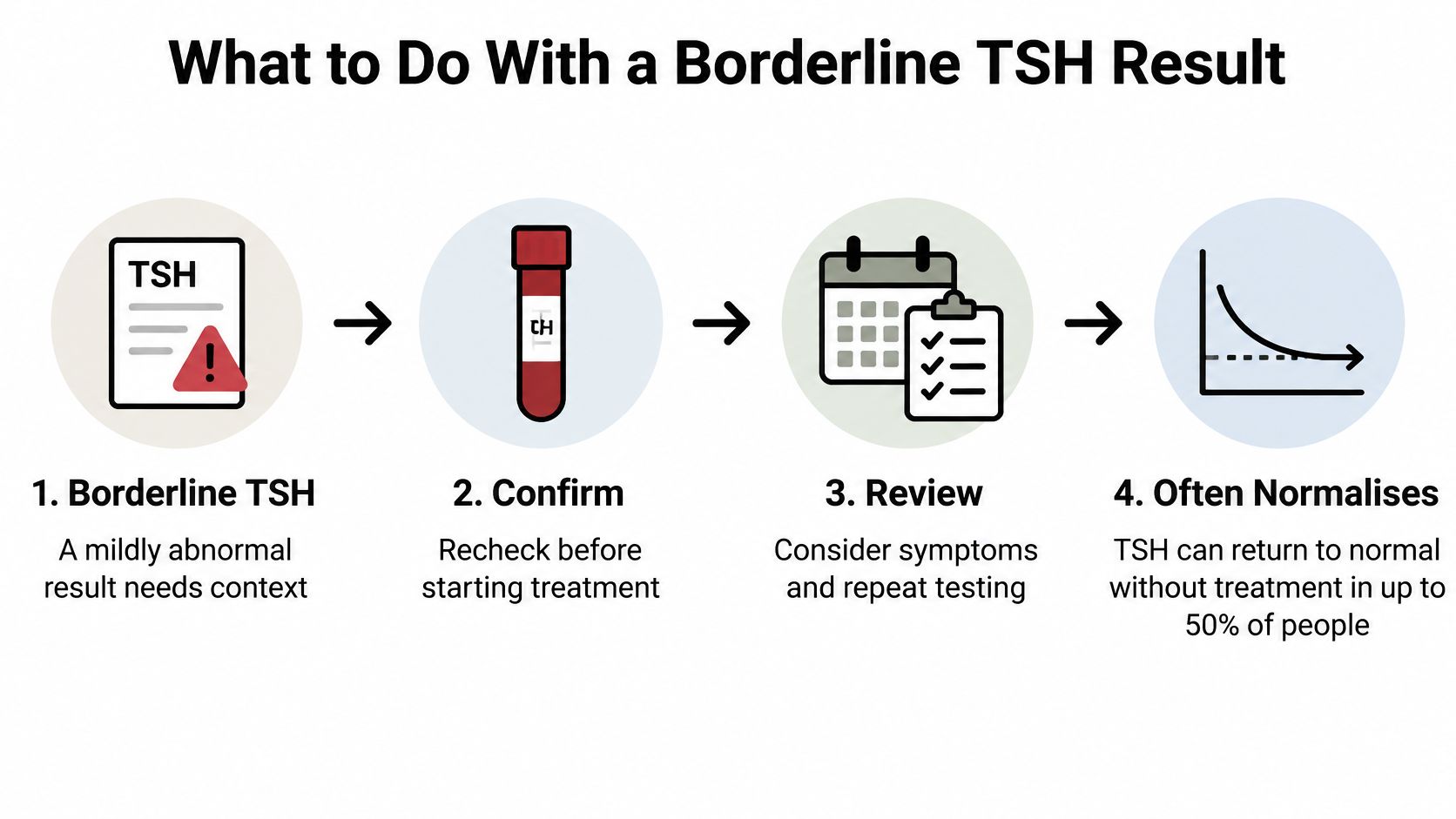
The Eastern Health pathology handbook reports that TSH can return to normal without any treatment in up to 50% of people with mildly high results, and recommends repeating TSH and free T4 after 6–8 weeks to confirm the finding (Eastern Health pathology handbook, thyroid function). A single slightly high reading works like one photo of a moving scene. It shows a moment, not a pattern.
Here is the routine that follows from it.
- Check your own interval first. Confirm the number sits outside the range printed beside it, in the unit the laboratory used.
- Read free T4 next. A raised TSH with a low FT4 is a different situation from a raised TSH with a normal FT4.
- List what could be interfering. Note your medicines, any supplements (high-dose biotin can distort some immunoassays), recent illness and whether pregnancy is possible.
- Repeat the test after 6–8 weeks. This step is frequently skipped, yet it is the one that resolves the question.
- Ask about thyroid antibodies if TSH stays raised. A mildly raised TSH rarely requires treatment on its own, but a persistently raised result combined with thyroid antibodies predicts a greater risk of eventual hypothyroidism and supports ongoing follow-up.
- Compare the pair, not the single reading. A TSH drifting back into range reads differently from one that keeps climbing, and the direction across both results is what a clinician weighs.
Why the repeat comes before the treatment
A borderline result has several possible explanations, and only some of them are thyroid disease. Assay variation, a temporary illness, a new supplement, the time of day the sample was taken and pregnancy can all nudge TSH without anything being wrong with the gland. Treating the first reading would mean treating a number that, in many cases, was never going to stay high.
Screening adults who feel well tends to produce exactly this kind of ambiguous result, which is why thyroid testing is generally aimed at people with symptoms, a history of thyroid disease or specific risk factors rather than offered to everyone.
The better question: "what should happen next if my TSH is slightly high or low".
Self-diagnosing from one borderline result is how people end up on treatment they never needed. Confirm the pattern, then act.
Confirm Your Next Step With a Clinician
The decision in front of you isn't really about the number. It's about whether the result needs follow-up, and who should do it.
Bring these five things to that conversation.
- The full report, including the printed interval for every marker, not just the TSH.
- The date of the test, since timing matters for repeat intervals and for pregnancy.
- A list of current medicines and supplements, including doses.
- Your pregnancy status or the possibility of pregnancy.
- Your symptoms, with when they started, rather than a general "I've been tired".
A GP reads all of that together with your history and decides whether a repeat test, an antibody check or a referral is the next move. For a borderline value, a repeat is often the whole answer.
When not to wait
Some results need same-week attention rather than routine follow-up: a markedly abnormal TSH, pregnancy with an out-of-range result, or symptoms that point to a pituitary problem. In those situations, book the appointment rather than the repeat test.
Some Australians arrange private blood testing when they want to check a marker between GP visits, and Vital iQ Health offers private blood tests that customers can order online without a GP referral or GP visit, with results delivered within 24–72 hours from NATA-accredited laboratories. Ordering the test is the easy part. Reading it in context is where a clinician earns their place, especially in pregnancy or when symptoms persist.
If you're mapping a wider picture of your hormones rather than a single marker, how to test hormone levels explains what different panels cover and when each is worth ordering.
Three rules carry everything in this article. Read the interval printed on your own report, read the markers together rather than one at a time, and confirm a borderline value before you act on it.
Vital iQ Health offers private thyroid and metabolic blood testing across Australia, with panels that measure TSH, free T3 and free T4 together so you can see the whole pattern rather than a single number. You can order online without a GP referral, attend a NATA-accredited collection centre near you, and have results back within 24 to 72 hours. Visit Vital iQ Health when you're ready to check your levels, and take your report to a clinician to interpret it against your own history.