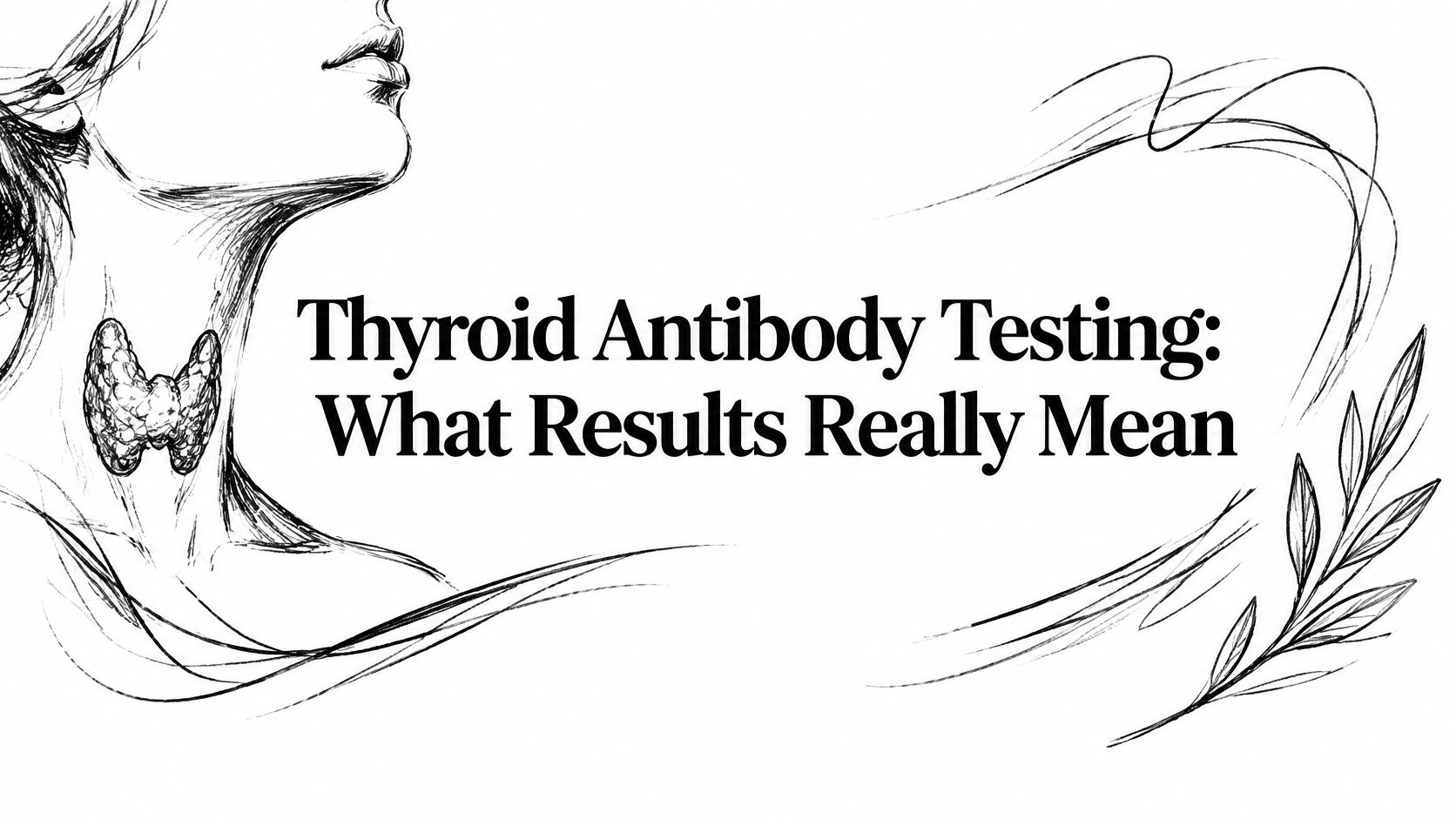
Thyroid Antibody Testing: What Results Really Mean
Learn what thyroid antibody testing measures, when it's worth ordering, and how TPO and TgAb results fit with TSH and free T4.
You opened the patient portal after a week of dragging yourself through work, and one line is flagged. Thyroid antibodies: positive. Nobody walked you through the words, so your mind has already moved from "a bit tired" to "I'll be on medication for life."
That leap is common, and it's usually too fast. Thyroid antibody testing looks for immune proteins that stick to parts of the thyroid. It doesn't measure the hormones the gland is making today. A positive result in someone who feels mostly well is often a reason to watch thyroid function over time, not a reason to start treatment the same week.
The question that comes first is simpler than the result. Did you need an antibody test at all, and if you did, which antibody matches the problem your symptoms suggest?
Thyroid Antibody Tests at a Glance
Say you've had months of tiredness. The form comes back and TPO antibodies are marked high. The report still doesn't say whether your thyroid is slow, fast, or working normally. These tests detect immune proteins aimed at thyroid tissue. They don't detect thyroid hormone itself.
Three assays get lumped together because they all sound like "thyroid antibodies." They answer different questions, and a positive on one doesn't stand in for the others.
| Antibody test | What it targets | Most useful for | Detection rate |
|---|---|---|---|
| TPO antibodies (TPOAb) | Thyroid peroxidase enzyme | Autoimmune hypothyroidism such as Hashimoto thyroiditis | 90–100% in chronic autoimmune thyroiditis; 8–27% of the general population |
| Thyroglobulin antibodies (TgAb) | Thyroglobulin protein | Supporting evidence of autoimmunity; mainly thyroid cancer follow-up | 80–90% in chronic autoimmune thyroiditis; about 5–20% of the general population |
| TSH-receptor antibodies (TRAb) | TSH receptor on thyroid cells | Suspected Graves disease | 90–99% of Graves disease cases |
RACGP guidance reports that TPOAb occurs in approximately 8–27% of the general population, while TgAb occurs in about 5–20%. In an Australian cohort of people without a history of thyroid disease, the corresponding figures were 11% for TPOAb and 5% for TgAb. In chronic autoimmune thyroiditis, detection rises to 90–100% for TPOAb and 80–90% for TgAb. In Graves disease, TSH-receptor antibodies are reported in approximately 90–99% of cases, compared with 50–80% for TPOAb and 50–70% for TgAb.
What each test is actually for
TPOAb targets thyroid peroxidase, an enzyme the gland uses while it builds hormone. It's the usual test when the suspicion is autoimmune hypothyroidism, including Hashimoto thyroiditis. A high rate inside that disease, set against a noticeable rate in the wider population, is why a positive result supports the diagnosis without proving it on its own.
TgAb targets thyroglobulin, a storage protein inside thyroid cells. It can add evidence of autoimmunity, especially if the picture is incomplete. In ordinary primary care it isn't the first test you reach for, and its clearer ongoing use is follow-up after thyroid cancer treatment.
TRAb targets the receptor that TSH normally switches on. Stimulating antibodies at that receptor drive an overactive gland. This is the assay that fits suspected Graves disease, not a general check for a slow thyroid.
Practical rule: Pick the antibody that matches the question. A positive TPOAb doesn't settle Graves disease, and a TRAb result doesn't replace a Hashimoto work-up.
Positivity is common enough that a flagged line is a weak diagnosis by itself. The useful step is choosing the antibody that fits the suspected condition, then reading it beside the hormone results.
Why the Immune System Targets the Thyroid
Think of the immune system as a building's security team. It's meant to check visitors and stop intruders. The thyroid is one tenant, turning out hormone the rest of the body uses for energy, temperature, and heart rate. In autoimmune thyroid disease, the team starts tagging the tenant's own equipment. Antibodies are those tags, stuck onto thyroid proteins the body should have left alone.
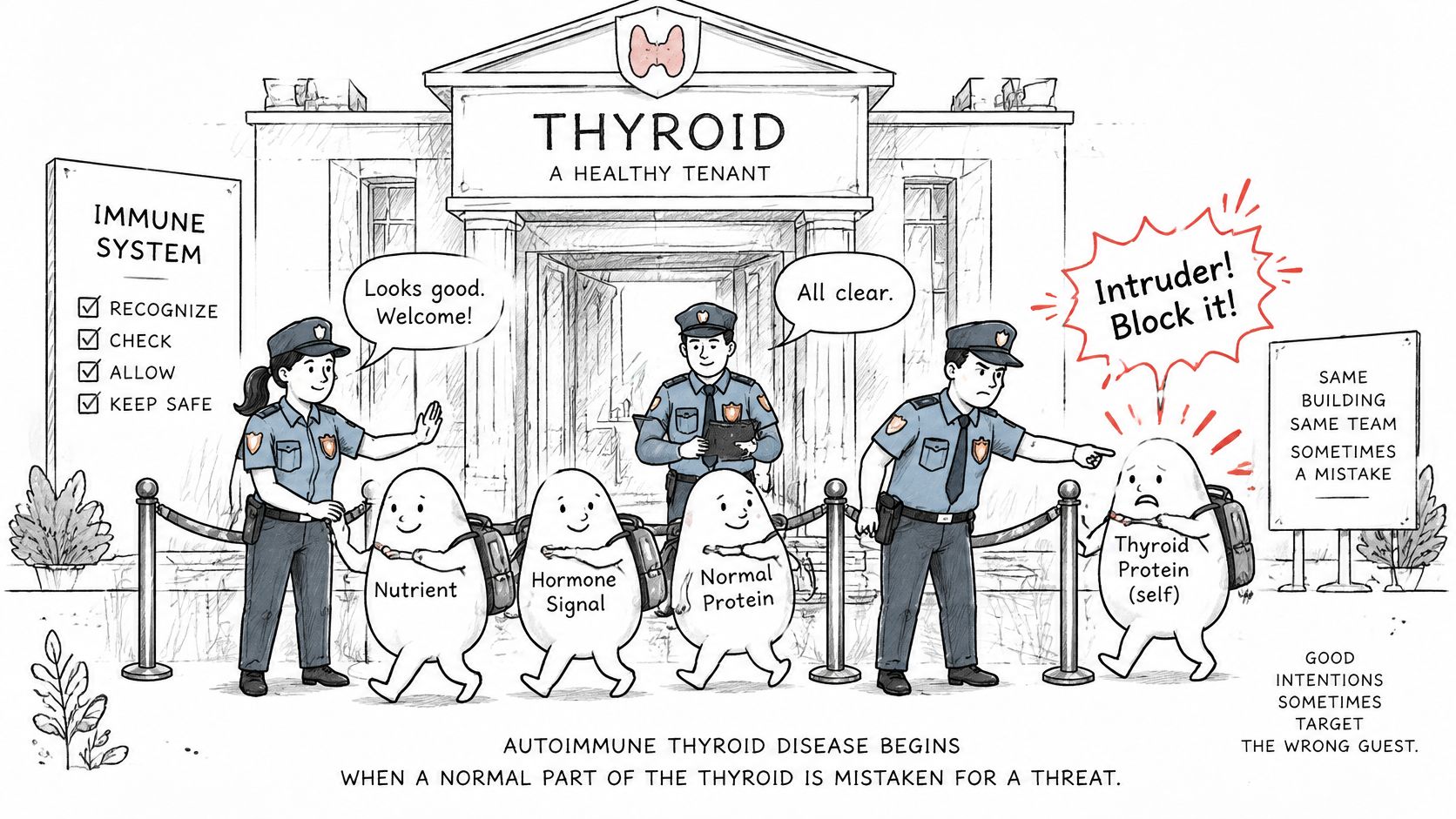
The tags can persist for years while the gland still makes enough hormone. You can feel ordinary, pass a routine check, and still carry antibodies. Hormone levels shift only after enough tissue is affected, or after stimulating antibodies push the gland too hard.
Two different outcomes
Once you drop the security image, the biology splits in two directions.
Hashimoto thyroiditis is gradual immune damage. Output falls and the person develops hypothyroidism. Typical features include tiredness, feeling cold, weight gain, dry skin, and a slower pulse. The gland is being worn down, not switched into overdrive.
Graves disease runs the other way. Antibodies stimulate the TSH receptor, the gland releases too much hormone, and the person develops hyperthyroidism. A racing heart, heat intolerance, weight loss, anxiety, and sometimes a goitre are the usual clues. Same organ, opposite hormone problem, different antibody doing the work.
The Busselton thyroid study tested 2,115 Western Australian adults who took part in a 1981 health survey. Among participants without a previous history of thyroid disease, 12.4% had raised thyroid antibodies, as set out in a Medical Journal of Australia review. Antibody positivity shows up in people who have never been told they have thyroid disease.
The short clip below shows how that immune misfire looks at the gland itself.
An antibody is evidence of an immune process. It isn't a verdict on how the thyroid is working today. That verdict comes from TSH and free T4, read with symptoms, pregnancy status, and clinical history.
When Antibody Testing Is Worth Ordering
Routine antibody screening of adults who feel well isn't recommended. RACGP guidance on hypothyroidism doesn't recommend routine thyroid-dysfunction screening for asymptomatic adults, and routine screening in pregnancy is generally not recommended because the evidence is insufficient. Ordering a panel "just in case" mostly creates incidental positives, repeat blood tests, and worry that doesn't change care.
Testing earns its place when something already raises the chance that the thyroid, or autoimmunity aimed at it, is involved.
| Situation | Test that usually helps | Why it matters |
|---|---|---|
| Symptoms of an underactive or overactive thyroid | TSH and free T4 first, then TPOAb if TSH is abnormal | Antibodies alone don't explain symptoms |
| Visible or palpable goitre | TPOAb; TRAb if the thyroid is overactive | A goitre prompts assessment of the thyroid |
| Pregnancy with a risk factor | TPOAb early in pregnancy, in line with clinical guidance | Routine pregnancy screening isn't generally recommended |
| Previous thyroid disease or earlier positive antibodies | Repeat only when clinically needed | Serial antibody levels seldom change management |
| Type 1 diabetes | TPOAb as a risk marker | Autoimmune thyroid disease is more likely with this condition |
| Asymptomatic adult with no risk factors | No routine antibody test | Incidental positives cause anxiety without changing care |
Where the case for testing is strongest
Symptoms come first. Persistent tiredness, weight change, palpitations, heat or cold intolerance, or a change in bowel habit can point to an underactive or overactive thyroid. TSH and free T4 are measured before antibodies, because an antibody tells you the immune system is involved, not whether the gland is still keeping up. If you're unsure which hormone markers belong in that first draw, our guide to how to test hormone levels sets out the difference between a function test and an immune marker.
A goitre is a reason to look, not a diagnosis. A visible or palpable swelling means the gland needs assessment. TPOAb helps when autoimmune thyroiditis is likely. TRAb is the better add-on if the gland is overactive, including in pregnancy or when a radioactive scan isn't suitable.
Pregnancy changes the context, not the rule. If there's a risk factor, such as known antibody positivity, previous thyroid disease, a goitre, or type 1 diabetes, TPOAb may be checked early in pregnancy in line with clinical guidance. A healthy pregnancy without those factors isn't a reason for a routine antibody screen.
Some histories already answer part of the question. Previous thyroid disease or an earlier positive antibody result rarely needs the antibody repeated for its own sake, because the level itself seldom changes what happens next. Type 1 diabetes is different: it raises the chance of autoimmune thyroid disease, so TPOAb can act as a risk marker when thyroid function is being checked.
The common thread is a prior reason to suspect autoimmunity. Without one, a positive result usually becomes a monitoring signal rather than a treatment trigger, and monitoring you never needed is an odd thing to order a test for.
A test without a question tends to produce a number without a plan. If nothing in the history or the hormone results would change after a positive antibody, don't order it.
Reading Antibodies Alongside TSH and Free T4
A thyroid antibody result is one marker in a three-marker picture. TSH is the pituitary's request signal: it rises when the brain wants more thyroid hormone and falls when it wants less. Free T4 is the gland's current output. TPOAb answers a different question: is the immune system already showing interest in the thyroid? Australian primary-care guidance treats TPOAb as the principal assay for confirming autoimmune thyroiditis, including Hashimoto disease, and describes it as sensitive and specific enough that routine antithyroglobulin testing is generally unnecessary.
That same guidance puts TPOAb positivity at roughly 8–27% of the general population, with thyroid autoantibodies detectable in up to 18% of euthyroid people. That frequency is why a positive antibody cannot carry a diagnosis on its own: in a person with normal TSH and free T4, it signals autoimmune susceptibility and usually sets up monitoring rather than treatment.
| TSH | Free T4 | Antibodies | Typical interpretation |
|---|---|---|---|
| Normal | Normal | Negative | No sign of antibody-related thyroid disease |
| Normal | Normal | Positive | Autoimmunity without current dysfunction; periodic TSH monitoring, usually no treatment |
| Raised | Normal | Positive | Early autoimmune hypothyroidism pattern; clinical review and follow-up |
| Raised | Low | Positive | Overt autoimmune hypothyroidism pattern; clinical review and treatment discussion |
| Low | High | Positive | Possible autoimmune hyperthyroidism; TRAb helps distinguish Graves disease |
| Low | Normal | Negative | Other causes considered; clinician review of symptoms and history |
The rows that change what happens next
Normal TSH, normal free T4, positive antibody. The immune flag is raised and the gland is still meeting demand. The practical response is a periodic TSH check, not a prescription aimed at the antibody itself.
Raised TSH, normal free T4, positive antibody. The pituitary is pushing harder while hormone output holds steady. This early autoimmune hypothyroidism pattern is where symptoms, age, pregnancy plans and the height of the TSH decide whether a clinician watches or treats.
Raised TSH, low free T4, positive antibody. Output has now fallen. This pattern points to overt autoimmune hypothyroidism, and the treatment discussion follows the hormone failure rather than the antibody number.
The two low-TSH rows work the same logic in the opposite direction. Low TSH with high free T4 and a positive antibody raises the possibility of autoimmune hyperthyroidism, where TRAb becomes the more useful test for separating Graves disease from other causes. Low TSH with normal free T4 and negative antibodies sends the clinician back to symptoms, history, medicines, illness and pregnancy-related change.
These rows describe typical patterns, not a diagnosis finished at the kitchen table. A clinician weighs all three markers against symptoms and history before making the call.
TSH and free T4 remain the foundation of the reading. Antibodies earn their place when they explain a hormone pattern or sharpen a risk that is already plausible.
Common Misreadings That Cause Needless Worry
A flagged antibody result is easy to over-read, and each over-reading has a cost. Three mix-ups account for most of the unnecessary worry.
"A positive antibody means I have Hashimoto thyroiditis and I'll need thyroid medication." It means an immune protein against the thyroid was detected. If TSH and free T4 are normal, the usual response is monitoring, not a prescription. Treating the antibody as if it were a low hormone level leads to medicine you don't need, plus side effects from a dose your gland wasn't asking for. Medication replaces hormone when hormone is lacking. It isn't prescribed to erase an antibody.
"I should re-measure the antibody to see if the disease is getting worse." Once positivity is confirmed, repeating the titre seldom changes what happens next. A higher or lower number doesn't reliably grade damage, symptoms, or whether treatment is working. The consequence is a string of costly repeats that don't guide the dose or the interval. The follow-up that matters is a periodic TSH, with free T4 added when TSH moves or the clinical picture changes. If a report is hard to line up, start with how to interpret blood test results before you book another antibody.
"A negative antibody means my thyroid is fine." A negative result lowers the chance of autoimmune thyroiditis. It doesn't exclude an underactive or overactive gland from surgery, radioactive iodine, medicines, pituitary problems, or a phase of thyroiditis. The consequence is false reassurance. If you're still exhausted, losing weight without trying, or noticing a swelling in the neck, the hormone results and the symptoms still need a proper look.
A short rule before you decide what a number means
Ask what the test was ordered to answer, then set the antibody beside the TSH and free T4 on the same report. A number that doesn't answer that question isn't a diagnosis. It's a loose end, and loose ends are for a consultation, not for a late-night search.
Three Real Results and What They Mean
These three people are hypothetical. The sequence is the point: reason for testing, what was ordered, the pattern, then the next step. Swap any one result and the plan changes.
A normal gland with a positive tag
Maya, 34, has months of fatigue and a mother who takes thyroxine. Her GP orders TSH, free T4, and TPOAb because of the symptoms plus the family history, not because fatigue alone proves a thyroid problem.
TSH and free T4 sit inside the reference interval. TPOAb is positive. The pattern is autoimmunity without current dysfunction. Nobody starts thyroxine to chase the antibody. The next step is a planned TSH check, sooner if she becomes pregnant or her symptoms shift in a way that suggests the gland is slowing. Fatigue still needs other explanations, including iron, sleep, and mood, because a positive antibody doesn't claim those symptoms.
An overactive gland that needs the Graves test
David, 52, notices his collar is tight and his resting pulse is high. Examination shows a goitre. TSH is low and free T4 is high, so the gland is overproducing. TPOAb might be positive, but it wouldn't separate Graves disease from other causes of an overactive thyroid.
TRAb is the test that fits. A positive result supports Graves disease and shapes referral, including decisions about scanning when a radioactive uptake test isn't suitable. The next step is specialist review of treatment options, not a repeat of every antibody on the menu.
A pregnancy plan shaped by another autoimmune condition
Priya is planning a pregnancy and has type 1 diabetes. That history is a recognised reason to look, so thyroid function and TPOAb are checked before conception rather than as a routine screen of every pregnancy.
A positive TPOAb with normal TSH and free T4 doesn't automatically mean treatment. It does change the monitoring plan. She and her clinician agree on early TSH checks once she's pregnant, because antibody positivity plus type 1 diabetes is a different risk picture from a symptom-free adult with no history. A negative result would still leave TSH worth knowing before pregnancy, because diabetes alone raises the chance of later thyroid dysfunction.
Each of these cases would read differently if one marker moved. That's why the pattern matters more than any single flagged line.
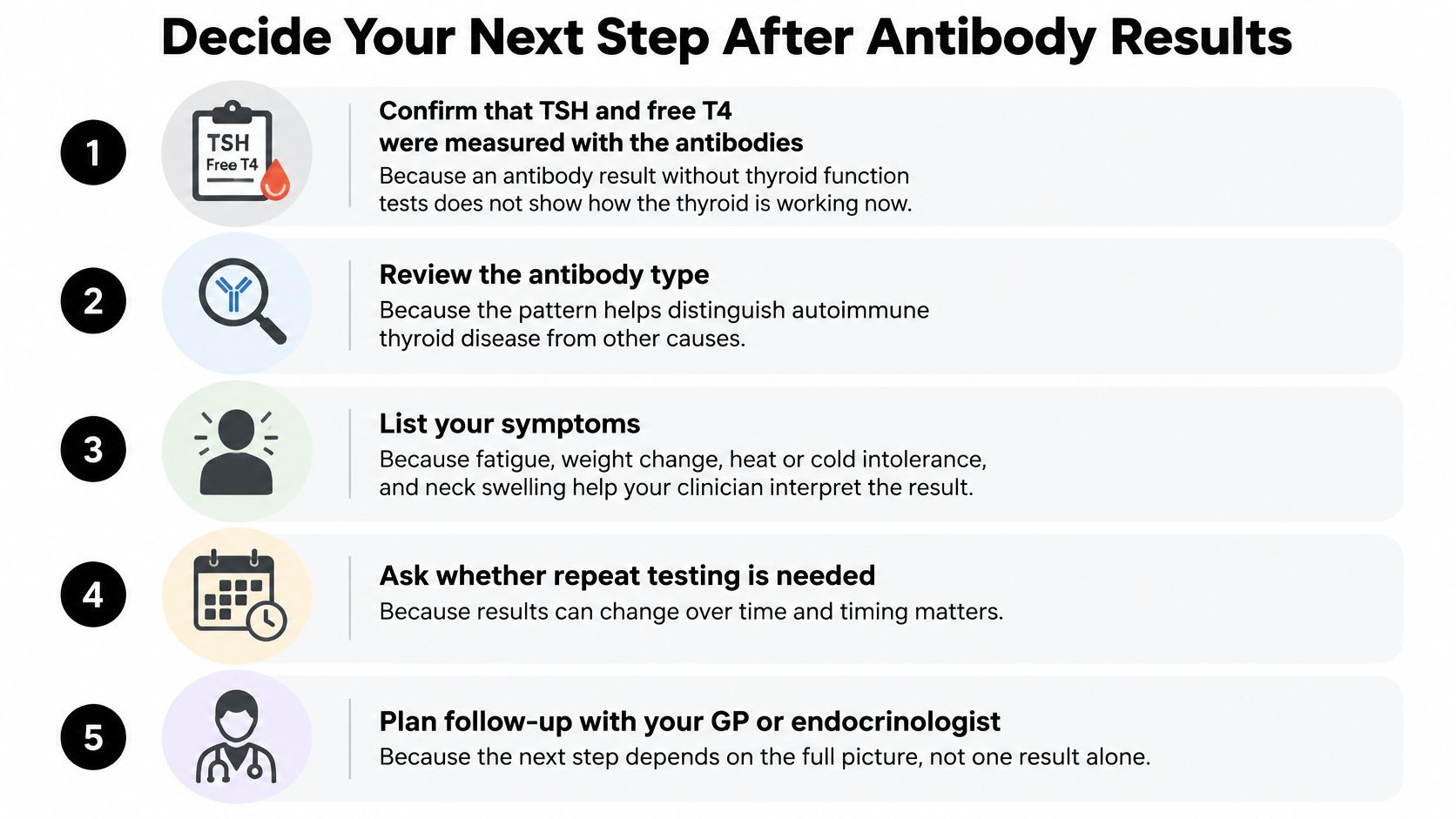
Decide Your Next Step After Antibody Results
Take this list into the appointment. Each item closes a gap that an antibody line on its own leaves open.
- Confirm TSH and free T4 were measured with the antibodies. An antibody without function tests can't show how the gland is working now. If they're missing, that's the first request, not another antibody.
- Ask which antibody was tested and why. TPOAb, TgAb, and TRAb answer different questions. A result you can't name is a result you can't use.
- Ask whether this pattern means monitoring, review, or a treatment discussion, and when the next TSH is due. Pin the interval to your result, pregnancy plans, and symptoms, not to a generic yearly habit.
- Write down symptoms, pregnancy plans, and family history before you go. Fatigue, weight change, heat or cold intolerance, neck swelling, type 1 diabetes, and a relative on thyroxine all change how the same pattern is read. A pregnant woman with type 1 diabetes and a positive TPOAb isn't managed like a symptom-free adult with the same antibody.
A clinician should interpret the result before any treatment decision. The same positive antibody can be a monitoring note in one person and a prompt for closer pregnancy care in another.
You can order private blood tests online without a GP referral or a GP visit, then attend a collection centre. Results come back within 24 to 72 hours from NATA accredited laboratories, directly to you. If the pattern is hard to place, partnered telehealth GPs can walk you through the results, answer questions, and recommend next steps from home.
The result is a starting point for a conversation, not the end of one.
If you want thyroid antibodies read beside TSH and free T4, rather than as a result in isolation, Vital iQ Health offers private pathology panels you can order online and complete at a NATA-accredited collection centre near you. A partnered telehealth GP can talk through what the pattern means and what to do next. Visit Vital iQ Health to choose a thyroid-focused panel and book your collection.