Fasting Plasma Glucose Test: What Your Results Mean
Learn what a fasting plasma glucose test measures, how to prepare, and how to read results from normal to diabetes range, with clear next steps.
You've opened a result or a pathology request, seen the words fasting plasma glucose test, and now you're trying to work out two things at once. What does the number mean, and can you trust it? That worry is common, especially when the figure sits near a cut-off and the report gives you very little context.
Start by matching your result to the right range. Then check whether you prepared properly and whether illness, medicines or a rushed fast could've shifted the reading. A single value rarely settles the question on its own, and understanding why will help you have a calmer, more useful conversation with your clinician.
What a Fasting Plasma Glucose Test Measures
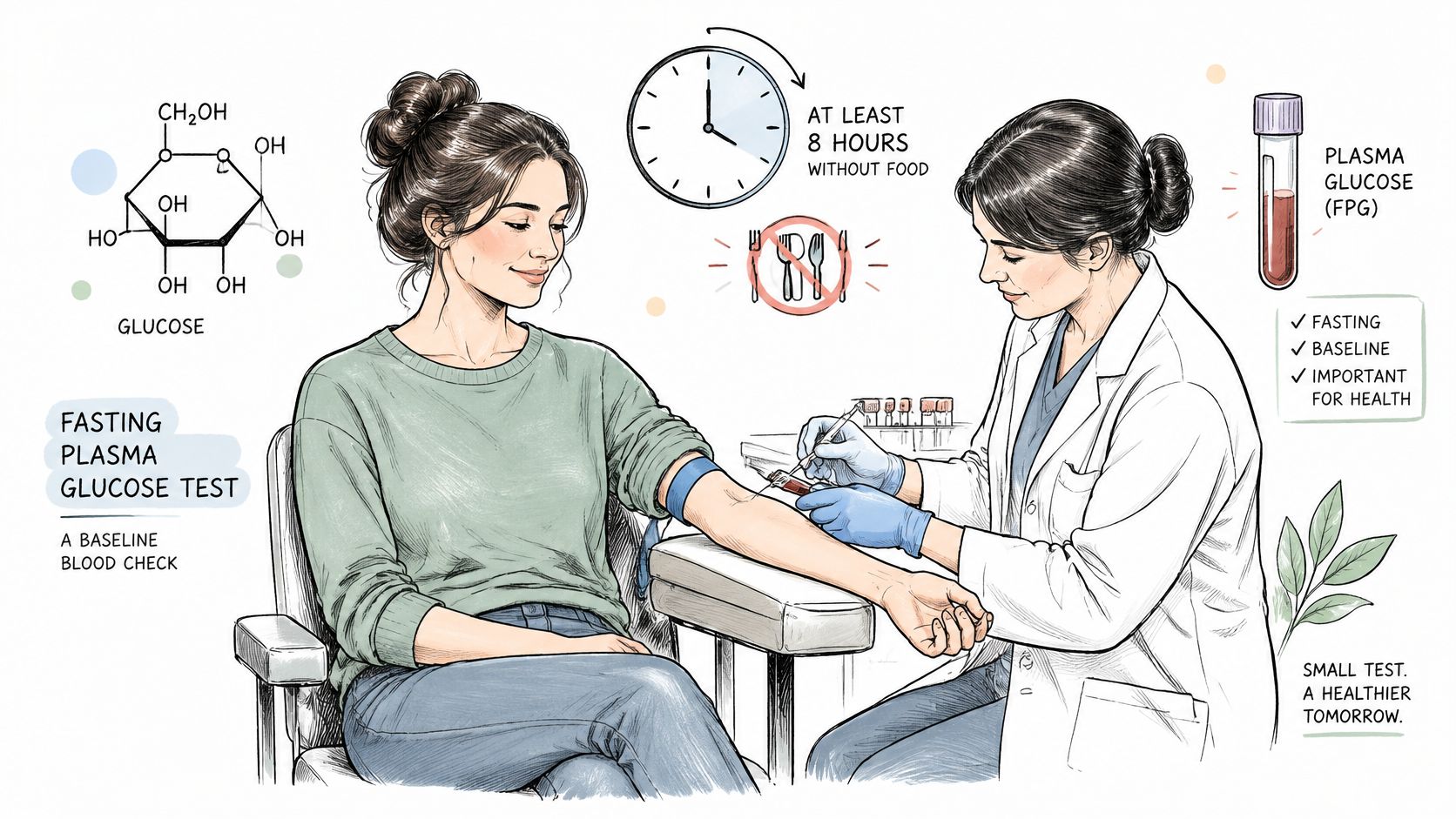
A fasting plasma glucose test measures the glucose in plasma from a venous blood sample taken after at least 8 hours without food. Think of weighing yourself first thing in the morning before breakfast. Eating pushes glucose up for a while, so the fast reveals your baseline starting point instead of a post-meal peak.
It's a laboratory test done at a pathology collection centre, not a finger-prick check. In Australian clinical practice it's considered the most reliable fasting glucose measurement, according to the Royal Australian College of General Practitioners guidance on type 2 diabetes.
Say you receive a letter asking you to book this test and you feel perfectly well. That's often the point. In the ABS National Health Measures Survey 2022-24, 6.6% of Australians aged 18 years and over were classified as having diabetes using FPG-based prevalence estimates, including 1.0% with newly diagnosed diabetes, as summarised on the Australian Institute of Health and Welfare pathology page. The test finds people who don't yet know there's a problem.
Fasting Glucose Ranges From Normal to Diabetes
Australian reports usually show glucose in mmol/L. If you're reading an overseas website, you'll often see mg/dL instead, which is why the table gives both. Find your figure in the left column first.
| Result (mmol/L) | Result (mg/dL) | Classification | Typical next step |
|---|---|---|---|
| Below 6.1 | Below 110 | Normal fasting glucose | Routine review; repeat testing as your clinician advises |
| 6.1 to 6.9 | 110 to 125 | Impaired fasting glucose | Clinical review and risk assessment; repeat or oral glucose tolerance test |
| 7.0 or higher | 126 or higher | Diabetes range | Confirmation with a repeat abnormal result on a separate day |
Reading Each Row in Plain Language
Below 6.1 mmol/L is the normal fasting range. It doesn't guarantee your glucose stays healthy after meals, and it doesn't remove future risk, but your fasting baseline isn't in the impaired range on that day.
6.1 to 6.9 mmol/L is called impaired fasting glucose. Some people call this the prediabetes range. It isn't diabetes, but it signals higher future diabetes risk and shouldn't be filed away as "close enough to normal". Your clinician will usually look at your overall risk, discuss food, activity and weight where relevant, and arrange follow-up testing.
7.0 mmol/L or higher reaches the diabetes range. That wording matters. One result at this level is a strong signal that needs prompt clinical review, but it isn't presented here as a diagnosis by itself, because preparation and health on the day can affect the sample.
The Overlap That Confuses Many Readers
You may see 5.5 to 6.9 mmol/L described elsewhere as an intermediate screening zone. That can look contradictory if your result is, say, 5.7 mmol/L and the table above calls it normal. Both ideas can sit together. The 6.1 mmol/L line defines impaired fasting glucose, while the wider screening zone identifies people whose clinician may want an oral glucose tolerance test to check what happens after a standard glucose drink.
Practical rule: Match the number to a row, write down the date and how long you fasted, then take that record to your clinician instead of trying to label yourself from the table alone.
That three-step habit prevents the most common mistake, which is reacting to the number before checking whether the test conditions were right.
How to Prepare for a Fasting Plasma Glucose Test
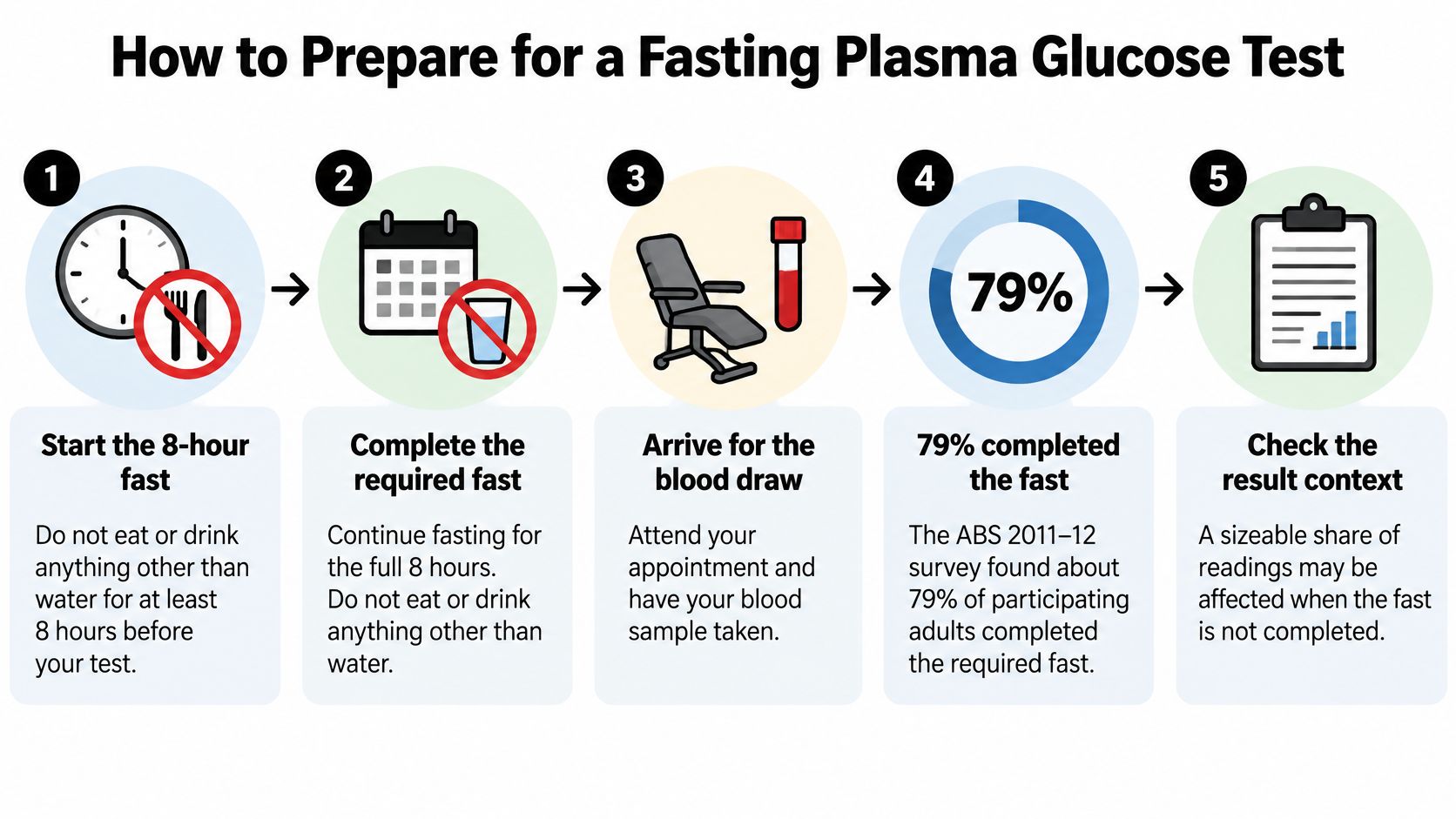
The 8-hour fast is the core requirement for a fasting plasma glucose test. The Australian Bureau of Statistics National Health Measures Survey 2011-12 found approximately 79% of participating adults completed the required fast, which means a sizeable share of readings aren't taken under standard conditions.
Use this visual summary before you book, then work through the steps below.
A Simple Routine That Works
- Book a morning appointment: Confirm the fasting instructions when you order. A morning draw makes the overnight fast easier and reduces the chance of accidental eating. If you're unsure which tests need fasting, check our guide to which blood tests require fasting before you attend.
- Stop eating at least 8 hours before: For an 8 am test, finish dinner by midnight at the latest, and earlier is simpler. Skip breakfast, including small snacks you might not count as a meal.
- Drink plain water only: Water doesn't add glucose, so it won't distort the result. Avoid tea or coffee with sugar or milk, juice, soft drinks and alcohol.
- Keep taking regular medicines: Don't stop prescribed medicine unless your clinician has told you to. Never stop diabetes medicine or insulin without specific advice, because that can be unsafe.
- Keep the morning light: Avoid heavy exercise before the draw. A hard workout can shift glucose and make the reading harder to interpret.
- Bring your paperwork and speak up: Take your pathology request form and photo ID. Tell the collector if you feel unwell or if your fast was shorter than planned, then eat a normal meal once the sample's taken.
This short video walks through the fasting idea in everyday terms.
A valid sample looks boring on paper. No food since the evening before, nothing but water, medicines handled as advised, and an honest note if anything went wrong. If you ate a biscuit at 6 am for an 8 am test, say so and reschedule. A delayed but reliable result is more useful than a fast result nobody can trust.
Factors That Can Skew a Fasting Glucose Result
Say a man grabs a muffin on the way to the collection centre because he feels shaky. His sample may now reflect breakfast, not his baseline. Or say a woman starts corticosteroid tablets for a flare-up and wonders whether her reading will be reliable. Both concerns are reasonable, and both should be mentioned before anyone acts on the figure.
| Factor | Likely effect on the reading | What to do |
|---|---|---|
| Food or sugary drink within the fasting window | Usually raises the result and can mask the true baseline | Reschedule and fast again |
| Acute illness, infection or major stress | Can raise glucose for a short period | Tell your clinician and repeat once well |
| Corticosteroid medicines | Can raise glucose | Tell the prescriber; timing of the test may be adjusted |
| Heavy alcohol the night before | Can lower glucose and make the reading unreliable | Avoid alcohol before the test and note it on the request |
| Intense exercise the day before or morning of | Can shift glucose readings | Keep the morning light and mention heavy training |
| Diabetes medicines or insulin | Changes the pattern of highs and lows | Take as directed and discuss timing before the test |
| Pregnancy | Different thresholds and screening tests apply | Your clinician chooses the correct test |
The Three to Watch Most Closely
Food in the fasting window causes the most avoidable problems. Even a sweetened coffee counts, because sugar and milk provide energy that can lift glucose. Plain water is the safe exception.
Illness and stress can push glucose up temporarily as your body responds to infection, pain or a major life event. A high reading during a bad flu doesn't have the same meaning as the same reading when you're well. Repeating the test after recovery gives a cleaner picture.
Medicines need context, not guesswork. Corticosteroids are a well-known example, and diabetes medicines change glucose patterns by design. List everything you're taking, including dose timing, so your clinician can read the result properly.
If anything on the day wasn't standard, write it down. A short note about food, illness, alcohol or a new medicine can save you from unnecessary worry over an unreliable number.
Why One Result Rarely Settles a Diagnosis
It's tempting to treat 7.0 mmol/L as a finish line. Cross it once, and you might assume the question's answered. In practice, a result at or above that level meets the biochemical threshold, but if you don't have unequivocal symptoms it should generally be confirmed with a repeat abnormal fasting test on a separate day.
Why Confirmation Protects You
A single sample can be affected by a rushed fast, an unreported snack, acute illness or a medicine you started that week. Repeating the test under proper conditions separates a one-off disturbance from a persistent pattern. It also protects you from the opposite error, where heavy alcohol the night before produces a falsely reassuring low reading.
Results between 6.1 and 6.9 mmol/L also need interpretation rather than an automatic label. Your clinician may repeat the fasting test, review your risk factors, or arrange a 75-gram oral glucose tolerance test. That test measures fasting glucose, gives you a standard sugar drink, then measures again two hours later to see how your body handles the load.
What Your Clinician Weighs Beside the Number
- Symptoms: Unusual thirst, frequent urination, unexplained tiredness or weight loss change how urgently a result is handled.
- Medicines and illness: Steroids, diabetes medicines, infection and major stress all provide essential context.
- Pregnancy status: Different screening pathways and thresholds apply in pregnancy.
- Risk factors: Family history, age, waist size and previous results help decide how soon to retest.
If you're working through a full report rather than one line, our overview of how to interpret blood test results explains flags, units and reference intervals in the same step-by-step way.
A fasting glucose result alone also doesn't distinguish type 1 from type 2 diabetes. Classification depends on symptoms, age, the clinical picture and sometimes further tests. Treat your result as the start of a conversation and ask directly whether you need a repeat test, an oral glucose tolerance test or a broader risk review.
Next Steps After Your Result
Start with a record you'll thank yourself for later. For every fasting plasma glucose test, note the date, mmol/L value, laboratory, length of fast and relevant medicines. Trends across properly prepared tests tell a clinician far more than isolated figures pulled from memory.
Where to Take the Figure
If your result sits in the impaired or diabetes range, discuss it with a clinician promptly. Don't self-diagnose, start someone else's medicine, or make drastic food changes based on one number. A GP is the usual route for interpretation, confirmation testing and ongoing care, and you'll get more from that appointment if you bring your dated record.
Timing can add to the stress while you wait. Our guide to how long blood test results take in Australia explains why turnaround varies between tests and laboratories. With us, results are delivered within 24 to 72 hours, which helps you plan the follow-up conversation sooner.
You can order private blood tests online with us without a GP referral or GP visit. Our partnered telehealth GPs can walk you through your results, answer questions and recommend next steps from home. That explanation is helpful, but it has a clear limit. It doesn't replace confirmation of an abnormal result with a repeat test on a separate day when your clinician says that's needed.
Bring the number, the date, the fasting time and your medicine list to every review. That small packet turns a worrying figure into a decision your clinician can actually make.
If you feel very unwell, can't keep fluids down, or have symptoms that are rapidly worsening, don't wait for routine follow-up. Seek urgent medical care instead.
If you want a clear baseline without arranging a GP visit first, you can order a fasting glucose test online through Vital iQ Health, attend a NATA-accredited collection centre near you, and receive your results within 24 to 72 hours. Book today, fast properly the night before, and use our partnered telehealth GPs to talk through what your number means and what to do next.