C-Reactive Protein High Means: What Your Result Shows
What c-reactive protein high means: inflammation somewhere in the body, not a diagnosis. Learn the ranges, common causes and when to see a doctor.

A high C-reactive protein result means inflammation is present somewhere in the body, but it does not show where or why. In Australia, a reading below 5 mg/L is generally treated as normal and a reading above 10 mg/L as raised, which leaves a wide middle band where the number on its own settles very little.
So why does an identical figure send one person for a throat swab and another to a rheumatologist? CRP is one of the most frequently ordered blood tests in medicine because it moves quickly, rising while something is active and falling once it settles. What it can't do is name the problem, point to a location, or tell you how serious the cause is.
A raised result is best read as a prompt. It's a reason to line up your symptoms, find the reference range printed on your own report, and ask your doctor what the pattern suggests, rather than a verdict you have to decode alone.
Reading a CRP Result Against the Ranges
Think of CRP as a smoke alarm. When it sounds, you know something is burning. You don't yet know which room, how big the fire is, or whether it's burnt toast.
The protein is made by the liver and released into the bloodstream during inflammation, infection or tissue damage, as healthdirect's guide to the CRP blood test sets out. The same guidance notes concentrations can rise within 24 to 48 hours, which is why doctors often repeat the test rather than act on one reading.
Healthdirect's reference points are below 5 mg/L for normal and above 10 mg/L for high. Everything between those two figures is a grey zone, and it's where most confusing results land.
| Result (mg/L) | Category | What it generally indicates |
|---|---|---|
| Below 5 | Normal range | Little sign of active inflammation |
| 5 to 10 | Borderline zone | Depends on lab reference range, symptoms and recent illness |
| Above 10 | Elevated | Inflammation present somewhere; source not identified |
A result of 7 mg/L doesn't carry a fixed meaning. On one laboratory's range it may sit inside normal; on another it may be flagged. Your symptoms, your recent health and the other tests on the same report decide how much weight it deserves, which is why the number should never be read in a vacuum.
Units trip people up too. Australian reports almost always use mg/L, but some overseas portals report mg/dL, and those two scales differ by a factor of ten. If a figure looks wildly wrong, check the unit before you check anything else.
Three things are worth doing before you read any further:
- Find the value and the range. The reference interval is printed beside your result. Read it, because each laboratory sets its own.
- Match it to the bands above. Normal, borderline or high. That's all the number can tell you at this stage.
- Note the date and context. Were you unwell, injured, or recovering from surgery when the sample was taken?
If the layout of the report itself is unfamiliar, this walkthrough of how to interpret blood test results covers the columns, flags and reference ranges.
What Commonly Pushes CRP Higher
CRP sits at the end of the body's acute-phase response, a general alarm that a wide range of problems can trip. That breadth is the point of the test and also its limitation.
Most causes fall into five broad groups, and each leaves a different trail of clues:
| Cause category | Examples | Typical clue |
|---|---|---|
| Infection | Chest, urinary or skin infection; flu; COVID-19 | Fever, cough, burning urine or local redness |
| Injury or surgery | Fracture, burn, recent operation | Recent event followed by localised pain or swelling |
| Inflammatory disease | Rheumatoid arthritis, lupus, psoriasis, inflammatory bowel disease | Morning joint stiffness, rashes or bowel symptoms |
| Chronic low-grade sources | Obesity, smoking, gum disease | Often no symptoms; found on routine screening |
| Cardiovascular events | Recent heart attack or unstable angina | Chest pain or pressure, often with breathlessness |
Notice how few of these are rare. A chest infection, a badly swollen ankle, a recent operation, inflamed gums after months of skipping dental visits. Ordinary events fill most of the list.
When the rise is acute and when it's a baseline
Acute triggers produce the steepest climbs. A bacterial infection or a significant injury can push the figure up sharply within a day or two, then let it drop once the trigger is treated. That pattern, big and brief, is the one clinicians find easiest to read.
Chronic sources behave differently. Excess weight, smoking and untreated gum disease raise the resting level modestly and keep it there. Someone in that group can carry a mildly high result for months without feeling unwell, and the finding usually arrives through routine screening rather than illness.
A useful question to bring to the appointment: has this figure been drifting upward across several tests, or did it jump once? A trend tells your doctor far more than a single point.
Run the table against your last few weeks, then stop. It's a prompt for questions, not a self-diagnosis checklist, and the absence of an obvious match doesn't mean nothing is going on.
Narrowing Down What Is Behind a High CRP
Two people collect the same figure on the same afternoon: 40 mg/L each. One has had a raw throat and a mild fever for three days. The other has woken every morning for six weeks with swollen, stiff knuckles.
The first will likely be examined for a throat or chest source and may need very little testing. The second is heading towards joint examination, specific antibody tests and a rheumatology referral. Same number, entirely different routes, because the history did the work the number couldn't.
Clinicians narrow the cause in three moves.
- History first. When symptoms started, what came with them, any recent illness, travel, injury, surgery or new medicine. Timing alone often separates an infection from an inflammatory condition.
- Examination second. Listening to the chest, testing the urine, feeling for hot or swollen joints, looking at the skin. Signs the person hasn't noticed often point the way.
- Targeted tests third. A full blood count, urine testing, a chest X-ray or an ultrasound, chosen to fit the picture rather than ordered as a batch.
What clinicians don't do is treat the number. There's no medicine for a high CRP, only treatment for whatever is producing it.
Three misreadings are worth clearing up. A normal result doesn't rule out every condition. A high one doesn't confirm cancer, heart disease or anything else on its own. And results are easiest to compare when they come from the same laboratory using the same assay, so a figure from a different provider may not line up neatly with an older one. If your doctor orders a broader screen, this guide to the complete blood panel explains what the other lines on the report are measuring.
Bring the printed report and a short note of your symptoms and their timeline. Skip the search engine in the waiting period. The pattern is what your doctor works from, and a phrase you found online rarely matches it.
Why CRP Rises Fast and Why Repeat Tests Matter
The speed of the response is what makes CRP clinically useful. It's also why a single reading dates so quickly.
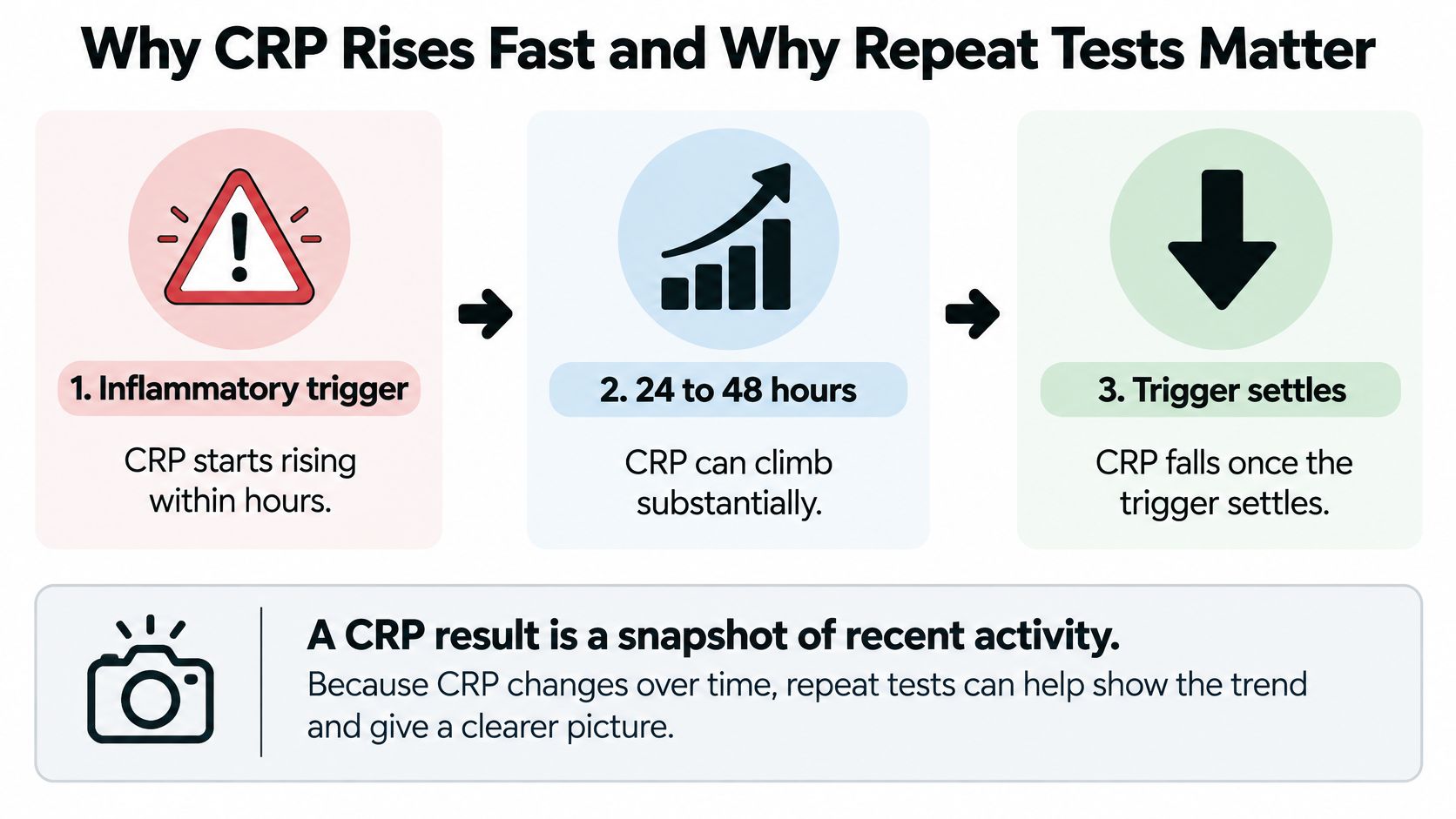
Say a chest infection starts on a Monday.
- Day one. The sample may barely move. The inflammatory response is only just getting going, and the liver hasn't had time to respond.
- Day two or three. The figure climbs steeply as the immune response ramps up. This is the phase where a result looks most alarming.
- Days five to seven, with effective treatment. It falls back towards the reference range, often dropping below the level it reached midweek.
That arc is why doctors recheck rather than reorder everything. A figure heading downward is usually reassuring, even while it's still above the reference range. A figure that stays flat or climbs after treatment has started sends the clinician looking for a complication, a collection of infection that hasn't drained, or a cause nobody has found yet.
For chronic inflammation the logic is the same, just slower. A falling number means the management plan is working. A stubborn one means it needs revisiting.
Timing the retest
The interval is a clinical decision, not a do-it-yourself one. Your GP will usually nominate a retest several days to a week out, timed so the reading reflects the new state rather than the same event. Ordering your own test 48 hours later rarely adds information and often adds worry.
Ask this at the appointment: when should we repeat this, and what result would change your plan? You'll leave knowing exactly what you're watching for.
Note the date your symptoms began. It's the single most useful thing to bring to a follow-up, because it lets your doctor line the number up against the timeline instead of guessing at it.
Warning Signs That Need Prompt Medical Care
Most raised results are not emergencies. A few combinations are, and they're worth knowing before you need them. Healthdirect advises discussing a raised CRP with a doctor, particularly where fever, persistent pain, unexplained weight loss, shortness of breath or worsening symptoms are present.
| Symptom or situation | Why it matters | What to do |
|---|---|---|
| Chest pain, severe breathlessness or confusion | Possible serious heart, lung or infection emergency | Call 000 immediately |
| Fever with chills or feeling very unwell | Possible infection needing prompt assessment | See a doctor the same day |
| Unexplained weight loss | Can accompany serious illness and needs investigation | Arrange a GP review soon |
| Pain that persists or keeps worsening | Possible injury, infection or inflammatory disease | Book a GP visit promptly |
| No symptoms, routine screening result | Usually reflects low-level or transient inflammation | Routine GP review and a planned repeat test |
The first row isn't a wait-and-see situation. Chest pain, severe breathlessness or confusion need an ambulance on 000 before any test result is available, not after.
Duration matters as much as severity. A fever lasting more than a few days, or pain that hasn't settled over a couple of weeks, deserves a GP appointment even if you feel broadly well otherwise.
A raised result with no symptoms sits at the opposite end. That usually means a routine review and a planned repeat test in a few weeks, not a same-day scramble.
If one row of that table fits, book now. If two or more fit, don't wait for the repeat test to come back first.
Standard CRP Versus hs-CRP Explained
Standard CRP and high-sensitivity CRP measure the same protein. What separates them is the part of the scale each one reads.
The standard test functions like a bathroom scale that registers only above a certain weight. It detects the large increases associated with infection, injury, or inflammatory disease, which is exactly what a doctor needs when those conditions are suspected. The high-sensitivity version, hs-CRP, is the more precise instrument. It detects very low concentrations that the standard test reports as normal, and that low end is the area that matters in cardiovascular discussions.
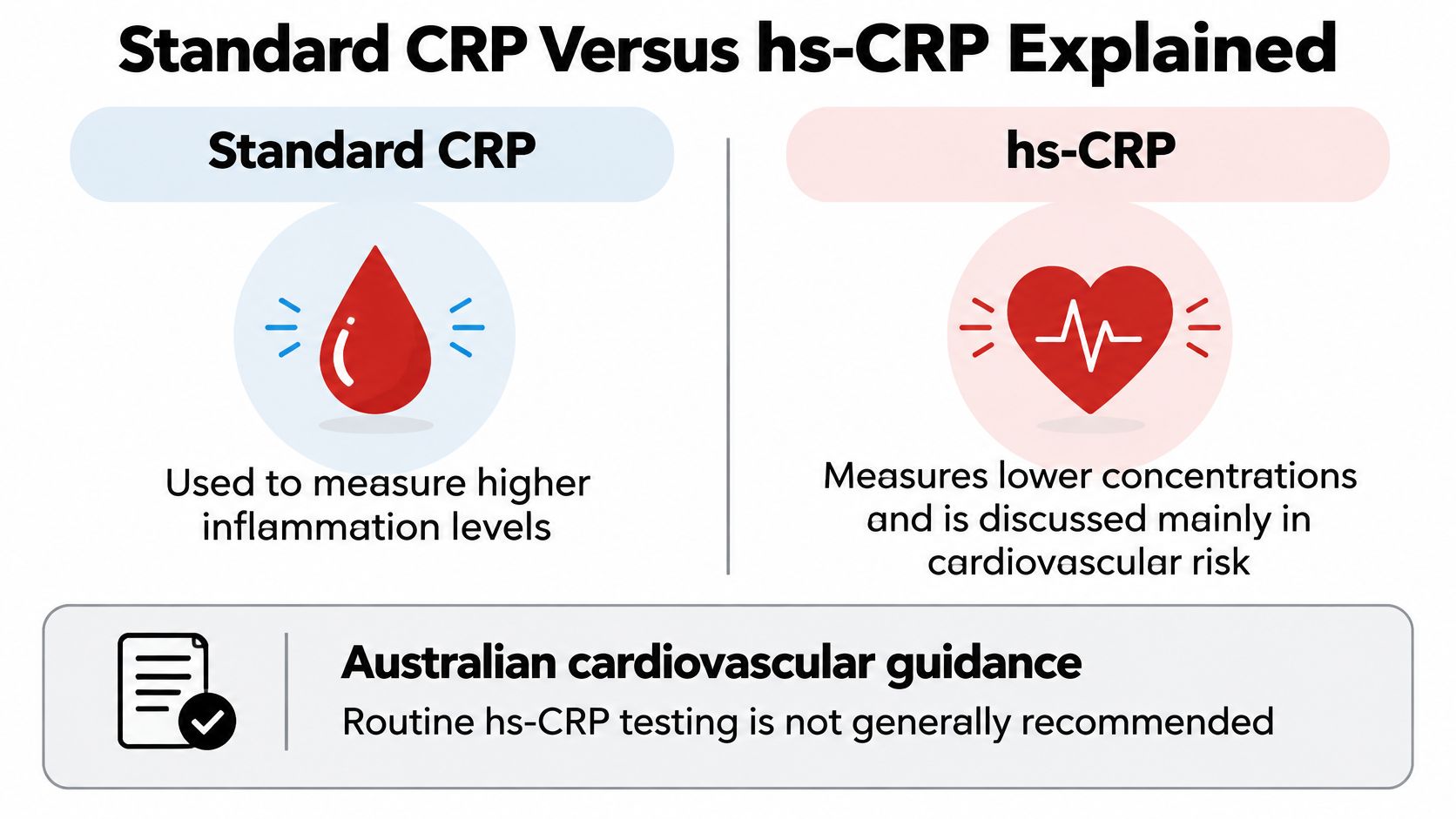
Australian cardiovascular guidance is cautious about that use. The Guideline for assessing and managing CVD risk advises that routine hs-CRP testing is not recommended for general cardiovascular risk assessment, because it adds little discrimination beyond established risk calculators and can incorrectly reclassify people into a higher-risk group.
| Test or concept | What it measures or shows | Main use |
|---|---|---|
| Standard CRP | Reported in mg/L against the lab reference range | Detecting and monitoring inflammation from infection, injury or disease |
| hs-CRP | Lower concentrations, measured more precisely | Cardiovascular risk discussion; routine use not recommended for general assessment |
| Acute inflammation | Standard CRP can rise within 24 to 48 hours and falls as the trigger settles | Shows current activity and treatment response |
| Long-term cardiovascular risk | A single hs-CRP result is not decisive | Judged with age, blood pressure, cholesterol, smoking, diabetes and family history |
There's a specific exception worth knowing. In people with chronic inflammatory conditions such as rheumatoid arthritis, lupus or psoriasis, who already carry increased cardiovascular risk, a persistently high CRP can add useful context. That decision belongs to the treating specialist rather than a test ordered on your own initiative.
The evidence is also less tidy than the marketing around the test suggests. Established risk calculators already fold in the factors that drive most cardiovascular danger, so a lone hs-CRP number rarely changes the answer they produce. If cholesterol is the question you're trying to answer, this explanation of LDL and cholesterol levels covers figures that carry more weight in that calculation.
For a short walkthrough of how inflammation shows up in the blood, this video is a reasonable starting point.
One high hs-CRP should not trigger a statin prescription, a battery of scans or a diagnosis of heart disease on its own. Those decisions draw on age, blood pressure, cholesterol, smoking, diabetes, family history, symptoms and any inflammatory condition. The most useful question the number raises is simpler: why was this test ordered, and what was it looking for?
Take the Result to Your Doctor
A result becomes useful in the consultation room. Five steps make that conversation sharper.
- Find the value and the range. Note the number, the unit (mg/L) and the reference interval printed beside it. Write all three down rather than relying on memory.
- Record your symptoms and their timeline. When they started, whether they're improving, any recent illness, injury, surgery or new medicine. A sentence or two is enough.
- Ask what this number means for you specifically. Not for the population, not for the internet. For your history, your examination and your other results.
- Ask whether a repeat test is needed, and when. If the answer is yes, book it before you leave the room.
- Raise heart risk separately if you have other risk factors. hs-CRP isn't a routine screening test, but age, blood pressure, cholesterol, smoking, diabetes and family history all belong in the same conversation.
Keep your previous reports. Trends are only visible if you have the older ones, and comparison is cleanest when both samples ran through the same laboratory.
If you're weighing up private testing, we offer a Standard Health Panel covering cholesterol, blood glucose, organ function, iron levels and key health markers, which gives your doctor a fuller picture to read alongside the CRP. Interpretation stays with a clinician either way, and that's exactly where it belongs.
Book a prompt GP review if any red flag applies. If the result is only borderline and you feel well, a planned retest is the sensible next move rather than an urgent appointment.
Vital iQ Health provides private blood testing across Australia, with no prior GP referral needed to order and results generally advertised as available within 24 to 72 hours. You can choose from 41 pathology panels or build your own from more than 300 individual biomarkers, then take the report to a telehealth GP who can talk through what it means alongside your symptoms and history. Visit Vital iQ Health to see the panels and arrange a collection.