Blood Tests Not Covered by Medicare Australia: What to Know
Blood tests not covered by Medicare Australia? Learn which tests Medicare pays for, why some are billed privately, and where to get private testing.
Medicare pays for a blood test when the test carries a Medicare Benefits Schedule item, a documented clinical reason and an eligible requester, not because the sample happens to be blood. Broad screening, wellness and performance panels sit outside those conditions, which is why a private panel can arrive as a full bill in a system where around 85% of pathology services are direct billed.
Why, then, does the same test cost one person nothing and another person several hundred dollars?
Look at the request form rather than the tube. A pathology referral is a bundle of separate claims, and each claim is judged on its own item number, its own clinical justification and the credentials of the person who signed it. Two people can hand over what looks like an identical panel and walk out with two very different accounts.
Coverage follows the reason, not the sample. Once you know which conditions a test meets, you can predict most of what you'll pay before the needle goes anywhere near your arm.
Which Blood Tests Medicare Pays For and Which It Does Not
Which line on the request form decides the bill: the test name, the reason for ordering, the signature, or the way the laboratory charges? In practice, each line matters. The Australian Government's plain guide to what Medicare covers puts pathology in the same basket as every other service: a test is subsidised only when it is clinically relevant, requested by an eligible doctor or health professional, and performed by or on behalf of an approved pathology practitioner in an appropriately accredited laboratory.
The schedule draws the boundary between a test that answers a clinical question about a documented condition and a test ordered to see what turns up. Once you sort a request by that boundary, most outcomes become predictable before you book.
| Situation | Medicare position | What you may pay |
|---|---|---|
| GP-requested test for a documented condition with an MBS item | Covered | Nothing when the account is bulk billed; otherwise the laboratory gap |
| Broad preventative screening with no clinical indication | Generally not covered | Every dollar of the private invoice |
| Wellness or hormone panel not tied to a diagnosis | Generally not covered | Every dollar of the private invoice |
| Performance-enhancement monitoring | Generally not covered | Every dollar of the private invoice |
| Cytotoxic food testing | Not covered | Every dollar of the private invoice |
| Repeat or confirmation test on the same specimen | Generally not covered | Every dollar of the repeat charge |
| Fourth or later pathology test requested by a GP on the same day | Only the three most expensive tests are paid | Nothing for the first three if bulk billed; tests beyond that are billed privately |
| Non-MBS biomarker inside a larger panel | Not covered for that biomarker | Every dollar of that biomarker's charge, while listed components can still be claimed |
| Employment, insurance or pre-procedure testing | Commonly self-funded | Usually every dollar of the private invoice |
Where a single request splits into paid and unpaid parts
The same government guidance sets a limit that catches people by surprise. If a GP requests more than three pathology tests on one day, Medicare pays only for the three most expensive. The extras are not rejected. They attract no benefit, so they land on your account.
Mixed panels work the same way. A privately ordered bundle can pair an MBS-listed full blood count with a marker that has no item at all. The listed component can still be claimed; the unlisted one stays private. If you are weighing a complete blood panel against a GP-ordered set, compare the item lists rather than the marketing copy, because the item list is the part that decides the bill.
Quick self-check: a test ordered to diagnose or manage a documented condition, by a GP, through an accredited laboratory, is likely covered. A test ordered to explore, to optimise performance, or to screen a well person with no symptoms usually is not.
Why Being a Blood Test Is Not Enough for a Rebate
Think of a rebate as a lock with three keyholes. The Australian Government's pathology fees guidance describes three linked conditions: the service must have an applicable MBS item, a Medicare-eligible treating practitioner must request it for a medically necessary reason, and the specimen must be processed by an approved pathology laboratory operating under the required accreditation and quality-assurance framework.
Turn one key and stop, and nothing happens. That's why most blood tests not covered by Medicare in Australia fail on paperwork rather than on the sample itself.
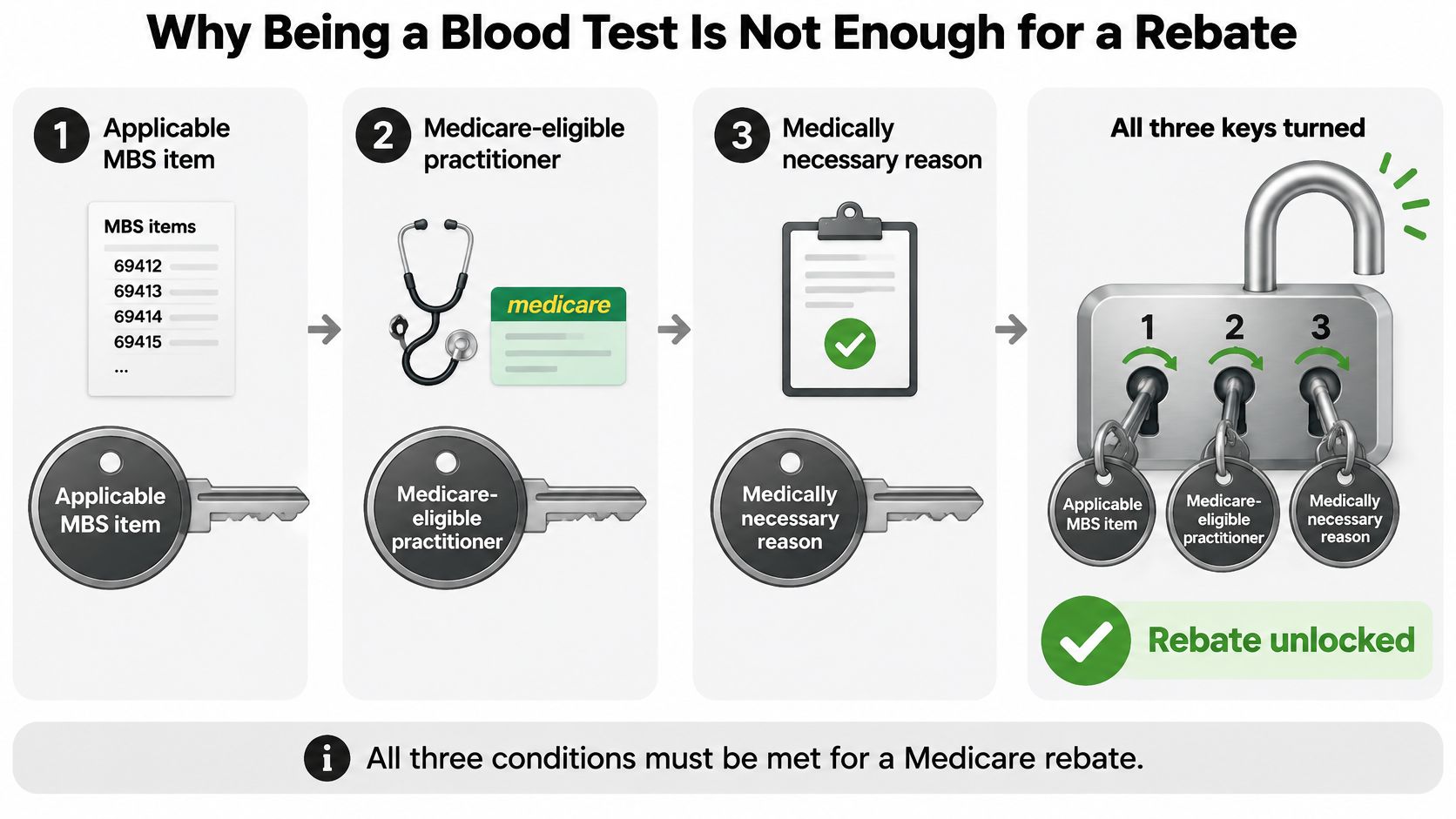
The three keys, one at a time
- An applicable MBS item. The item is the billing code, and it exists only for defined services. A well-known marker without its own item can't be claimed, however routine it feels.
- An eligible requester with a real reason. A GP ordering thyroid function for fatigue, hair loss and weight change has a clinical indication. The same test ordered because a supplement company suggested it doesn't.
- An approved, accredited laboratory. The specimen has to be processed within the accreditation and quality-assurance framework the schedule requires.
The middle key does double duty, which is where bundles go wrong. A large online hormone and nutrient panel often has neither an eligible requester nor an item for several of its markers, yet the buyer assumes "pathology is bulk billed" applies to the whole thing.
A bundle is not a package deal. It's a list of separate claims travelling together in one envelope, and each claim stands or falls alone. The same logic explains why PSA screening in Australia is a discussion about a man's age, symptoms and family history rather than a standing annual entitlement for every man who asks.
Three keys. One missing key, no rebate.
Before you book, put three questions to the person signing the request and to the laboratory that will process it.
- Does each marker on this list have its own MBS item?
- Does the reason written on the referral meet that item's clinical indication?
- Is the laboratory approved for these tests, and will it bulk bill each one?
Why Bulk Billing Does Not Mean Every Test Is Free
The Australian Government's consumer guidance on pathology fees reports that approximately 85% of pathology services were direct billed, meaning the laboratory accepted the Medicare benefit as full payment and charged no gap. More recent government figures put the bulk-billing rate for out-of-hospital pathology even higher.
Both figures are real. Neither is a promise about your panel.
Those percentages measure how often eligible services are billed without a gap. They say nothing about how many blood tests qualify for Medicare in the first place, because that is a different question entirely. Bulk billing is a payment arrangement for a service the schedule already accepts. It does not spread across a laboratory's whole catalogue the way a shop-wide discount covers every item on the shelf.
The two ways a bill still appears
Government guidance is explicit that laboratories may send an account when tests are not covered by Medicare, and that you can face an out-of-pocket amount when a laboratory charges more than the rebate.
Say a laboratory bills $65 for an item whose Medicare benefit is $40. The rebate covers $40, you pay the $25 difference, and the size of that gap is set by the laboratory rather than by the schedule. That is the first route: a covered item carrying a gap on top.
The second route stings more. A private panel may contain markers that are not separately listed, are not clinically justified under the schedule's rules, exceed the same-day limit, or sit outside the conventional doctor-led pathway. A bulk-billed component in the same request does not pull the uncovered ones under its umbrella, because the covered and uncovered parts of a single request are settled separately.
Worth asking when you book: "Is every marker on this request covered, and what gap applies to each one?"
The financial question was never whether pathology is generally bulk billed. It's whether each component on your request is eligible and accepted at the rebate.
How to Check Whether a Test Will Be Covered
Coverage is decidable in advance, usually in about five minutes, if you ask in the right order. Work through the checks before anything is collected, not after the invoice lands.
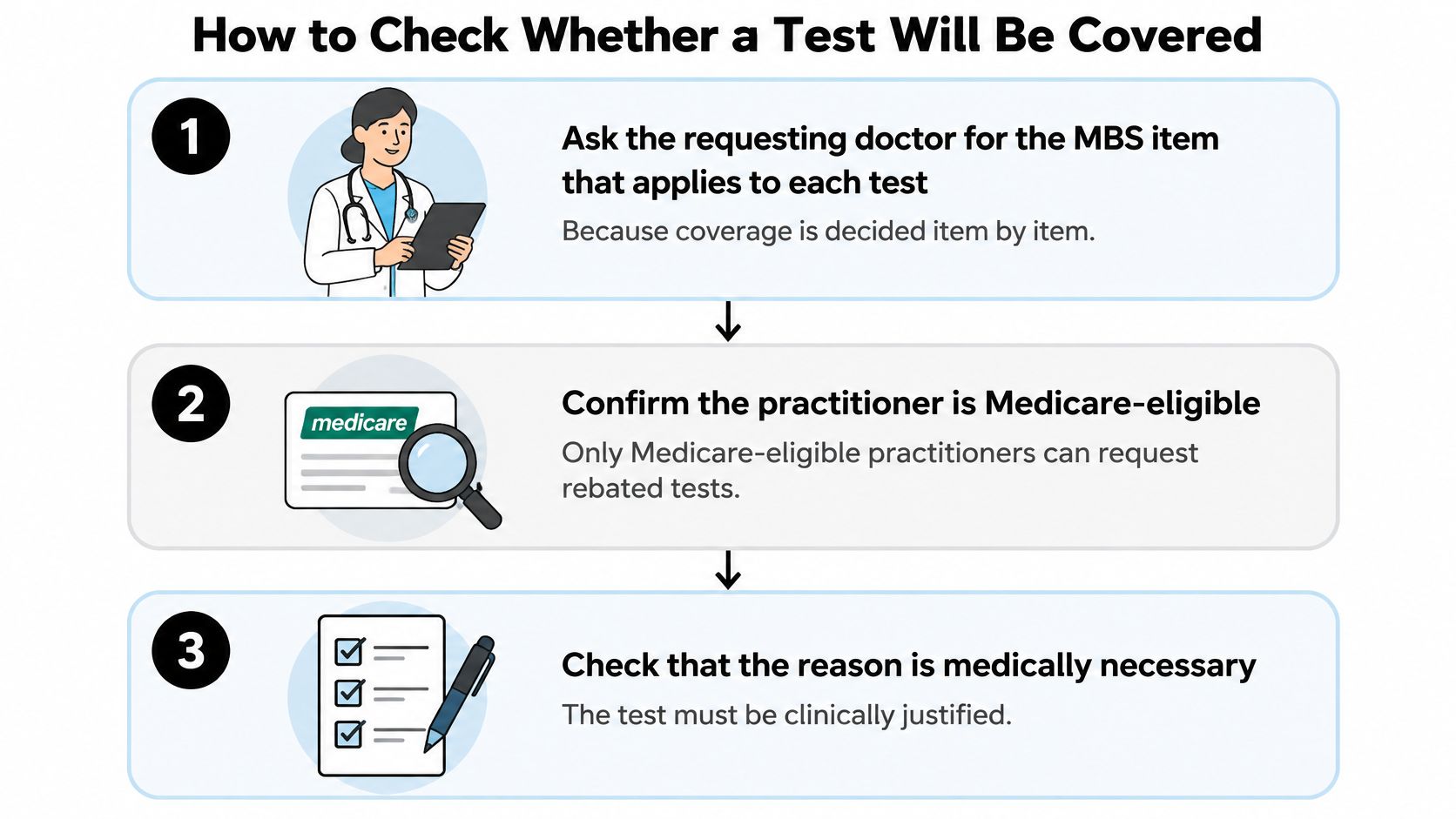
- Ask the requesting doctor for the item number behind each test. Coverage is decided item by item, so a single item number covering a ten-marker panel is a signal to look closer at what's inside it.
- Confirm the clinical reason is written down, not just discussed. "Fatigue, check thyroid" supports a thyroid item. "Wellness screen" supports very little, and the laboratory can only bill what's documented.
- Ask the laboratory whether it bulk bills that item. The rebate comes from the schedule, but the gap comes from the laboratory's own billing decision, and the two are set by different parties.
- Request a written quote that separates the two amounts. A figure that shows the Medicare benefit beside the out-of-pocket cost lets you compare two collection centres without arithmetic in your head at the counter.
- Count how many pathology tests the GP has requested for the same day. Medicare caps how many it pays for in one day, so you pay for the extras even though they were clinically reasonable.
- Audit any private panel marker by marker. Ask which components have no item number and would be paid privately in full, then decide whether you want those markers enough to fund them.
Before the sample is taken you should be holding three things in writing: the item list, the rebate estimate and the maximum gap. Anything quoted verbally can change between the request and the account.
If you'd rather hear the eligibility logic talked through than read it, this walkthrough covers the same ground.
Cutting Your Costs With the Safety Net and Smart Ordering
The Extended Medicare Safety Net is the part of the system that softens a year of gap payments, and it's widely misunderstood as automatic. For 2024, the general threshold was $2,544.30, after which eligible patients could receive 80% of additional out-of-pocket costs for qualifying out-of-hospital services, according to the Australian Government's Extended Medicare Safety Net factsheet.
Read that as a conditional benefit rather than a rebate upgrade. The threshold is set for a calendar year, it's a figure from a specific year, and it changes. Confirm the current year's threshold on the government's Medicare pages before you budget around it, because a number quoted in an article or repeated by a friend may belong to a previous year.
What counts, and what doesn't
Only eligible, MBS-related out-of-hospital costs count toward the safety net. The non-MBS components of a private panel generally don't, no matter how much you paid for them. A $300 wellness bundle with no item numbers behind it does nothing for your threshold, which is precisely why the item list matters more than the total spend.
The habits that make the scheme work are unglamorous.
- Keep every pathology invoice and Medicare statement. You can't reconcile a gap total you never recorded, and the statements show the benefit that was paid.
- Total your gap amounts across the year. A handful of small gaps can add up quicker than expected, and you'll only know where you stand if you add them.
- Ask the GP to rank the tests by clinical need. If several tests are justified, the ones that matter most should be the ones the schedule pays for, given the cap on what a single day's request can attract.
- Don't plan around a benefit you haven't confirmed. Treat the safety net as a possible refund later, never as a discount at the counter.
Practical rule: the safety net rewards people who keep paperwork, not people who spend the most.
Before you decide which tests to fund privately, check two things: the current threshold for the year you're in, and your own running total of gaps.
Private Routes and the Choice Before You Book
Four routes get a blood test into a laboratory, and they differ on three things: who signs the request, whether a rebate applies, and how the laboratory bills. Get those three straight and the cost becomes predictable.
| Route | Referral needed | Medicare rebate | Likely cost to you |
|---|---|---|---|
| GP-requested MBS test at a bulk-billing laboratory | Yes, GP request | Yes, if eligible | Usually nil when bulk billed |
| GP-requested MBS test at a laboratory that private bills | Yes, GP request | Yes, rebate applies | Gap above the rebate, set by the laboratory |
| Private order for non-MBS or wellness tests | No | Generally no | Full private fee, set by the provider before ordering |
| Private panel from a provider such as Vital iQ Health | No | Generally no | Panel price confirmed before ordering |
When the rebate is there and the bill still isn't zero
Routes one and two use the same request, the same item numbers and often the same laboratory building. The difference is the billing arrangement. A bulk-billing laboratory accepts the benefit as full payment. A laboratory that private bills claims the benefit on your behalf and invoices the remainder, and that remainder is its own commercial decision.
The practical move is to ring the collection centre with the item numbers in front of you. One question settles it: will you accept the Medicare benefit as full payment for these items?
Buying the test outright
Route three is the direct private order. No referral, no rebate for the unlisted markers, and the full fee sits with you. Employment medicals, insurance assessments, pre-procedure screens and the exploratory panels people buy on impulse fall into this category. Speed and access are what you're purchasing, and that's a legitimate trade, as long as nobody told you it would be free.
What a private panel changes
Route four removes the GP step entirely. A private panel from Vital iQ Health works on that basis: you order online without a GP referral or a GP visit, choose from 41 pathology panels or build a profile from over 300 individual biomarkers, then attend a NATA-accredited collection centre near you. Collection centres are grouped into five lab-network regions covering Queensland and northern New South Wales, New South Wales and the ACT, Tasmania, Western Australia and the Northern Territory, and Victoria.
What you give up is the rebate. What you gain is a request form without a consultation, which matters if the barrier was getting an appointment rather than getting the test.
Choosing without regret
Pick route one or two when a GP is already investigating a symptom, because the clinical reason is the thing that enables the benefit. Pick route three or four when you're monitoring something specific, screening by choice, or chasing a marker the schedule doesn't recognise, and pay for it with your eyes open.
Whatever you choose, do two things before the sample is collected. Name the clinical reason out loud, and hold the written item list, the expected rebate and the maximum gap. If a test can't be justified or itemised, assume you're funding it and decide whether you want to. The full body checkup cost question is really this question in a different outfit: not what a panel costs, but which parts of it anybody else will help pay for.
Private blood testing through Vital iQ Health is built for exactly the situations Medicare doesn't cover: you order online without a GP referral or visit, choose from 41 pathology panels or build your own from over 300 individual biomarkers, and attend a NATA-accredited collection centre near you for the sample. If you're monitoring a marker, screening by choice, or want results without waiting for an appointment, that route is available now. Visit Vital iQ Health to see the panels and confirm the price before you order.