B12 Blood Test Results Explained Clearly
A B12 blood test is not a simple pass or fail. Learn Australian result bands, borderline gaps and when a second marker helps.
You've been tired for weeks, your feet tingle at night, and now a pathology report has landed with one vitamin result circled in your mind. It's just a number, followed by pmol/L, and a reference interval you don't quite understand. Is that low, borderline, or fine? Does it explain how you feel, or doesn't it?
A B12 blood test can help answer part of that question, but it rarely answers all of it on its own. Read it as one piece of evidence, alongside your symptoms, your blood count, your diet and your medicines, and the number starts to make much more sense.
What a B12 Blood Test Measures
Say you're the person with fatigue and tingling in the feet, staring at a single result. The test measured cobalamin, the scientific name for vitamin B12, circulating in your blood. Most reports show total serum vitamin B12, reported in picomoles per litre, written as pmol/L. That unit counts a very small amount of substance in a litre of blood.
B12 has two jobs you can picture easily. First, it helps your bone marrow release properly formed red blood cells. Second, it helps maintain the insulation around nerves, a bit like the coating around electrical wires. That's why one shortfall can show up in quite different ways, as anaemia, weakness, memory trouble or numbness, and why a blood count alone can't stand in for this test. If you're looking at broader results too, a complete blood panel covers related markers that sit beside B12 on many reports.
A pantry, not a proof of use
Think of the result like checking a pantry shelf. It shows what's stored there at that moment. It doesn't show whether your body can open the container and use what's inside.
A B12 result shows how much is circulating, not whether every cell is getting enough usable B12.
Australian laboratories print their own reference interval beside your result, so don't compare reports from different labs using a memorised cutoff. You may see two first-line labels, total B12 and holotranscobalamin, also called active B12.
Before you go further, keep three things together:
- Your printed result: The number itself, in pmol/L.
- Your laboratory interval: The range printed on your own report.
- Your brief notes: Diet, medicines and symptoms, in a few lines.
With those beside you, you're ready to place the number in its band.
How to Read a B12 Result Band
| Result band | How it is read | What it does not prove |
|---|---|---|
| Below 148 pmol/L | Consistent with deficiency; reported specificity about 95–100% | Cause, severity or nerve damage |
| 148–241 pmol/L | Borderline; deficiency unlikely but not excluded, estimated probability about 1–5% | That symptoms are unrelated to B12 |
| 120–680 pmol/L adult reference span (RACGP) | Reference span quoted by a RACGP resource, not a universal cutoff | That every laboratory uses this same interval |
Australian practice uses the interval from your own laboratory rather than one national pass mark. The RACGP clinical resource reports adult reference values of 120–680 pmol/L for vitamin B12, while an Adelaide laboratory interpretation cited there reads results below 148 pmol/L as consistent with deficiency, with reported specificity of 95–100%. Specificity, in plain words, means a result that low is rarely a false alarm. It supports deficiency strongly, but it still doesn't name the cause or grade any nerve injury.
The borderline band
From 148 to 241 pmol/L, deficiency is considered unlikely but not excluded, with an estimated probability of about 1–5% in that Adelaide interpretation. That's the awkward zone where people most often get stuck. The number isn't clearly low, and it isn't comfortably clear either.
Because a RACGP resource quotes that wider 120–680 pmol/L span, a result can sit inside one printed interval and still land in another laboratory's borderline zone. That's not a contradiction. It reflects different methods and populations behind each interval, which is why your own report's interval matters most.
Practical rule: Read the band first, then ask what the band cannot prove. Don't let the number do more work than it can.
Serum B12 can also underestimate a true shortfall, particularly when the value is borderline or symptoms are already present. Methylmalonic acid and homocysteine are sometimes used later to look for functional evidence, but they're a second step, not part of reading this first band.
Why a normal blood count does not clear it
A normal full blood count doesn't reliably exclude deficiency. Macrocytosis, which means red cells that are larger than usual, and hypersegmented neutrophils, a change in white cells seen under a microscope, are late findings. Nerve or energy symptoms can come first.
That matters when you're comparing B12 with other causes of anaemia, such as those explored through an iron studies test. Different nutrients fail in different ways, and their blood counts don't always change at the same speed.
Now do this with your own report. Circle your number, copy the interval printed beside it, and note which band you're in. Only then move on to causes, symptoms and follow-up questions.
When a B12 Blood Test Is Considered
A test is usually considered because something in your history raises a question, not because everyone needs one on a set schedule. The reasons group neatly into intake, absorption, medicines and symptoms. Think of a leaky bucket. The bucket can empty because not enough goes in, because it leaks on the way, or because demand and losses rise. The same test is answering a different question in each case.
Intake that supplies little B12
B12 comes mainly from animal foods, so long-term vegetarian or vegan eating without a reliable fortified food or supplement source is a common reason to check. It doesn't mean deficiency is inevitable. It means intake can't be assumed, so measuring beats guessing.
Pregnancy and breastfeeding also raise the question, because demand increases and blood count changes in pregnancy are easy to misread. A result there needs careful reading alongside the rest of antenatal care, not a quick judgement from one number.
Absorption that does not keep up
You can eat enough B12 and still absorb too little. Coeliac disease and inflammatory gut disease can damage the lining where absorption happens. Previous bariatric surgery or other gastrointestinal surgery can bypass or remove the parts of the stomach and bowel that handle B12.
- Coeliac and inflammatory gut disease: Food B12 may pass through without being taken up properly.
- Gut surgery: The route itself has changed, even when the diet looks adequate on paper.
- Pernicious anaemia: In plain language, the immune system blocks the stomach's helper protein that B12 needs for absorption, which sits within the broader group of autoimmune disease.
Medicines and symptoms
Some medicines can lower B12 status over time, and metformin, widely used for type 2 diabetes, is the familiar example. Don't stop a medicine because of a B12 result. Note it down, because it changes how a clinician reads the number.
Symptoms can justify testing even when anaemia is absent. Neurological symptoms, fatigue, weakness or memory change are reasons to measure, because nerve effects don't need to wait for haemoglobin to fall. The test screens for status. It doesn't prove why the level changed.
One preparation point is worth a line. Ask whether fasting is required for your panel, and don't take a B12 supplement immediately before collection if your clinician has told you to hold it.
Three Cases and the Low-Normal Gap
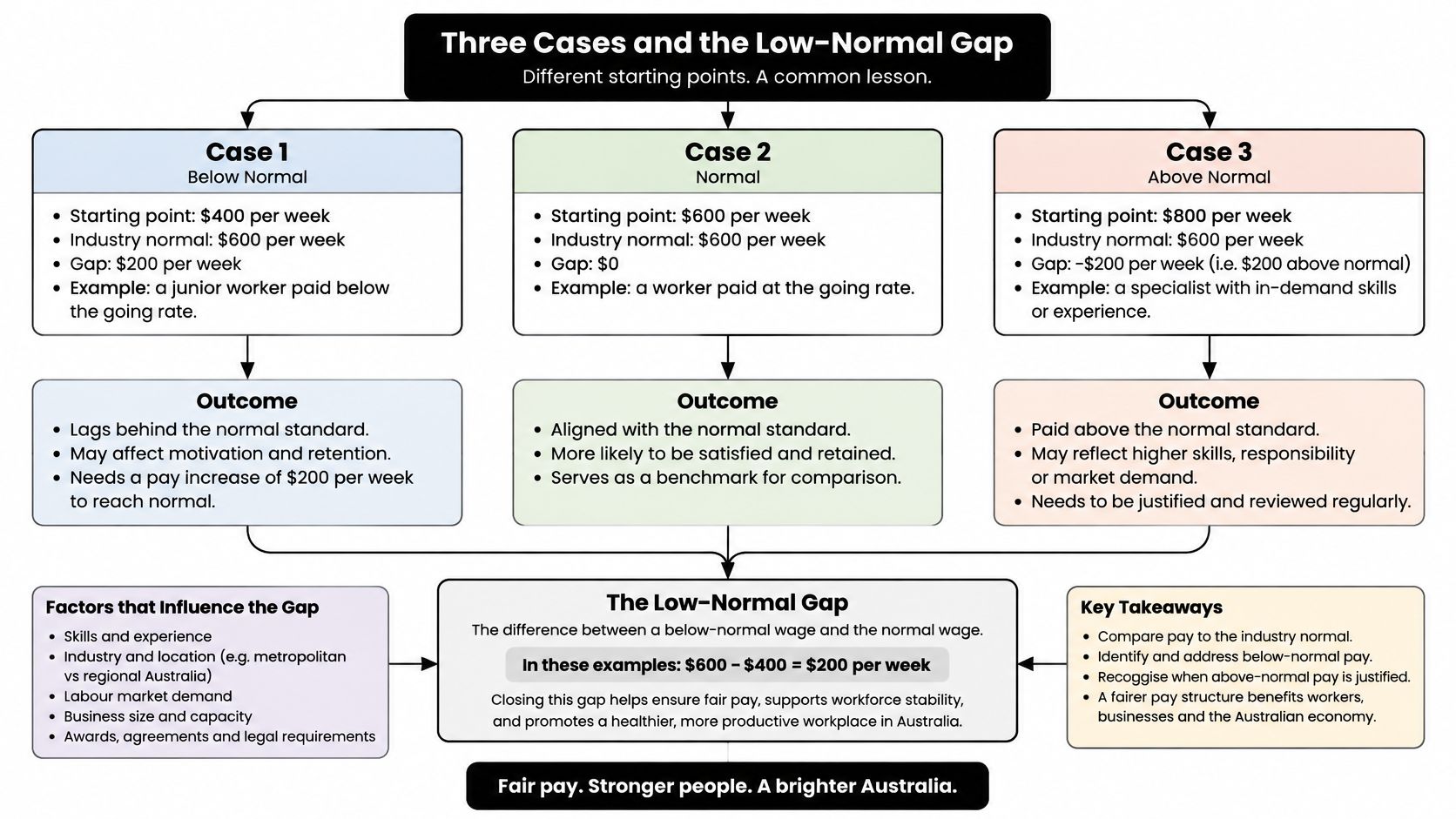
Numbers are easier to read inside a person's story. These three cases run from clearly low to apparently fine, and each one shows what the band supports and what it leaves open.
Case one at 130 pmol/L
A vegan adult has tingling feet and a result of 130 pmol/L. That sits in the band consistent with deficiency, so the number and the symptom point the same way. What it doesn't prove is that diet is the only cause, or that nerves will recover on tablets.
The next look is wider. According to Healthdirect guidance on the vitamin B12 test, B12 is commonly assessed alongside folate because abnormalities in either nutrient can impair red-blood-cell production. So the full blood count, red-cell size and folate all belong in the same review, along with supplement history and gut symptoms. A result this low earns a full workup rather than a single-nutrient answer.
Case two at 190 pmol/L
A tired adult taking metformin gets 190 pmol/L with a normal haemoglobin. That is borderline territory, and the normal count offers limited reassurance because larger red cells can arrive late in the process.
The useful questions here are unglamorous but decisive:
- Medicine list: How long has metformin been part of daily life, and what else is on it?
- Diet pattern: Is there a reliable B12 source most days?
- Symptom fit: Does the tiredness come with numbness, unsteadiness or thinking changes, or does it track with poor sleep and a heavy workload?
Neither automatic supplementation nor dismissal fits this case. It needs context, and possibly a second marker.
Case three near 400 pmol/L
A person with numbness after heavy nitrous-oxide use or after gut surgery gets a result near 400 pmol/L. That looks comfortable. Yet the symptom hasn't been explained, and a total B12 in a comfortable range doesn't, by itself, close the question in a high-risk setting like that.
This case is the one people find hardest. They're told the vitamin is fine, and the numbness is still there. The useful response is to ask what else could explain the symptom, and whether a functional marker or a neurological review belongs in the picture.
Read side by side, the same test answers three different questions:
| Case | Result and setting | What the band supports | What it leaves open |
|---|---|---|---|
| One | 130 pmol/L, vegan diet, tingling feet | Number and symptom agree on likely deficiency | Whether diet is the sole cause, and how nerves respond to treatment |
| Two | 190 pmol/L, metformin use, normal haemoglobin | A borderline result that warrants context | Whether a second marker or monitoring fits better than tablets |
| Three | Near 400 pmol/L, numbness, nitrous use or gut surgery | Circulating B12 looks adequate | Whether cells are getting usable B12, and what else explains the numbness |
The low-normal gap
Australian cohort data show how wide that grey space is. In the Deakin University repository record of a representative regional cohort study, 26% of adults had low-normal B12 levels of 156–250 pmol/L, compared with 3.6% who met the study's deficiency definition. That study used a deficiency cut-off of below 150 pmol/L, which differs slightly from the 148 pmol/L Adelaide cutoff, so the two figures are named separately rather than averaged.
The same source reports a mean adult B12 level of 391 pmol/L. Case three, near 400 pmol/L, sits almost exactly on that average, while clear deficiency lies far below it. Between the average and the cut-off there's a long interpretive stretch, and many people land in it.
B12 status works more like a dimmer switch than an on-off light. Brightness can fade gradually, and other faults can dim the room too.
So fatigue, numbness, memory change or anaemia may still matter in the low-normal zone, and they can also have unrelated causes, from thyroid problems to poor sleep. Additional markers such as holotranscobalamin, homocysteine or methylmalonic acid are sometimes used in selected cases, though each one fluctuates and none settles the question on its own.
One shared review list
Whichever case resembles yours, the review list is the same:
- Blood count and red-cell indices: Size and number of red cells, not just haemoglobin.
- Neuropathy signs: Numbness, tingling, balance or reflex changes.
- Fatigue or cognitive change: What's changed, and since when.
- Diet: Your usual B12 sources, described accurately.
- Pregnancy or breastfeeding: Current stage, if relevant.
- Absorption conditions: Gut disease, surgery or autoimmune history.
A low value flags clinician review. It doesn't set the cause or the severity, and it doesn't separate total stored B12 from biologically available B12. Recent supplements can also lift the number and muddy the reading, so mention them even if you only took one tablet.
When a Second B12 Marker Is Justified
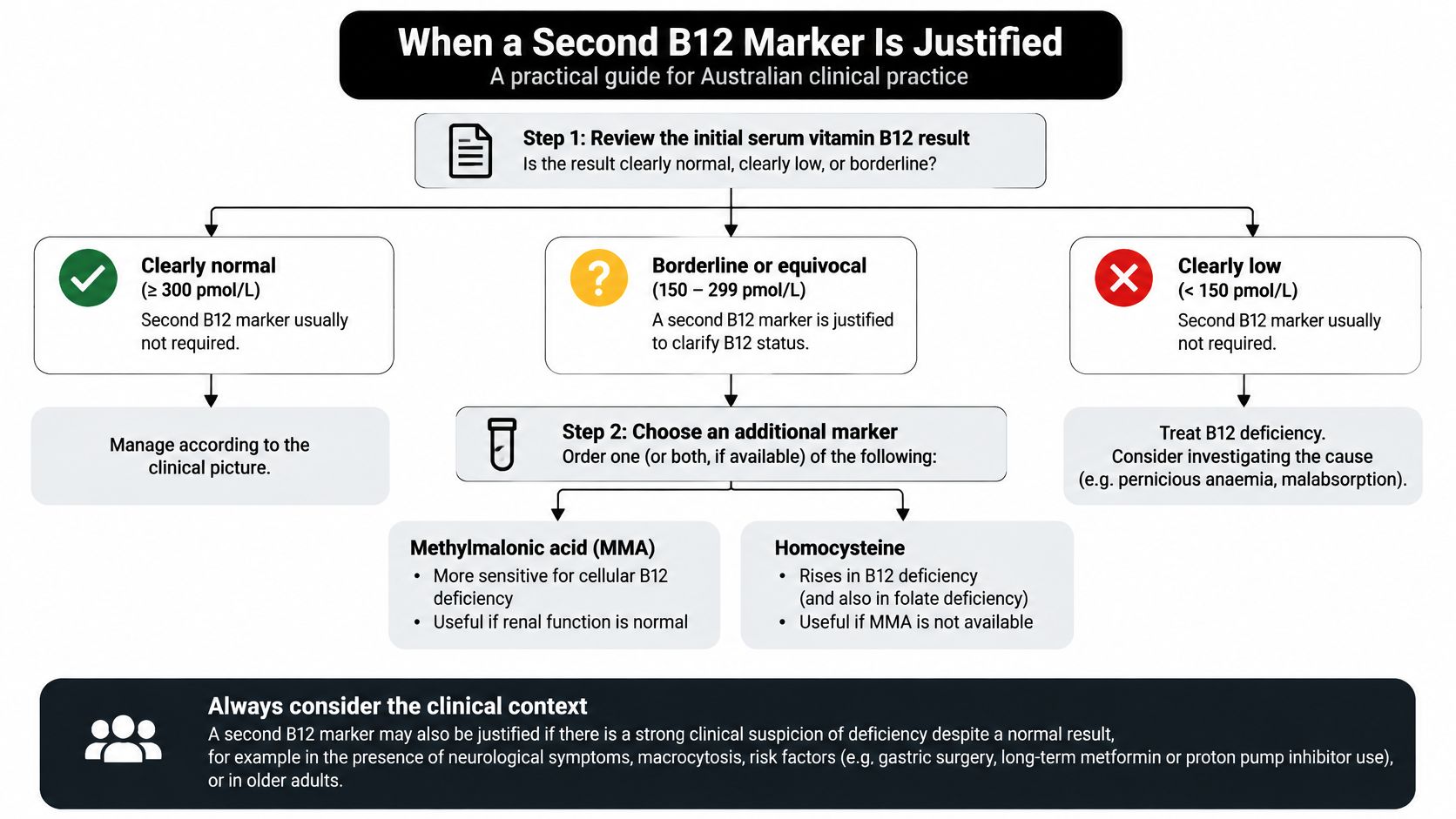
A second marker answers a different question from the first test, and it earns its place when the first result and the clinical picture disagree. Serum B12 reads the amount circulating in the blood. A functional marker asks whether cells are short of usable B12. The flowchart below sets out that decision path in order.
Step one is the first look
Total serum B12, or holotranscobalamin (active B12), can serve as the first-line test in specified circumstances. Under the Medicare Benefits Schedule amendments for vitamin B12 testing, methylmalonic acid or homocysteine may be added when the initial result is abnormal or inconclusive. A raised functional marker supports the case that cells lack usable B12, and a normal one weakens it, so the second test can tilt a borderline picture either way.
Higher-risk settings strengthen the case for that second look:
- Low-B12 diet: Little reliable intake over a long period.
- Family history: Deficiency or autoimmune disease in close relatives.
- Gastrointestinal surgery: A changed absorption route.
- Recent recreational nitrous-oxide use: A known disrupter of B12 function.
- Monitoring B12 treatment: Checking whether status is responding.
Step two needs a reason
Ask what the extra marker will change. If your total B12 is borderline and you've got numbness, a functional marker can shift the decision. If you're well and the first result sits comfortably inside the printed interval, it usually adds noise.
Extra markers fluctuate, and they don't predict treatment response better than total B12. One result, of any kind, never shows why B12 is low or whether absorption has failed. Screening flags a possibility. Diagnostic follow-up explains it. Keep those jobs separate, because a marker ordered without a question behind it tends to produce a number nobody can act on.
The short video below walks through how clinicians weigh that first result against symptoms before ordering more.
Step three is timed reassessment
If symptoms persist, arrange clinical reassessment after a reasonable interval rather than ordering an immediate duplicate test. Early repeats rarely settle a question that time and treatment response answer better.
One frequency rule affects timing. As the RACGP summary of the 1 July 2025 MBS updates describes, from 1 July 2025 items 66838 and 66839 clarified the pathway, with an 11-month frequency restriction for second-line quantification and an exception item where clinical need is documented. A repeat within that period may not be automatically reimbursed unless an exception applies.
The decision line is simple. Repeat the same test only for a new clinical question. Ask about active B12 or a functional marker when the first result and symptoms disagree. Look for another cause when the picture stays discordant despite further testing.
Decide the Next Step With Your Result
Take a three-item brief to your clinician, and the appointment gets easier for both of you:
- The number: Your B12 result, with its unit.
- The interval: The laboratory range printed beside it.
- The short list: Symptoms, diet and medicines, including supplements.
If the result is low or borderline, or you've got numbness, weakness or thinking changes, that conversation comes before any supplement experiment. Starting tablets first can lift the next number and hide the original problem. If you feel well and the result sits comfortably inside the printed interval, file it as a baseline for future comparison.
Where private screening fits
We offer online ordering of private blood tests without a GP referral or GP visit, with collection at a collection centre and results delivered within 24–72 hours. Our Vitamins & Mineral Panel assesses essential vitamins, minerals and antioxidants to identify nutritional deficiencies, so B12 becomes one question among several. Readers curious about related nutrients sometimes start with our overview of low zinc levels before choosing a panel.
Use private testing for non-urgent screening questions, not as a substitute for a clinical read of a worrying result.
You can confirm delivery timing, accreditation and telehealth follow-up with us before ordering. Book the clinical read of this result first, and order a broader panel only if your open question is deficiency screening. Rapidly worsening neurological symptoms need urgent care, not a panel.
If your open question is broader nutritional screening rather than an urgent symptom, Vital iQ Health lets you order a Vitamins & Mineral Panel online without a GP referral, attend a collection centre near you, and receive results within 24–72 hours to discuss with a clinician. Visit Vital iQ Health to choose a panel that includes vitamin B12 alongside other essential vitamins and minerals, and bring the result, its printed interval and your notes to that follow-up conversation.